
At the end of the seventh century the Alsatian duke Eticho rejected his own daughter because she was born blind and not male, handing her over to peasants far from him. At the age of twelve, during her baptism, the child miraculously recovered her sight and took the name Odile — “daughter of the light”. When her father fell gravely ill, it was she who came back to nurse him; converted by her persistence, Eticho ended up founding a monastery for her on the mountain, of which Odile became the first abbess.
About Mont Sainte-Odile Abbey
Odile of Alsace was born around 662, the daughter of Etichon (also known as Adalrich or Aldaric), Duke of Alsace and founder of the Etichonid noble family. According to the 9th-century “Life of Odilia,” she was born blind, and her father, disappointed both by her sex and her disability, refused to accept her; her mother Bethswinda had the infant taken to Palma, likely present-day Baume-les-Dames in Burgundy, to be raised by peasants away from her father’s household. A 10th-century legend recounts that at age twelve, while staying at a nearby monastery, Odile was baptised by the itinerant bishop Erhard of Regensburg, said to have been led there by an angel; at the moment of her baptism, taking the name Odile — meaning “child of light” — she miraculously regained her sight. Years later, when Etichon fell seriously ill, Odile returned to nurse him, and her father, finally relenting to his daughter’s persistence, founded an Augustinian monastic community for her in the Hohwald forest of what is now the Bas-Rhin, on the site now known as Mont Sainte-Odile — also called Hohenburg Abbey — where Odile became its first abbess. Some years afterward, according to tradition, Saint John the Baptist appeared to Odile in a vision, showing her the site of Niedermünster at the foot of the mountain, where she founded a second monastery, including a hospital. Odile died around 720 at the Niedermünster convent. Pilgrimages to her shrine at Mont Sainte-Odile became widely popular among ordinary people and, from the time of Charlemagne onward, among emperors as well, cementing her lasting status as patron saint of Alsace and of those with eye ailments or blindness. The abbey itself stands atop the remains of the Mur Païen (Pagan Wall), a massive prehistoric dry-stone fortification encircling the mountain summit, predating the Christian foundation by many centuries.
Key facts
- c. 662: Odile born blind, daughter of Duke Etichon of Alsace; rejected and sent away by her father
- Age 12: baptised by Bishop Erhard of Regensburg, miraculously regains her sight, takes the name Odile (“child of light”)
- Late 7th century: Etichon founds the Augustinian monastery of Hohenburg (Mont Sainte-Odile) for his daughter, its first abbess
- Second foundation: Niedermünster, at the mountain’s foot, following a vision of Saint John the Baptist
- c. 720: Odile dies at Niedermünster
- Mur Païen: the prehistoric dry-stone wall encircling the mountain summit, predating the monastery
- Legacy: Odile remains patron saint of Alsace and of good eyesight; pilgrimages continued from Charlemagne onward
History
Odile’s origin story — rejected by her own father specifically because of her sex and disability, then miraculously healed and renamed at her own baptism, before ultimately compelling that same father to found her a monastery — gives Mont Sainte-Odile an unusually direct narrative arc from personal rejection to institutional foundation, one in which the abbey’s very existence is presented as the concrete outcome of a parent’s reconciliation with the daughter he had initially refused. Her subsequent veneration specifically as patron saint of the blind and of good eyesight follows directly and logically from the central miracle of her own biography, giving the cult a coherence between the saint’s personal story and her devotional function that is unusually clear among medieval regional patron saints.
The abbey’s location directly atop the Mur Païen, a massive prehistoric fortification whose builders and precise purpose remain debated by archaeologists, situates the Christian monastic foundation within a landscape already invested with monumental significance many centuries before Odile’s own lifetime — a pattern of layering new sacred purpose onto much older sites of human activity found repeatedly across early medieval European monastic foundations.
What you see
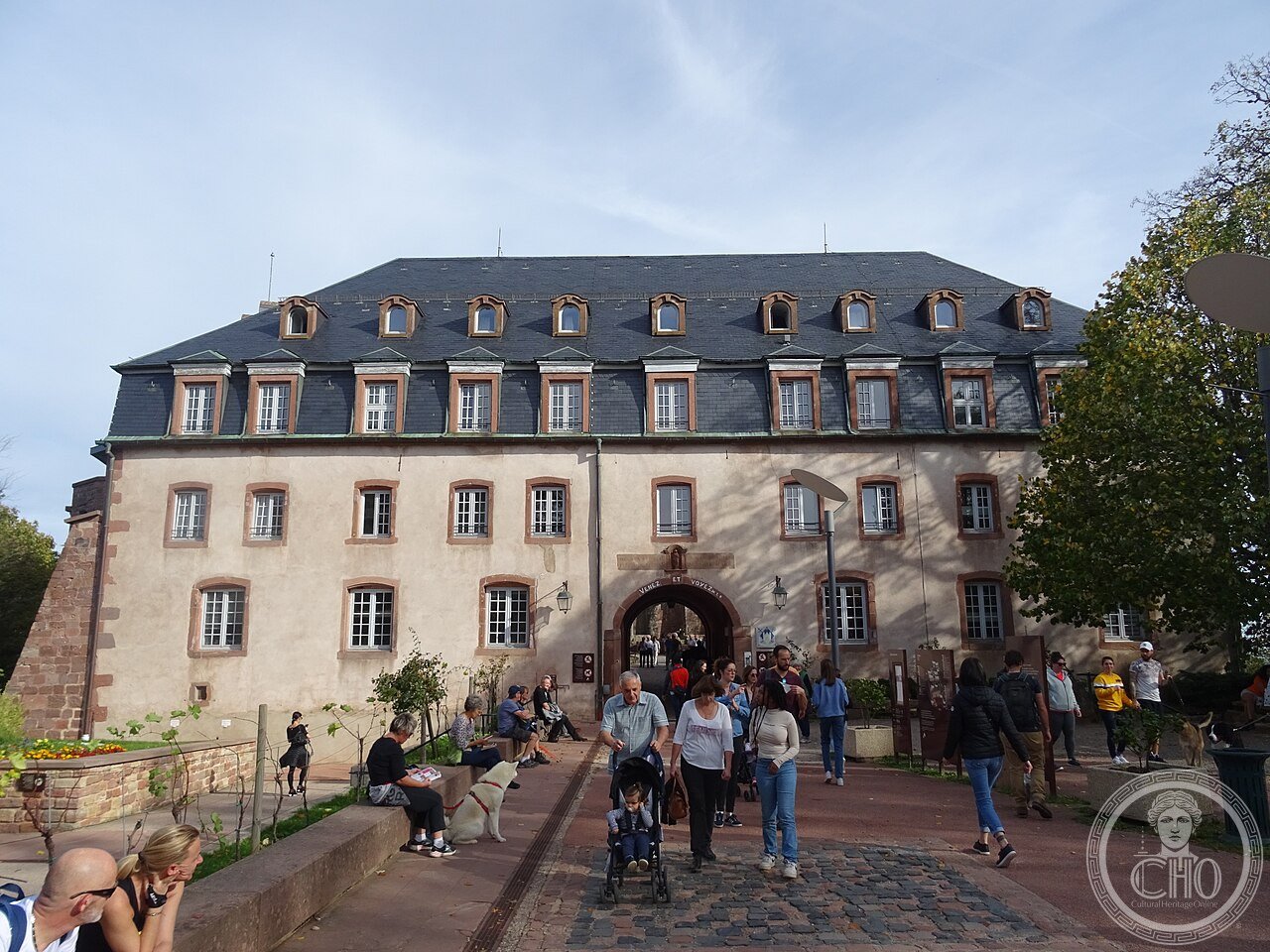
The abbey complex, rebuilt and expanded across many centuries following its original 7th-century foundation, sits at 764 metres atop Mont Sainte-Odile in the Vosges, its grounds still tracing the line of the ancient Mur Païen. The basilica and convent buildings offer views across the Alsatian plain, and the site remains an active place of pilgrimage, drawing visitors both for its religious significance and its dramatic mountaintop setting.
Practical information
- Opening hours: generally open daily with seasonal variation; check current hours before visiting; free admission
- Address: Couvent du Mont Sainte-Odile, Chemin de Croix, 67530 Ottrott, France
Getting there
Mont Sainte-Odile is reachable by car from Strasbourg (approximately 45 minutes) in the Bas-Rhin, Alsace. GPS: 48.4378° N, 7.4053° E.
Nearby
- Ottrott — the nearby village, known for its own red wine tradition
- Mur Païen — the prehistoric fortification wall surrounding the mountain summit
- Strasbourg — approximately 45 minutes away; the Alsatian regional capital
Sources
- Wikipedia — “Odile of Alsace” (en.wikipedia.org)
- The Good Life France — “Mont Sainte-Odile, Alsace” (thegoodlifefrance.com)
- Mont Sainte-Odile Tourisme — “The Legend of Sainte Odile” (mso-tourisme.com)
Find it on the map
See this place and what’s around it →📷 Become a Cultural Heritage Online photographer
Share your photos of places: they stay published under your name as the author. The more they're seen, the more you get noticed — and soon a contest will reward the most appreciated photos.
Log in or sign up free to add a photo