
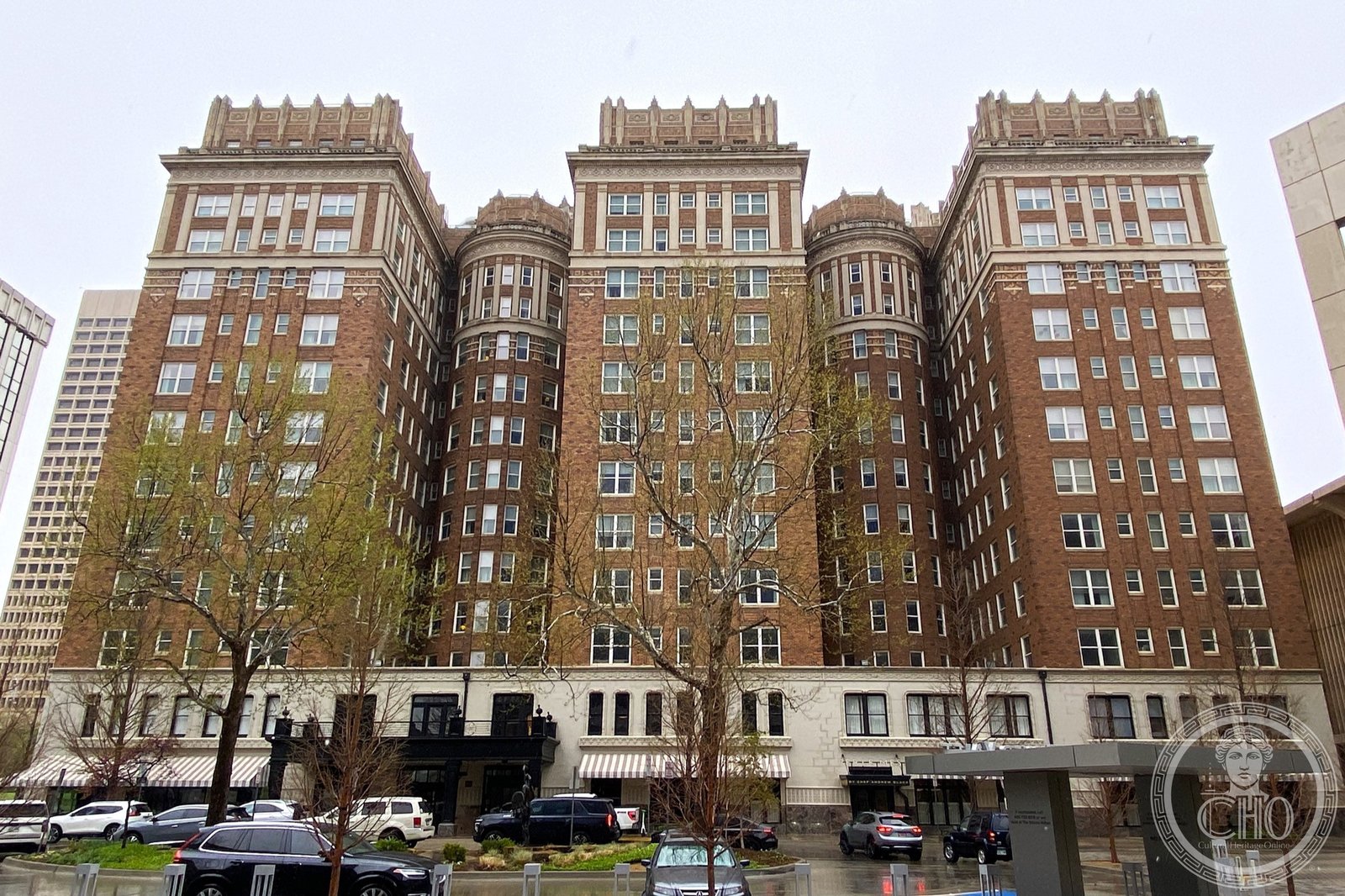
Oklahoma City’s oldest operating hotel, the Skirvin opened in 1910 at the center of a boomtown built on oil and cattle, then grew into its current form with a 1929 tower addition; closed for two decades and reopened as the Skirvin Hilton in 2007, it remains the definitive address in a city remade by energy wealth.
At a glance
The Skirvin Hotel stands at 1 Park Avenue in downtown Oklahoma City, its tower visible from the Bricktown entertainment district to the east and the state capitol to the north. William Balser Skirvin, an oil and cattle entrepreneur, commissioned the original ten-story building in 1910 and expanded it to fourteen stories in 1929, adding the tower wing whose architectural detail reflects the transitional period between classical and Art Deco hotel design. The hotel closed in 1988 after decades of decline, then reopened in 2007 as the Skirvin Hilton following a comprehensive restoration that preserved the public room finishes and exterior brick profile while upgrading systems throughout.
Key facts
- Address: 1 Park Avenue, Oklahoma City, OK 73102
- GPS: 35.4680° N, 97.5164° W
- Built: 1910 (original building); 1929 (tower addition)
- Original architect: Solomon Andrew Layton
- Style: Classical Revival (1910) with Transitional Art Deco elements (1929 tower)
- Rooms: 225 guest rooms
- Status: Operating hotel (Hilton Collection); reopened 2007
- NRHP: Listed on National Register of Historic Places
History
William Balser Skirvin struck oil and cattle money at the convergence of Oklahoma Territory’s twin economies and chose to make a hotel in downtown Oklahoma City the monument to that wealth. The commission went to Solomon Andrew Layton, the most prominent architect working in Oklahoma at statehood, and the ten-story building that opened in 1910 was the largest hotel between Dallas and Kansas City. Its public rooms—ballrooms, a rooftop garden, dining rooms—established the Skirvin as the social center of a city that had reached its current scale in barely twenty years of existence.
The 1929 expansion added a tower section that pushed the hotel to fourteen stories and accommodated the demand generated by the Oklahoma oil boom that had made Oklahoma City one of the fastest-growing cities in the United States. The architectural language of the 1929 wing—simplified classical pilasters, geometric ornamental detail at the upper stories—occupies the transitional moment between Beaux-Arts formalism and the Art Deco economy of means that would define the decade to come. The complete Skirvin, as built by 1930, presented a unified brick mass that anchored the Park Avenue block.
The hotel declined through the postwar decades as suburban growth and the energy industry’s cycles restructured downtown Oklahoma City. The Skirvin closed in 1988. A twenty-year closure left the building mothballed in a downtown that had itself hollowed out. The 2007 restoration—part of a broader downtown revitalization investment by the city—stripped out accumulated deferred maintenance, restored the lobby and ballroom plasterwork, and reopened the hotel under the Hilton flag. The Skirvin Hilton has since hosted NBA playoff series (the Oklahoma City Thunder plays at the adjacent Paycom Center) and serves as a primary event hotel for the city.
What you see
The Park Avenue elevation presents two phases of construction readable as a continuous brick mass. The 1910 base carries classical cornice moldings and paired windows in a restrained commercial Renaissance manner characteristic of Layton’s institutional work. The 1929 tower addition rises above with simplified pilasters and geometric ornamental bands at the upper floors that move toward the Art Deco register without fully committing to it—a conservatism appropriate to a hotel audience in 1929 Oklahoma City that valued permanence over novelty.
The lobby is the interior’s most significant surviving space. The restoration preserved original plasterwork in the barrel-vaulted ceiling and the ornamental details around the reception area; the 1929 ballroom on the mezzanine level carries the most complete surviving example of the transitional Deco styling applied across the tower addition. Polished marble floors, bronze fittings, and the original elevator lobby ironwork were retained or restored rather than replaced during the 2007 work. The net effect of the restoration is a hotel that reads as genuinely historic rather than nostalgically themed—the layers of 1910 and 1929 construction remain legible in the fabric.
Practical information
- The Skirvin Hilton operates as a full-service hotel; reservations at the Hilton website.
- The lobby and public rooms are accessible to non-guests during daytime hours; the ballroom is event-only.
- The hotel bar and restaurant serve the public; check hours on arrival.
- Valet parking available; street parking on Park Avenue and Robinson Avenue.
- The hotel is within walking distance of the Paycom Center arena and the Bricktown entertainment district.
Getting there
The Skirvin Hilton is at 1 Park Avenue in downtown Oklahoma City, one block east of the Myriad Botanical Gardens. Oklahoma City’s streetcar (Embark Oklahoma City) serves the downtown core with stops near the hotel on Robinson and Broadway. Will Rogers World Airport is 8 miles southwest of downtown; the drive takes 15–20 minutes. By highway, Oklahoma City sits at the junction of I-35 (north-south) and I-40 (east-west), making it accessible from all directions.
Nearby
- Myriad Botanical Gardens (1 block west): the 17-acre urban park and Crystal Bridge Tropical Conservatory is Oklahoma City’s primary downtown green space.
- Oklahoma City National Memorial (4 blocks northeast): the memorial and museum marking the site of the 1995 Murrah Federal Building bombing.
- Paycom Center (2 blocks east): the 18,000-seat arena serves as the home of the Oklahoma City Thunder NBA franchise.
- Bricktown (3 blocks east): the restored warehouse and entertainment district along the Oklahoma River canal with restaurants, bars, and the minor league baseball stadium.
Sources
- Skirvin Hilton Hotel, skirvin.com — property history and restoration documentation
- National Register of Historic Places, “Skirvin Hotel Oklahoma City” nomination
- Oklahoma Historical Society records
- Oklahoma City Downtown Development records, 2007 restoration
Find it on the map
See this place and what’s around it →Record researched and written by Luigi De Marchi for Cultural Heritage Online, 2026.
📷 Become a Cultural Heritage Online photographer
Share your photos of places: they stay published under your name as the author. The more they're seen, the more you get noticed — and soon a contest will reward the most appreciated photos.
Log in or sign up free to add a photoIs this page about you?
This page is read by travellers and heritage enthusiasts who find it on Google. Tell us how you are connected to this place and we will take it from there.