
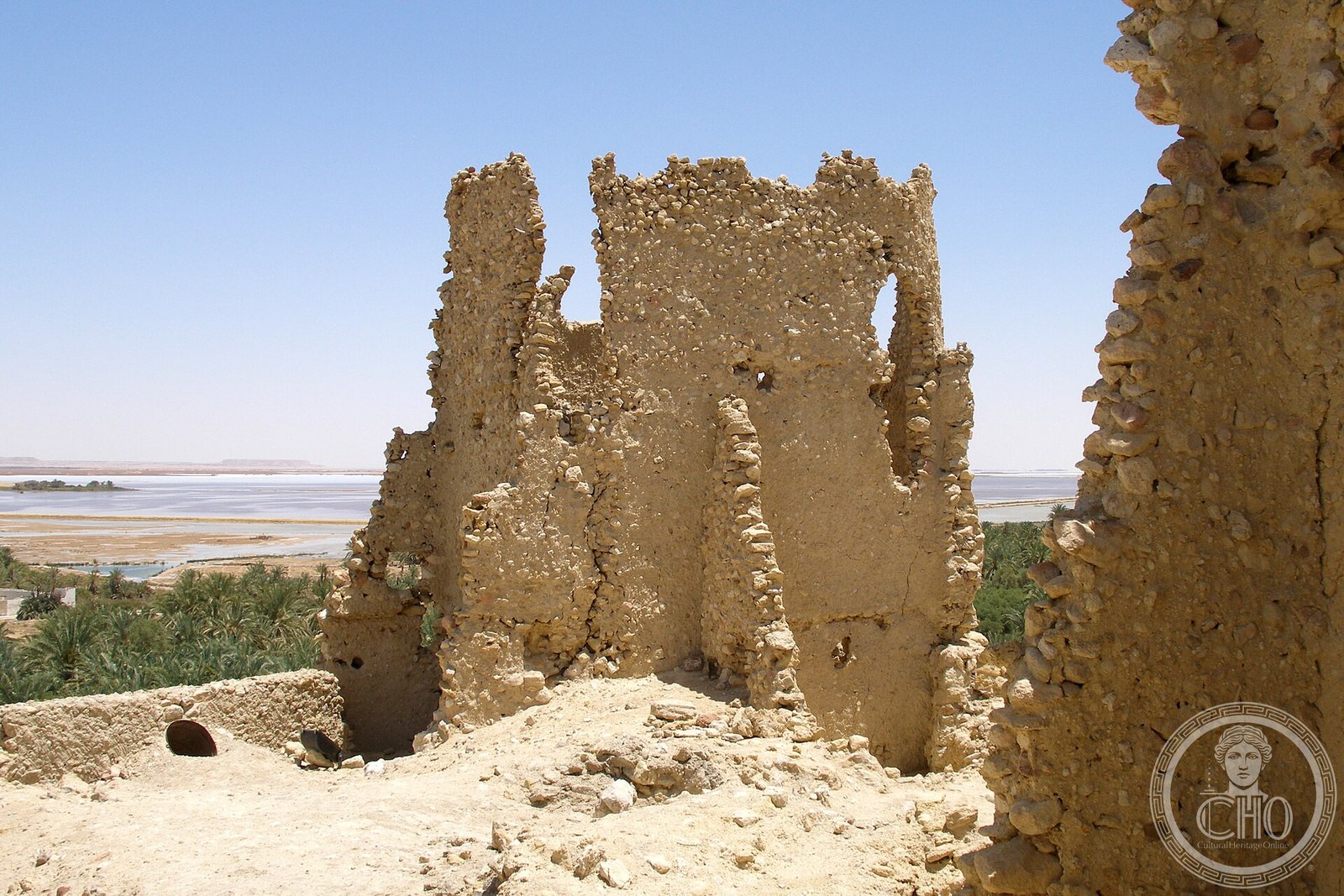
In the heart of the Libyan Desert, 560 km west of Cairo, the Siwa Oasis shelters the ruined oracle temple where Alexander the Great received divine confirmation of his kingship in 331 BC — one of the most consequential consultations in the ancient world.
At a glance
The Siwa Oasis occupies a depression below sea level some 80 km long and 20 km wide, irrigated by more than 200 freshwater springs in an otherwise barren stretch of the Libyan Desert. Inhabited since at least the 10th millennium BC, it became a place of international religious pilgrimage during the first millennium BC, when the Oracle of Amun at Aghurmi Rock was consulted by rulers and generals from across the Mediterranean world. The oasis today retains a distinctive Berber-Amazigh character — the Siwi language, traditional kharsana salt-mud architecture, and elaborate silver jewellery traditions — alongside the ancient ruins.
Key facts
- Location: Matruh Governorate, northwestern Egypt; approx. 50 km east of the Libyan border
- Elevation: minus 18 m below sea level at the oasis floor
- Size: Approx. 80 km long by 20 km wide; population c. 30,000
- Temple of the Oracle (Aghurmi): Built c. 6th century BC; inner sanctuary where Alexander stood survives
- Alexander visit: 331 BC — eight-day desert crossing; oracle priest addressed him as son of Amun, legitimising his rule of Egypt
- Gebel el-Mawta: Mountain of the Dead — rock-cut Ptolemaic tombs with painted walls
- UNESCO status: Not yet inscribed; on Egypt Tentative List
History
The Siwa Oasis has been inhabited since the 10th millennium BC, its freshwater springs making it a perennial refuge in one of the most hostile desert environments on Earth. By the first millennium BC it had developed as a major cult centre: the Oracle of Amun at Aghurmi was famous enough that the Persian emperor Cambyses II reportedly dispatched an entire army to destroy it in 524 BC — an army the desert swallowed entirely. The oracle greatest moment came in spring 331 BC when Alexander the Great, fresh from his conquest of Egypt and the founding of Alexandria, undertook a gruelling eight-day journey across the Libyan Desert to consult it. Ancient sources record miraculous navigations — ravens guiding the army according to Ptolemy, two snakes according to Aristobulus — and describe Alexander receiving a private answer whose full content he never revealed. The oracle priest addressed him as son of Amun, which Alexander interpreted as confirmation of his divine origin. By receiving this recognition, Alexander legitimised his rule of Egypt in exactly the terms Egyptian tradition required.
The oasis prospered under Ptolemaic rule and later under Rome. After the Arab conquest in the 7th century, Siwa isolation kept it relatively insulated until the 13th century. Virtually unknown to European travellers until the late 18th century, it became a subject of serious archaeological study in the 20th century, with major work by Ahmed Fakhry documenting the ancient monuments and the living Berber-Amazigh culture.
What you see
The Temple of the Oracle (locally Aghurmi) sits on a rocky outcrop above the village of Aghurmi, approximately 4 km east of Siwa town. Though substantially ruined, the inner sanctuary survives to significant height, with inscriptions and carvings still legible on the walls. The adjacent Temple of Umm Ubayd, also dedicated to Amun, is largely rubble following a 19th-century gunpowder explosion. The panoramic view from Aghurmi Rock — palm groves, salt lakes, and the desert plateau — is among the most dramatic in Egypt.
Gebel el-Mawta on the northern edge of Siwa town contains dozens of rock-cut tombs from the 26th Dynasty through the Ptolemaic period: the Tomb of Mesu-Isis with well-preserved painted scenes, the Tomb of the Crocodile, and the Tomb of Si-Amun with exceptional colour preservation. The medieval fortified village of Shali — a hilltop kharsana settlement of salt-mud brick — dominates the centre of modern Siwa town as a further layer of the oasis remarkable architectural heritage.
Practical information
- Getting there: Daily bus from Cairo (8–9 hours) or Marsa Matruh (3–4 hours); no train; transfers from Marsa Matruh airport
- Entry fees: Separate tickets for Aghurmi temple complex and Gebel el-Mawta tombs; check current Egyptian Antiquities Organisation rates
- Best season: October–April; summer temperatures exceed 40 degrees C
- Accommodation: Range from simple guesthouses to ecolodges; advance booking essential October–March
- Local transport: Bicycles and tuk-tuks standard; some desert sites require a licensed 4WD with local guide
- Photography: Permitted at archaeological sites; respect local Amazigh customs
Getting there
Siwa is served by West Delta Bus Company from Cairo Turgoman terminal (daily, approximately 8–9 hours) and from Marsa Matruh (approximately 3–4 hours). There is no airport at Siwa; the nearest is Marsa Matruh, from which private transfers cover the 300 km via desert highway. Driving from Cairo takes approximately 9 hours via the coastal road to Marsa Matruh then south. Within the oasis, most visitors hire bicycles or tuk-tuks; the Great Sand Sea requires a licensed 4WD.
Nearby
- Great Sand Sea — The spectacular dune field of the Libyan Desert begins at the oasis edge; jeep excursions provide access to pristine desert landscapes
- Cleopatra Bath (Ain Guba) — A large natural freshwater pool approximately 3 km from Siwa town, fed by a bubbling spring
- Fatnas Island — A palm-grove island in the middle of Lake Siwa, accessible by causeway, famous for sunset views
- Marsa Matruh — Mediterranean coastal town 300 km north; main access point for Siwa
Sources
- Arrian. Anabasis of Alexander, III.3–4. Primary source for Alexander visit to the oracle.
- Fakhry, Ahmed. Siwa Oasis. Cairo: American University in Cairo Press, 1990.
- Kuhlmann, Klaus P. Das Ammoneion. Mainz: von Zabern, 1988.
- Wikipedia contributors. Siwa Oasis. Wikipedia, The Free Encyclopedia. Retrieved June 2026.
- Wikipedia contributors. Temple of the Oracle, Siwa Oasis. Wikipedia, The Free Encyclopedia. Retrieved June 2026.
Find it on the map
See this place and what’s around it →📷 Become a Cultural Heritage Online photographer
Share your photos of places: they stay published under your name as the author. The more they're seen, the more you get noticed — and soon a contest will reward the most appreciated photos.
Log in or sign up free to add a photo