
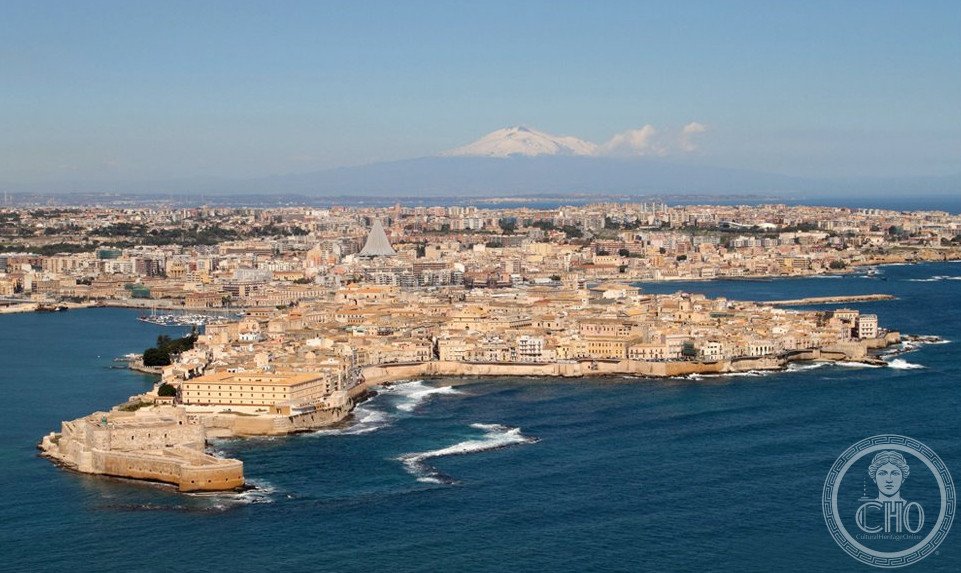
Siracusa carries twenty-seven centuries of continuous life on one small island and one hillside park, from the Corinthian founders of Ortygia to the theatre where Greek tragedy is still staged. Inland, the rock-cut tombs of Pantalica add a much older, prehistoric layer to the same UNESCO-listed site.
At a glance
The site inscribed by UNESCO in 2005 (reference 1200) is a serial one, made up of two separate components. The first is the archaeological area of Siracusa itself, spanning the island of Ortygia and the mainland Parco Archeologico della Neapolis. The second, some 60 kilometres inland along the Anapo river valley, is the rock-cut necropolis of Pantalica.
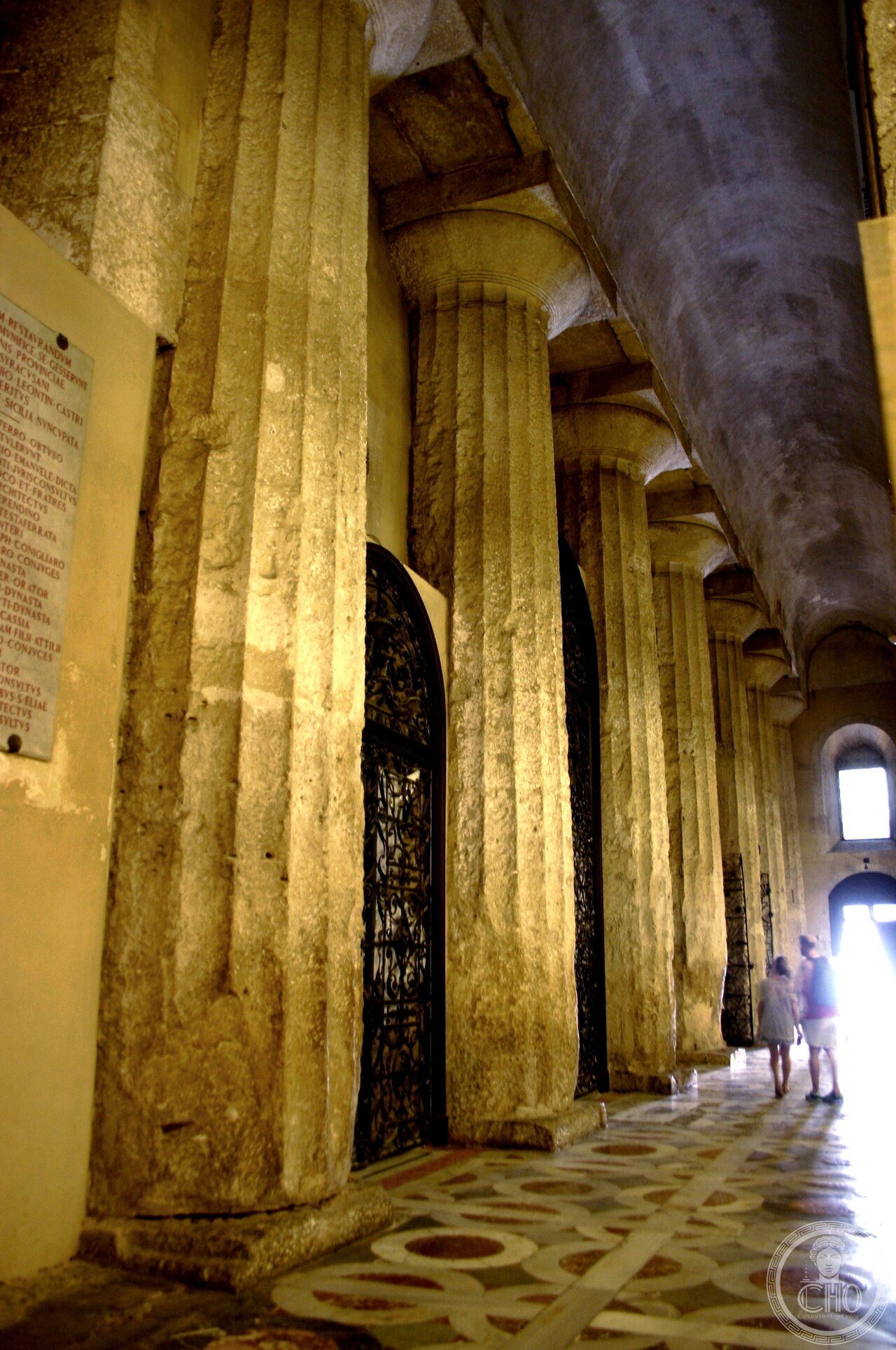
Ortygia was the original Corinthian settlement, and its cathedral still stands on the footprint of a 5th-century BCE temple to Athena, its ancient columns visible inside the later walls. The Fontana di Aretusa, a freshwater spring on the shoreline, is tied to the myth of the nymph pursued across the sea by the river god Alpheius. On the mainland, the Neapolis park holds the Teatro Greco, still used for performances of Greek tragedy, the acoustically remarkable cave known as the Orecchio di Dionisio, and the partly buried remains of a Roman amphitheatre.
Key facts
- Founded: c.734 BCE by Corinthian colonists led by Archias, on the island of Ortygia.
- Peak: in the 5th century BCE Siracusa was the most powerful Greek city in the western Mediterranean, said to have surpassed Athens in population.
- Teatro Greco: built in the 5th century BCE, with a capacity of around 15,000, still used today for tragedy performances.
- Pantalica: a Bronze Age necropolis of roughly 5,000 rock-cut tombs, 13th–7th century BCE, in five distinct groups.
- Archimedes: born and active in Siracusa, 287–212 BCE.
- UNESCO inscription: 2005, reference 1200.
History
Siracusa was founded around 734 BCE by settlers from Corinth under Archias, on the small island the Greeks called Ortygia. Within a century the settlement had expanded onto the mainland and grown into the dominant Greek city of the west, rivalling and by some accounts surpassing Athens in size. The tyrant Gelon defeated a Carthaginian invasion at Himera in 480 BCE, and later Dionysius the Elder extended Siracusan power across most of Sicily and into southern Italy; his court drew Plato to the city three times, encounters recorded, not favourably, in Plato’s Seventh Letter.
The city’s greatest crisis came with the Athenian expedition of 415–413 BCE, sent officially to aid Egesta but aimed in practice at capturing Siracusa’s wealth for the war against Sparta. The campaign ended in catastrophe for Athens in the Great Harbour, with its fleet destroyed and thousands of prisoners dying in the quarries at the edge of what is now the Neapolis park, a defeat Thucydides called the most calamitous in Greek history.
Archimedes, born in Siracusa in 287 BCE, worked in the city until his death during the Roman siege of 212 BCE, when the defensive devices attributed to him failed to hold off Marcellus’s forces.
What you see
In Ortygia, the Piazza del Duomo is built in the Baroque style that followed the 1693 earthquake, and the cathedral behind it still shows the fluted Doric columns of the Temple of Athena embedded in its walls and forming the frame of its facade. A short distance away, the Fontana di Aretusa is a freshwater spring at the water’s edge where papyrus plants grow, an unusual sight this far from Africa.
On the mainland, the Parco Archeologico della Neapolis centres on the Teatro Greco, carved into the hillside and still hosting performances of ancient tragedy. Nearby, the Orecchio di Dionisio is a tall artificial cave known for its acoustic properties, and further into the park the outline of a Roman amphitheatre survives, though much of its stone was removed for later fortifications on Ortygia.
Practical information
- Access: the Neapolis park and the Ortygia monuments keep seasonal hours that change through the year; check the official channels before visiting.
- Tickets: a combined ticket covering the Neapolis park and the Museo Archeologico Regionale Paolo Orsi is available and worth considering, given the museum’s collection.
- Performances: the Teatro Greco hosts a season of Greek tragedy in spring, organised by the Istituto Nazionale del Dramma Antico; programme and booking details are published on the INDA website.
- Coordinates: the Parco Neapolis stands at approximately 37.0627° N, 15.2932° E.
Getting there
Ortygia and the Parco Archeologico della Neapolis are close enough to cover on foot, roughly half an hour apart across the modern city. Pantalica lies about 60 kilometres north-west, in the Anapo river valley, and is reached by road rather than public transport.
Nearby
- Pantalica — about 60km north-west, the Bronze Age necropolis of some 5,000 rock-cut tombs that forms the second half of the UNESCO site.
- Museo Archeologico Regionale Paolo Orsi — in Siracusa, home to the Landolina Venus and the terracotta votive plaques known as the Pinakes.
- The Latomie quarries — at the edge of the Neapolis park, where Athenian prisoners were held after the defeat of 413 BCE.
- Gela — about 50km west, traditionally said to be where Aeschylus died.
Sources
- Thucydides
- Plato, Seventh Letter
- Istituto Nazionale del Dramma Antico (INDA)
- Museo Archeologico Regionale Paolo Orsi
Gallery
Find it on the map
See this place and what’s around it →📷 Become a Cultural Heritage Online photographer
Share your photos of places: they stay published under your name as the author. The more they're seen, the more you get noticed — and soon a contest will reward the most appreciated photos.
Log in or sign up free to add a photo