
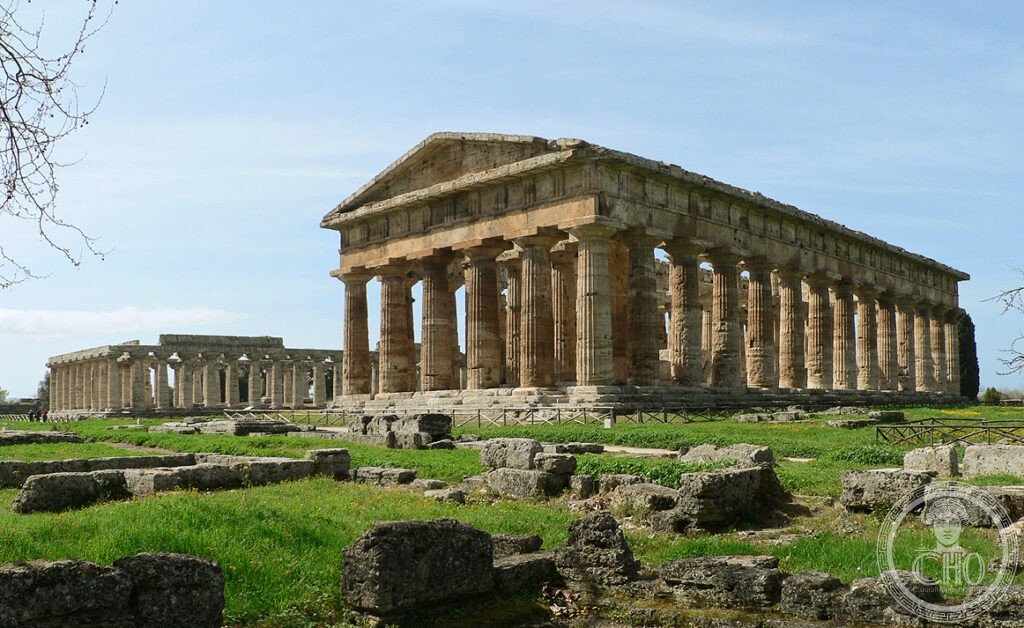
On the Gulf of Salerno, three Doric temples raised by Greek colonists over a single century still stand almost complete, while the Cilento hills behind them hold Velia, birthplace of Parmenides and Zeno, and the vast Carthusian monastery of Padula.
At a glance
The UNESCO-listed area covers three sites within the Cilento and Vallo di Diano National Park, the peninsular headland south of the Gulf of Salerno. Paestum, ancient Poseidonia, was founded around 600 BCE by colonists from Sybaris and preserves three Doric temples still standing within its largely intact city walls. Thirty kilometres south lies Velia, ancient Elea, founded by Phocaean Greek refugees, where the philosophers Parmenides and Zeno lived and taught. The Certosa di Padula, a Carthusian monastery founded in 1306, completes the inscription.
The wider Cilento landscape is a limestone massif behind a coastline of beaches and cliffs, covered in Mediterranean maquis of lentisk, mastic and strawberry tree. In the 1950s the nutritionist Ancel Keys studied villages here for his Seven Countries Study, identifying what became known as the Mediterranean diet.
Key facts
- Temple of Hera I (‘Basilica’): c.550 BCE, the earliest of the three, with markedly archaic, swollen column proportions.
- Temple of Athena (‘Cerere’): c.500 BCE, a transitional building with slimmer Doric columns and Ionic touches in the frieze.
- Temple of Neptune: c.450 BCE, mature Classical Doric proportions and the best preserved of the three; excavation finds suggest it too was dedicated to Hera.
- Velia: home to Parmenides, founder of Western ontology, and his student Zeno, famed for his paradoxes of motion.
- Coordinates: 40.4207° N, 15.0049° E (Paestum temples).
- Recognition: inscribed on the UNESCO World Heritage List in 1998 (reference 842).
History
Poseidonia was founded around 600 BCE by colonists from Sybaris, then the wealthiest city of Magna Graecia, and dedicated to Poseidon. Its three temples were built within the colony’s first century and a half. Around 400 BCE the Oscan-speaking Lucanians conquered the Greek cities of the south and the city became Paistom; painted Lucanian tombs from this period, including the celebrated Tomba del Tuffatore of the late fourth century BCE, survive from a cemetery outside the walls.
Rome established a colony here in 273 BCE, and the Forum was laid over the earlier Greek agora. From the sixth century CE the city was abandoned as drainage canals silted up, malaria spread and Saracen raids increased; by the ninth century it lay deserted, its temples spared only because they were too massive to quarry. The site was rediscovered in the eighteenth century when a new road from Naples to Calabria was cut through it, drawing visits from Winckelmann and Goethe, who wrote candidly of his initial unease before the ruins. The area was inscribed on the UNESCO World Heritage List in 1998.
What you see
Entering from the south, the Temple of Hera I is the first structure encountered, its archaic, heavily tapered columns visible from a distance. Further north stands the Temple of Athena, more slender in its proportions and showing Ionic elements in the frieze. The Temple of Neptune, generally approached from the east, offers the classic view of the site with the Temple of Hera I in the background.
Between the temples, the Roman forum’s travertine paving overlies the earlier Greek agora, and beneath it lies a Doric shrine to an unknown deity that predates the forum by some four centuries. The adjoining Museo Nazionale di Paestum holds the painted panels of the Tomba del Tuffatore, showing a symposium and a diving figure, alongside the largest surviving group of Lucanian tomb paintings from Magna Graecia.
Practical information
- Access: the archaeological area lies close to Paestum’s train station, reached on foot along a flat but not especially pleasant road.
- Season: the temples stand in an open plain with no shade, so a summer visit is best planned for the early morning or the end of the day.
- Tickets and times: hours and combined temple-museum admission are set by the site’s management and should be checked through its official channels before visiting.
Getting there
Paestum is reached by train from Naples Centrale on the Sapri line, alighting at Paestum station, from which the archaeological site is a short walk away. Velia and the Certosa di Padula lie further into the Cilento and are best reached by road.
Nearby
- Velia (Elea) — about 30 km south along the Campanian coast, birthplace of Parmenides and Zeno.
- Certosa di Padula — the Carthusian monastery of San Lorenzo, the largest in southern Italy, with a cloister second in size only to that of the Certosa di Pavia.
- Cilento coast — beaches and cliffs within the national park, backed by Mediterranean maquis.
Sources
- UNESCO
- Museo Nazionale di Paestum
- Cilento and Vallo di Diano National Park
- Ancel Keys’ Seven Countries Study
Gallery
Find it on the map
See this place and what’s around it →📷 Become a Cultural Heritage Online photographer
Share your photos of places: they stay published under your name as the author. The more they're seen, the more you get noticed — and soon a contest will reward the most appreciated photos.
Log in or sign up free to add a photo