
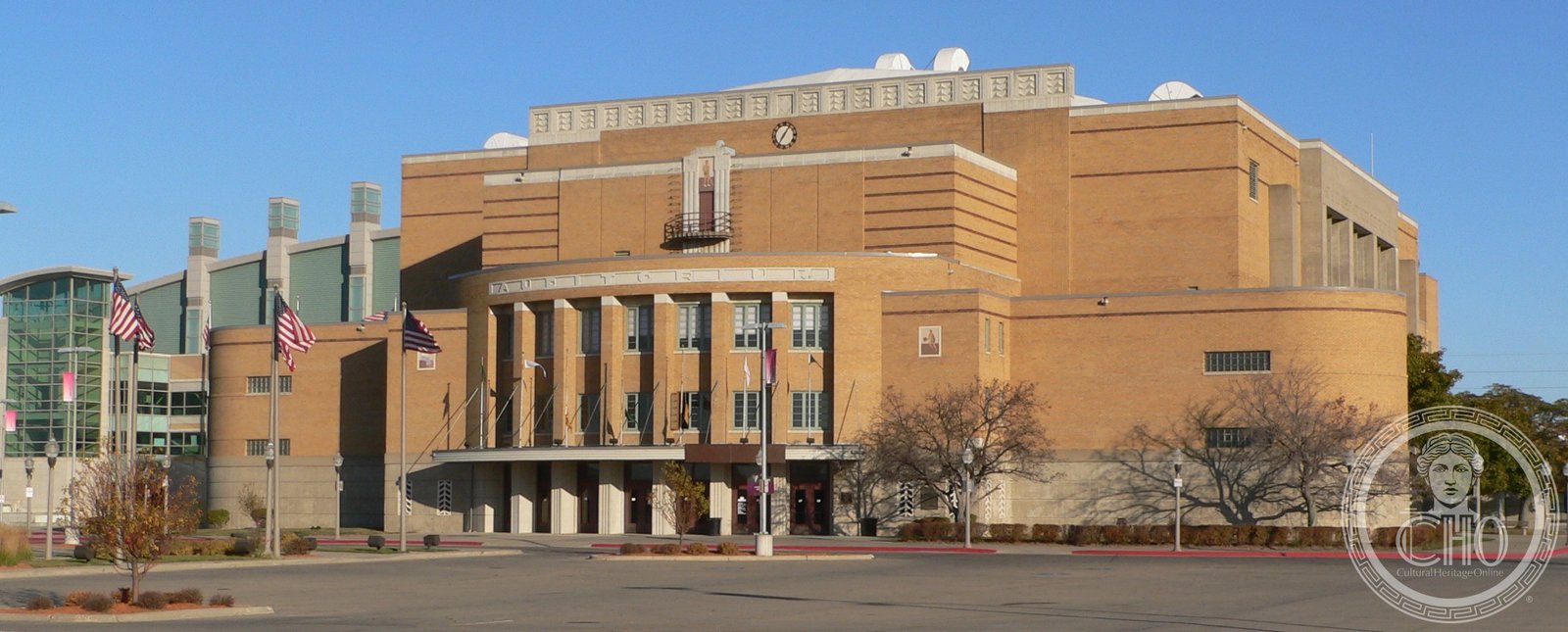
A PWA Moderne landmark twelve years in the making, the Municipal Auditorium opened in 1950 and brought Elvis Presley, Van Cliburn, and President Kennedy to the banks of the Missouri River.
At a glance
Designed by architect Knute E. Westerlind in 1938 and finally dedicated on September 9, 1950, after wartime shortages and three bond referendums totaling $2.7 million, the Sioux City Municipal Auditorium is the city’s fifth major indoor venue and one of Iowa’s finest examples of PWA Moderne design. It stood as the cultural anchor of the Missouri River bluffs for over fifty years before a 2003 arena replaced it for large events. Today, preserved as the Long Lines Auditorium and recreation center, it retains the full exterior integrity that earned its National Register of Historic Places listing in 2006.
Key facts
- Completed: September 9, 1950 (designed 1938, delayed by WWII)
- Architect: Knute E. Westerlind, protégé of Prairie School architect William L. Steele
- Style: PWA Moderne with Beaux-Arts massing
- Address: 401 Gordon Drive, Sioux City, Iowa 51101
- NRHP: Listed July 27, 2006 (ref. 06000316)
- Capacity: Originally 3,500 seats; now recreation center
- GPS: 42.4928°N, 96.4067°W
History
The Old Municipal Auditorium of 1909 had been declared an “ugly, barn-like structure” by the Western Architect even at its opening, and by the 1930s Sioux City needed a replacement. Westerlind’s 1938 design won voter approval in a $590,000 bond referendum, but the project stalled as the city pursued federal assistance. Bonds were finally issued in April 1941, and foundation pilings were driven before World War II material shortages halted construction in 1943. Work resumed in 1947 with a second referendum ($975,000), only to require a third in April 1949 ($1.4 million) as post-war inflation drove costs higher. The final bill came to more than $2.7 million.
For over fifty years after its dedication the auditorium routinely hosted graduations, Sioux City Symphony concerts, and Sioux City Musketeers ice hockey. Its stage welcomed Elvis Presley, Robert Plant, Van Cliburn, John F. Kennedy, and Richard Nixon. When the Symphony moved to the restored Orpheum Theater in 2001 and the new Tyson Events Center opened around the auditorium’s northeast corner in 2003, the building was repurposed as the Long Lines Family Recreation Center, its exterior intact and its history preserved.
In 2023 the building added Long Lines Auditorium signage to the southeast entrance, honoring both the performance tradition and the corporate sponsor whose name it had carried since 2003.
What you see
Westerlind’s building is fundamentally PWA Moderne: smooth brick walls, rounded corners, glass block windows, and horizontal banding that keeps the eye moving across the facade rather than upward. The “cut-into-the-building” quality of the openings makes the walls read as a continuous surface punctuated by voids rather than a frame filled with windows.
Against this streamlined field, Westerlind added a Beaux-Arts sense of civic ceremony inherited from his mentor William Steele. Relief sculptures of stylized Native Americans mark the northern exterior, recalling the cultures whose ceremonial ground this land once was. Terracotta panels on the south wall depict sport and music in the angular, compressed idiom of the 1930s. Above two entrances, stone inscriptions carry the building’s moral ambitions: “There Is No Greater Conquest Than That of Self” on the west, and “Art at Its Highest and Nature at Its Truest Are One” on the east.
Practical information
- Current use: Long Lines Auditorium and recreation center (volleyball, basketball, climbing wall, events)
- Season: Year-round
- Access: Accessible entrances on Gordon Drive and the east facade
- Nearby: Connected to the Tyson Events Center via internal passage
- Photography: Best from the southeast, where the rounded corner and main facade read together
Getting there
The auditorium sits on Gordon Drive in Sioux City, a short drive from Interstate 29 (exit 147B toward Downtown). The nearest regional airport is Sioux Gateway Airport (SUX), approximately four miles southeast of downtown. From Chicago, Sioux City is roughly seven hours by road via I-90/I-29; from Minneapolis, approximately three and a half hours via I-90/US-75. Street parking is available along Gordon Drive and in the adjacent Tyson Events Center parking structures.
Nearby
- Woodbury County Courthouse (1918) — Prairie School masterpiece by Purcell and Elmslie, seven blocks southeast
- Sioux City Art Center — regional museum in the renovated 1936 Federal Building, one block west
- Orpheum Theatre Sioux City (1927) — Spanish Revival movie palace, now home of the Symphony
Sources
- National Register of Historic Places, ref. 06000316 (Municipal Auditorium, Woodbury County, Iowa)
- Sorensen, Scott, and B. Paul Chicoine. Sioux City: A Pictorial History. Donning Company, 1982.
- Gebhard, David, and Gerald Mansheim. Buildings of Iowa. Oxford University Press, 1993.
- Wikipedia: “Sioux City Municipal Auditorium” (accessed 2026-07-06)
- City of Sioux City — Long Lines Auditorium official page
Find it on the map
See this place and what’s around it →Record researched and written by Luigi De Marchi for Cultural Heritage Online, 2026.
📷 Become a Cultural Heritage Online photographer
Share your photos of places: they stay published under your name as the author. The more they're seen, the more you get noticed — and soon a contest will reward the most appreciated photos.
Log in or sign up free to add a photoIs this page about you?
This page is read by travellers and heritage enthusiasts who find it on Google. Tell us how you are connected to this place and we will take it from there.