
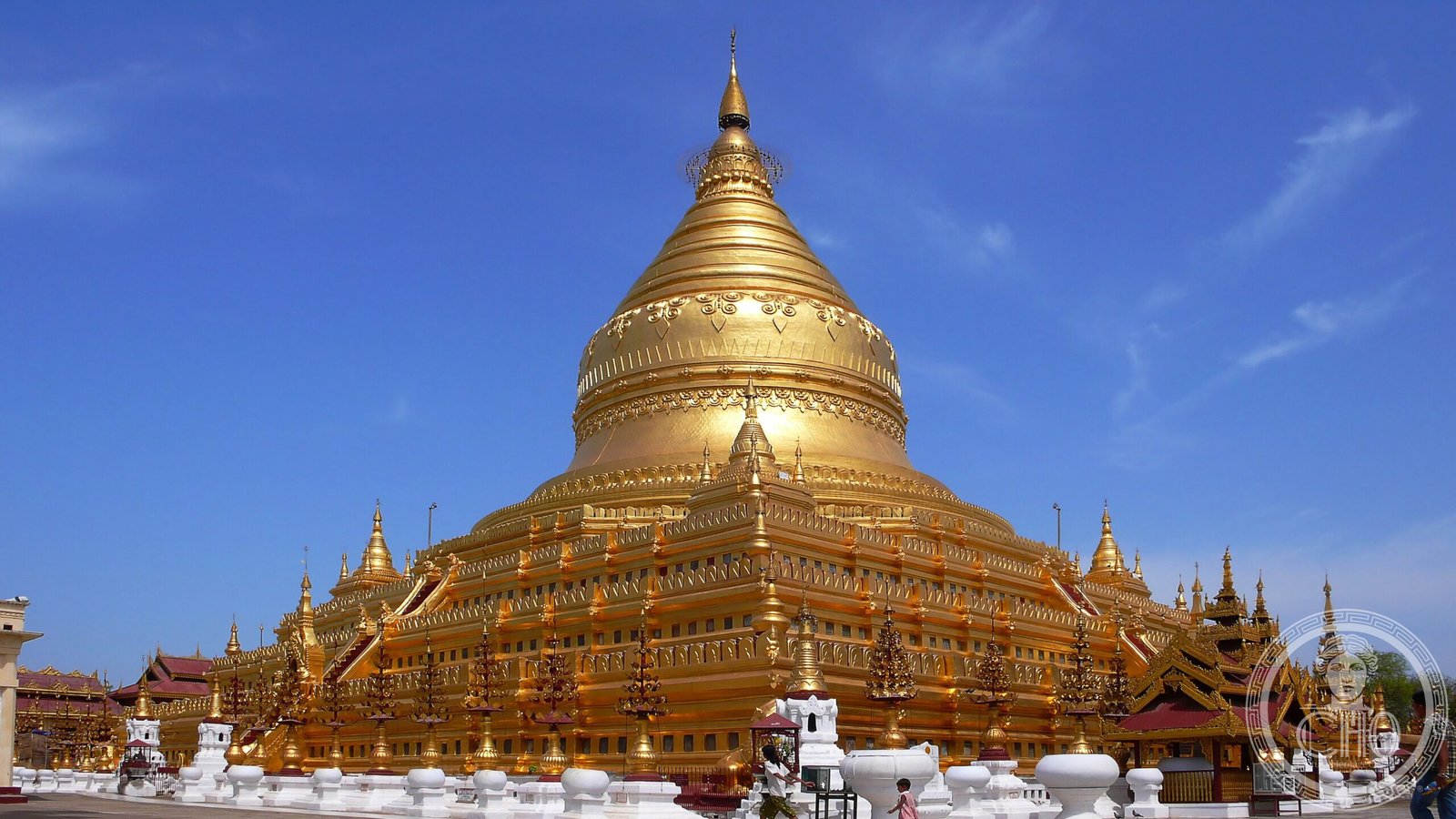
Myanmar’s most influential Buddhist stupa, the Shwezigon Pagoda established the architectural template for Burmese stupas. Built over four decades beginning in 1059, it remains a sacred pilgrimage site believed to house relics of Gautama Buddha.
At a glance
A gold-leaf gilded cone rising from five square terraces, the Shwezigon Pagoda sits at the heart of a sacred compound in Nyaung-U. The stupa is surrounded by smaller temples, shrines, Buddha statues, and representations of 37 deified nats—spirits central to Burmese folk belief. Copper plating and repeated restoration campaigns have preserved its gleaming exterior across centuries of earthquakes and weathering.
History
King Anawrahta, founder of the Pagan Empire, initiated construction in 1059–1060 as part of his campaign to establish Buddhism as the dominant religion across his realm. His son King Kyansittha completed the work in 1102, embedding a stone pillar with Mon language inscriptions within the compound to commemorate the achievement. Numerous earthquakes have damaged the structure over the centuries; recent renovations have applied more than 30,000 copper plates to reinforce and restore its surface, while the lowest terraces retain their original form.
What you see
The stupa rises as a solid cone composed of five concentric square terraces ascending to the central gilded dome. Four standing Buddha statues occupy cardinal positions, each with footprints inscribed below. Jataka legends—stories of the Buddha’s past lives—are rendered in glazed terra-cotta tiles set into three rectangular terrace levels. Temple guardians in monumental stone form flank the entrance. The compound also features four bronze Buddha statues representing the current age Buddha, and at its outer limits stand representations of 37 nats, with an intricately carved wooden figure of Thagyamin, the Burmese adaptation of the Hindu god Indra, commanding particular prominence.
Cultural significance
The Shwezigon Pagoda established the prototype for all Burmese stupas, making it architecturally foundational to the region’s Buddhist heritage. Sacred Buddhist tradition holds that it enshrines a bone and tooth of Gautama Buddha, possibly a replica of the Tooth Relic gifted by the King of Sri Lanka. The pagoda synthesizes Theravada Buddhist devotion with indigenous Burmese veneration of nats, reflecting the spiritual syncretism that defines Myanmar’s religious landscape.
Key facts
- Location: Nyaung-U, Myanmar
- Coordinates: 21.1953°N, 94.8939°E
- Construction period: 1059–1102
- Builder: King Anawrahta (initiated); King Kyansittha (completed)
- Architectural type: Buddhist stupa with five square terraces and central gilded dome
- Recent renovation: Over 30,000 copper plates applied
Practical information & getting there
The Shwezigon Pagoda is accessible from nearby Bagan and the town of Nyaung-U. Visitors should dress modestly and remove footwear before entering sacred spaces. The site remains an active pilgrimage destination and Buddhist religious center. For current hours and any site-specific restrictions, check locally before your visit.
Sources & resources
Find it on the map
See this place and what’s around it →📷 Become a Cultural Heritage Online photographer
Share your photos of places: they stay published under your name as the author. The more they're seen, the more you get noticed — and soon a contest will reward the most appreciated photos.
Log in or sign up free to add a photoIs this page about you?
This page is read by travellers and heritage enthusiasts who find it on Google. Tell us how you are connected to this place and we will take it from there.