
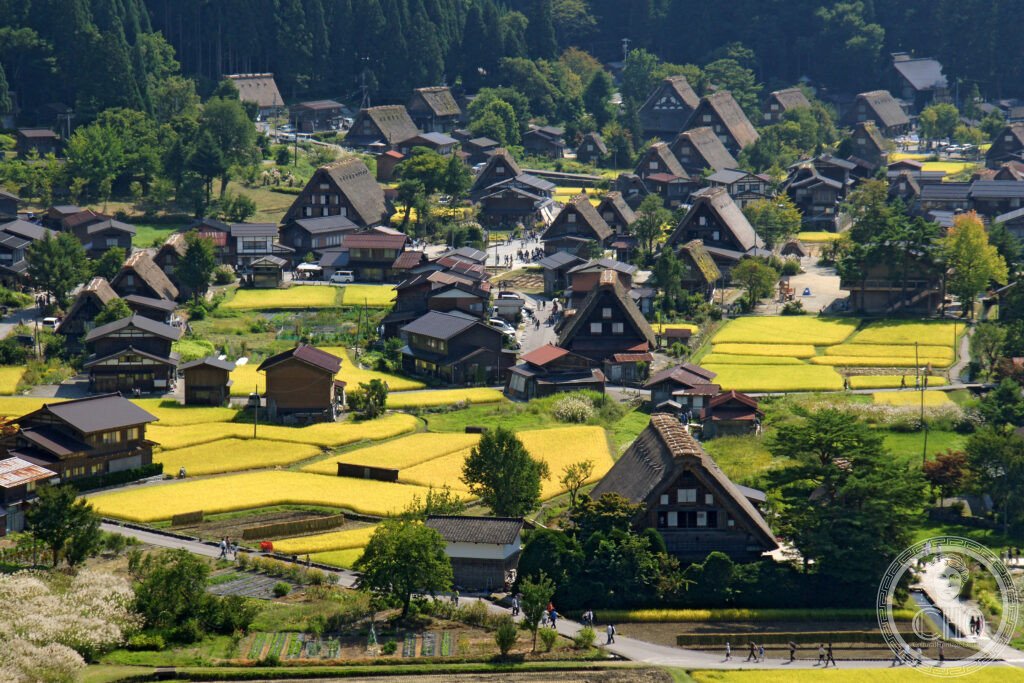
The most isolated mountain villages in Japan. The gassho-zukuri (“praying hands construction”) farmhouses of Shirakawa-go and Gokayama are large wooden structures with thatched roofs pitched at 60 degrees to shed the exceptionally heavy snowfall of the Japanese Alps (up to 3 metres annually). Isolated in deep mountain valleys between Gifu and Toyama Prefectures, the villages maintained semi-autonomous communities and a unique clandestine Jōdo Shinshū Buddhist practice for 300 years. UNESCO inscribed them in 1995.
At a glance
Shirakawa-go (White River Village, Gifu Prefecture) and Gokayama (Five Mountains, Toyama Prefecture) are two adjacent clusters of mountain villages in the Shōkawa River valley (Shō River; a tributary of the Jinzū River) in the Hida region of central Japan, approximately 180 km north-east of Kyoto and 120 km north-east of Nagoya. The area receives the heaviest snowfall in Japan outside of Hokkaido (regularly exceeding 3 metres of annual accumulation at village level). The villages are dominated by gassho-zukuri farmhouses. Multi-storey structures whose large interior attic space (4–5 floors) was used for silk worm cultivation, and whose steeply pitched thatched roofs (the thatch reaches to within 1 metre of the ground on the roof ridge line) shed the snow load before it can collapse the structure. UNESCO inscribed the Historic Villages of Shirakawa-go and Gokayama in 1995.
Key facts
- Gassho-zukuri construction: the most distinctive architectural tradition in Japan. The name (“praying hands construction”) refers to the way the triangular roof frame, when viewed from the end, resembles two hands pressed together in Buddhist prayer. The main beams of the roof are assembled without nails (using only wooden joints, rope lashing, and the weight of the thatch to hold the structure in compression). The thatch (kayabuki, of miscanthus grass — a different species from the European pampas-type thatch) is approximately 1 metre thick at the ridge and requires complete replacement every 30–40 years. The thatching of a large gassho farmhouse requires 200–300 people working for 2–3 days. A community activity (called yui) that both the Shirakawa-go and Gokayama villages maintain. Visitors can observe yui in October–November.
- Wada House (Ogimachi): the most important surviving gassho-zukuri farmhouse. The Wada family’s ancestral home (built approximately 1700, on a larger scale than typical farmhouses because the Wadas were regional governors and later prosperous silk merchants). The house has five attic floors, each of which shows a different phase of silk worm cultivation (egg incubation, larvae feeding, cocoon formation, silk thread extraction). The ground floor has an irori (central hearth, whose smoke rises through all five floors to preserve the roof timbers and deter insects). Guided tours daily in Japanese and English.
- The clandestine Jōdo Shinshū communities: from the 16th to the early 19th century, the remote mountain location of Shirakawa-go and Gokayama allowed the villages to maintain Jōdo Shinshū (True Pure Land Buddhism) practice in secret. The sect had been banned by Oda Nobunaga and the Tokugawa shogunate because of its egalitarian theology (which was considered a threat to feudal social order; the Ikkō-ikki — Single-Minded League — of Jōdo Shinshū believers had fought a century of armed resistance against feudal lords before being suppressed in the 1580s). The practice was maintained in concealed temple rooms within the farmhouses. The Jōdo Shinshū temples of the villages date from the period when the ban was lifted in the Meiji era.
- Ogimachi, Ainokura, and Suganuma: the three main village clusters of the UNESCO inscription. Ogimachi (in Shirakawa-go, Gifu Prefecture) is the largest, with approximately 59 gassho-zukuri farmhouses, a small open-air museum (the Gassho-zukuri Minka-en, with 25 relocated farmhouses), an observation deck (Shiroyama Viewpoint, 30 minutes walk or 10 minutes bus from the village centre) giving the classic bird’s-eye view over the farmhouse rooflines. Ainokura (in Gokayama, Toyama Prefecture) is more remote (45 minutes from Ogimachi) and has 20 farmhouses. Suganuma (also Gokayama) is the smallest and most intact cluster (9 farmhouses) and is least visited.
- Winter illuminations: the Shirakawa-go winter illumination events (January and February, on specific weekends — exact dates announced annually in November) when the village is lit by floodlights in the evening snow are among the most popular photographic events in Japan. The combination of deep snow, the steep gassho rooflines, and the warm interior light through the paper shoji screens creates an image of Japanese rural winter that has become iconic in Japanese tourism. Tickets and booking are required months in advance.
- Heritage: UNESCO World Heritage Site, Historic Villages of Shirakawa-go and Gokayama, inscribed 1995.
- GPS: 36.2571° N, 136.9051° E.
History
The Shōkawa valley was settled in the Heian period (794–1185). The isolation of the valley (accessible from the plain via difficult mountain passes that were frequently blocked by snow for months in winter) produced a degree of social autonomy unusual in feudal Japan. The gassho-zukuri farmhouse type developed in the Edo period (1603–1868) as a response to both the extreme snowfall and to the economic requirement to produce silk and washi (handmade paper) for the national market. Activities that required large interior spaces for the silk worm trays and the paper-making vats. The large farmhouses housed extended families of 20–40 people. The Tokugawa shogunate’s ban on the Jōdo Shinshū sect (which had fought the Ikkō-ikki wars against Nobunaga and Hideyoshi in the 16th century) drove the practice underground in the valley. The remote location and the internal solidarity of the village communities protected the practice for approximately 250 years.
The opening of the Sho River valley road in the Meiji period and the construction of the Miboro Dam (1960) flooded several historical gassho villages. The threat of further development and the emigration of the young to cities in the postwar economic miracle period created the impetus for the village preservation movement. The inhabitants of the remaining villages formed the “Shirakawa-go Three Principles Association” in 1971 (do not sell, do not rent, do not destroy), which has maintained the village fabric to the present. The UNESCO inscription of 1995 and the subsequent tourism development have largely solved the economic sustainability problem while creating new pressures from mass tourism.
What you see
The Ogimachi village (the main access point for most visitors) is best experienced by arriving early in the morning (before 9 am, when most tour buses arrive from Kanazawa and Toyama). The Shiroyama Viewpoint (20–30 minutes uphill walk from the village, or a short bus ride to the observation car park) gives the classic panoramic view over the gassho rooflines with the mountain backdrop. The walk down from the viewpoint into the village gives time to observe the farmhouse scales before they are surrounded by tourists. The Wada House interior tour (approximately 30–45 minutes, audio guide available) is the most informative single experience. The open-air museum (Gassho-zukuri Minka-en, 10 min walk north of the village centre) is worth visiting if time allows to understand the full range of farmhouse types.
The most atmospheric season is winter (December–February): the combination of heavy snowfall, the steep thatched rooflines under snow, and the warm light from the irori hearths through the screen windows is the defining image of Shirakawa-go. The winter illumination weekends (January–February) are the peak photographic event. Spring (April–May) has cherry blossoms against the farmhouse rooflines. Autumn (October–November) has the yui thatching ceremony and autumn foliage.
Practical information
- Admission: village streets free. Wada House approximately ¥400 (about €2.50). Open-air museum approximately ¥600. Ogimachi viewpoint free. Seasonal illumination events require advance ticket purchase (approximately ¥1,000 per person).
- Getting there: no direct train service to Shirakawa-go. The main access is by highway bus. From Kanazawa Bus Terminal: Nohi bus (approximately 1.5 hours, ¥1,850 one-way, reservation required). From Nagoya (Meitetsu Bus Centre): Nohi bus or Gifu Bus (approximately 2.5 hours). From Takayama: Nohi bus (approximately 50 minutes). From Toyama: Nohi bus (approximately 1.5 hours). JR Pass holders can use the Kanazawa or Takayama connection then pay the highway bus separately. The buses stop at the Shirakawa-go bus terminal, 5 minutes walk from the Ogimachi village centre.
- Combining with Takayama: the historic town of Takayama (60 km south of Shirakawa-go by bus, 50 minutes) is the standard complement to Shirakawa-go. A beautifully preserved Edo-period merchant town (the Sanmachi Suji historic street of sake breweries, craft shops, and miso merchants is the finest Edo streetscape outside Kyoto). The Takayama Jinya (the restored regional government office, the only surviving example of a Tokugawa administrative building in Japan) and the Hida Folk Village (an open-air museum of Hida mountain farmhouses, 10 minutes from the town centre) complete a 2-day Takayama + Shirakawa-go itinerary.
Getting there
Highway bus from Kanazawa (1.5h, ¥1,850, reservation required) or Takayama (50 min). No rail service to village. GPS: 36.2571, 136.9051.
Nearby
- Kanazawa. 80 km north of Shirakawa-go (1.5h by bus). One of the finest preserved castle towns in Japan. The seat of the Maeda clan (the wealthiest daimyo outside the Tokugawa family during the Edo period) with the Kenroku-en garden (one of the Three Great Gardens of Japan, famous for the yukitsuri — rope frames supporting the pine tree branches against snowfall), the Kanazawa Castle (partially restored), the Higashi Chaya (the best-preserved geisha district outside Kyoto), and the 21st Century Museum of Contemporary Art (a world-class contemporary art museum in a circular glass building by SANAA architects).
- Historic Town of Takayama. 50 km south of Shirakawa-go (50 min by bus). The most complete Edo-period merchant townscape in Japan. The Sanmachi Suji district of sake, miso, and craft breweries. The Takayama Jinya (the only surviving Tokugawa-era regional government office). The biannual Takayama Festival (April and October — the most elaborate float-procession festival in Japan, with mechanically animated marionettes on the festival floats). The Hida Folk Village open-air museum (another collection of gassho-zukuri farmhouses from the surrounding mountains, relocated to an open hillside setting).
- Ainokura and Suganuma (Gokayama). 45–70 km east of Ogimachi by road (on the Gokayama side of the UNESCO inscription, Toyama Prefecture). Less visited than Shirakawa-go but more atmospheric in the absence of large tour groups. The Ainokura village (20 farmhouses, gently terraced on a south-facing slope) and the Suganuma hamlet (9 farmhouses in a cluster immediately beside the road — the most photogenic small concentration of gassho buildings) can be combined in a single day with Ogimachi on a hired car or scheduled bus circuit.
Sources
- Wikipedia, Shirakawa-go. Gassho-zukuri. Gokayama, accessed June 2026.
- UNESCO, Historic Villages of Shirakawa-go and Gokayama, WHS reference 734, inscribed 1995.
- Arata Isozaki and others, Japanese Farmhouses, Kodansha, 1984.
- Agency for Cultural Affairs, Japan, Survey of Traditional Building Types: Shirakawa-go Region, 1975.
Find it on the map
See this place and what’s around it →📷 Become a Cultural Heritage Online photographer
Share your photos of places: they stay published under your name as the author. The more they're seen, the more you get noticed — and soon a contest will reward the most appreciated photos.
Log in or sign up free to add a photo