

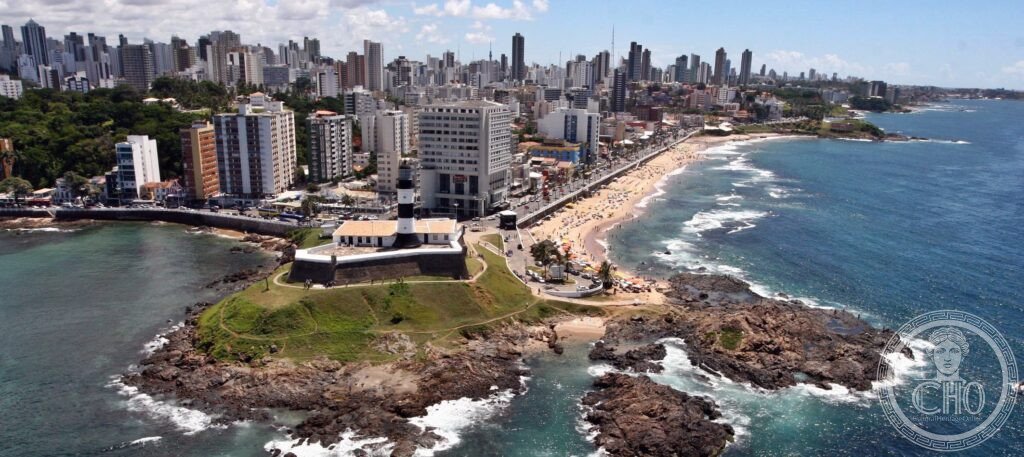
The most African city outside Africa — Salvador was the capital of colonial Brazil from 1549 to 1763, the port through which approximately 1.5 million enslaved Africans were imported to Brazil between the 16th and 19th centuries, and the city where the syncretic Afro-Brazilian culture — Candomblé religion, capoeira martial art, axé music, moqueca seafood cuisine, and the largest Carnival in the world — was created and has survived with the greatest intensity; the historic Pelourinho district preserves the colonial city plan and architecture in which this culture lives.
At a glance
Salvador (official name: Salvador de Bahia; population of the metropolitan area approximately 4 million) is the capital of the State of Bahia, north-eastern Brazil, at the mouth of the All Saints’ Bay (Baía de Todos os Santos) on the Atlantic coast. It was founded in 1549 by the first Governor-General of Brazil, Tomé de Sousa, as the administrative capital of the Portuguese colony; it remained the capital until 1763, when the centre of colonial economic gravity shifted to Rio de Janeiro (following the discovery of gold in Minas Gerais). The city is divided into the Cidade Alta (upper city, approximately 70 m above sea level) and the Cidade Baixa (lower city, on the shore), connected by the Elevador Lacerda (a public lift, 1873, the world’s first urban public lift). UNESCO inscribed the Historic Centre of Salvador de Bahia in 1985.
Key facts
- The Pelourinho (Pelouriho district): the historic upper city district, named after the pillory (pelourinho) that stood in the central square — where enslaved people were publicly punished; the name is a reminder of the brutality at the foundation of the city’s culture; the district (rehabilitated in the 1990s) contains approximately 1,500 colonial buildings in a range of Baroque, Neoclassical, and Pombaline styles, painted in the characteristic yellow, pink, blue, and ochre colour scheme that UNESCO required during the rehabilitation; the main square (Pelourinho) and the adjacent Largo do Pelourinho are the centre of the Afro-Brazilian cultural performance scene (capoeira groups, blocos afros, and Candomblé processions).
- Candomblé: the most important African-derived religion in the Americas — brought to Salvador by enslaved Yoruba people from present-day Nigeria and Benin, who maintained their orixá (deity) worship under the cover of Catholic saints (a syncretism forced by the requirement to convert to Catholicism); the terreiros (Candomblé ceremonial houses) of Salvador are the centres of a religious practice that has been continuously maintained for more than 400 years; the Casa Branca do Engenho Velho (founded c. 1830, UNESCO Intangible Cultural Heritage) is the oldest terreiro in Brazil; public ceremonies (xirê, batuque) are held on weekends at several terreiros and are open to respectful visitors.
- Capoeira: the most globally exported element of Afro-Brazilian culture — a martial art/dance/music practice developed by enslaved Africans in Brazil (primarily in Bahia) as a means of maintaining fighting skills disguised as dance, so that the slave owners would not recognise it as combat training; the practice is accompanied by the berimbau (a bow instrument), the atabaque (drum), and the pandeiro (tambourine); the Mestre Bimba and Mestre Pastinha developed the two modern schools (Capoeira Regional and Capoeira Angola) in Salvador in the 1930s; capoeira is now practised in approximately 150 countries; UNESCO inscribed Capoeira on the Intangible Cultural Heritage list in 2014.
- Igreja e Convento de São Francisco: the finest Baroque interior in Brazil — a Franciscan church and convent built 1708–1723 whose interior is entirely covered in carved and gilded jacaranda wood and azulejo (blue-and-white Portuguese tile) panels; the quantity of gold leaf used in the gilding is estimated at 300–800 kg (estimates vary widely); the azulejo panels in the cloister (depicting scenes from the life of Saint Francis) are among the finest Portuguese tilework outside Portugal; admission approximately R$10.
- The Carnival of Salvador: the largest street carnival in the world (by attendance) — approximately 2 million people participate in the street processions annually (February); unlike the Carnival of Rio de Janeiro (which is a ticketed stadium spectacle), the Salvador Carnival is a genuinely popular street event in which any person can join the procession behind the sound trucks (trios elétricos, giant mobile sound systems mounted on trucks that broadcast the amplified music to the surrounding crowd); the blocos afros (Afro-Brazilian carnival groups — Ilê Aiyê, Olodum, Muzenza, Malê Debalê) who perform are cultural organisations that maintain African-Brazilian identity year-round through music, education, and community.
- Heritage: UNESCO World Heritage Site, Historic Centre of Salvador de Bahia, inscribed 1985.
- GPS: 12.9714° S, 38.5014° W.
History
The Portuguese governor Tomé de Sousa founded the city on 29 March 1549 on a strategic headland at the mouth of the Bay of All Saints. The site was chosen for its defensibility, a high cliff above the sea, and for its harbour, the largest bay in Brazil by water area. The early economy was based on sugar cultivation in the surrounding Recôncavo Baiano, the lowlands around the bay, which required an enormous and continuously renewed labour force. From approximately 1570, the Portuguese began importing enslaved Africans to work the sugar plantations. Over the following 300 years, approximately 4 million enslaved Africans were imported to Brazil in total, of whom approximately 1.5 million passed through Salvador — the largest slave port in the Americas. The mix of Yoruba, Fon, Bantu, and Mahi peoples who were transported to Bahia, and the specific religious, musical, and culinary traditions they maintained and merged, created the distinctive Afro-Brazilian civilisation whose capital is Salvador.
The city was sacked by the Dutch (1624–25) and remained the colonial capital until 1763; after the shift of the capital to Rio de Janeiro, Salvador declined relative to its previous importance but maintained its Afro-Brazilian cultural vitality; the abolition of slavery in Brazil (1888 — the last country in the Americas to abolish it) did not immediately improve the condition of the formerly enslaved population, and the Pelourinho district became a poor tenement quarter through the 19th and early 20th centuries; the UNESCO inscription of 1985 triggered the Pelourinho restoration project (1990s), which displaced many poor residents but restored the architectural fabric.
What you see
The Pelourinho and the adjacent Maciel district (the core of the UNESCO zone) are best explored on foot, starting from the Elevador Lacerda (the public lift connecting lower and upper city — accessible from the Mercado Modelo market hall in the lower city, open daily; a R$0.15 ride in a historic cage lift — a Salvador institution). The upper city walk: Elevador Lacerda exit → Praça Cairu → Terreiro de Jesus (the main Baroque square, with the Cathedral, the churches of São Pedro dos Clérigos and the third oldest church in Brazil) → Igreja e Convento de São Francisco (the gilded interior — allow 1 hour) → Pelourinho (the main square) → Largo do Pelourinho → Colegio dos Jesuítas (founded by the Jesuits in 1549, one of the oldest schools in the Americas).
The evening in the Pelourinho (particularly Tuesday nights, when several blocos perform free shows in the streets) is one of the most vivid urban cultural experiences in South America; the drums of the blocos start around 7 pm and the outdoor concert continues until midnight; the combination of colonial Baroque architecture, tropical night air, and the deep percussion of the atabaque drums is unique to Salvador.
Practical information
- Admission: all Pelourinho streets free; Igreja e Convento de São Francisco approximately R$10; the Museu Afro-Brasileiro (Museu Afro-Brasileiro, in the Terreiro de Jesus, the finest museum of Afro-Brazilian culture in Brazil) R$10; the Fundação Casa de Jorge Amado (dedicated to the Brazilian novelist Jorge Amado, 1912–2001, whose novels of Bahia introduced the culture to world audiences) R$5; the Elevador Lacerda R$0.15; recommended guided walking tours available from the Pelourinho tourist office (Rua das Laranjeiras) and from several certified tour operators.
- Getting there: Deputado Luís Eduardo Magalhães International Airport (SSA) — direct international flights from Lisbon (TAP, 8h), London (British Airways, approximately 11h with stop), Miami, Fort Lauderdale, Miami; domestic connections from São Paulo (2h, many daily), Rio de Janeiro (2h, many daily), Brasília (1.5h); from the airport to the historic centre: taxi approximately R$90–120 (45 min to 1 hour depending on traffic); bus (approximately R$3.50; the A002 bus goes to the city centre, change for the Pelourinho).
- Safety: the Pelourinho itself (the UNESCO heritage zone) is well-patrolled and considered safe for tourism during the day and evening; the adjacent lower city areas and the bus station neighbourhood have a higher crime rate; the standard safety advice (no visible jewellery, carry a copy of your passport, use registered taxis or Uber after dark) applies; the free Tuesday night concerts in the Pelourinho are attended by large mixed crowds and considered safe.
Getting there
Salvador Airport (SSA): direct flights from Lisbon (8h), São Paulo (2h), Rio (2h). Taxi to Pelourinho ~45 min. GPS: -12.9714, -38.5014.
Nearby
- Cachoeira and the Recôncavo — 110 km west of Salvador; the historic Recôncavo Baiano (the lowlands around the All Saints Bay) contains the finest collection of colonial sugar-plantation heritage in Brazil; Cachoeira is the best-preserved colonial town (18th-century architecture, the Irmandade de Nossa Senhora da Boa Morte — the Sisterhood of the Good Death, a Candomblé-inflected Catholic sisterhood of elderly women descended from enslaved Africans whose annual festival in August is one of the most important Afro-Brazilian religious events); the ferry from Salvador to Bom Despacho on the Ilha de Itaparica, then bus to Cachoeira, is the most scenic approach.
- Praia do Forte and the Linha Verde coast — 80 km north of Salvador on the Coconut Coast (Costa dos Coqueiros); the Tamar Turtle Research Station at Praia do Forte (one of Brazil’s most important sea turtle nesting beaches, open to visitors) and the long white-sand beaches of the Linha Verde are the most accessible beach circuit from Salvador; the Projeto Tamar has protected loggerhead, hawksbill, leatherback, olive ridley, and green sea turtle nesting on the Brazilian coast since 1980.
- Morro de São Paulo (Ilha de Tinharé) — 100 km south of Salvador by catamaran or speedboat (2–2.5 hours from Salvador ferry terminal); a car-free island village on the Tinharé archipelago with colonial fortifications (the Forte de Tapirandu, 1630), long white-sand beaches (Primeira, Segunda, Terceira, and Quarta Praia), and the most laid-back beach resort culture in Bahia; the absence of vehicles on the island is enforced by law; wheelbarrows are the standard luggage transport.
Sources
- Wikipedia, Salvador, Bahia; Candomblé; Capoeira, accessed June 2026.
- UNESCO, Historic Centre of Salvador de Bahia, WHS reference 309, inscribed 1985.
- João Reis, Slave Rebellion in Brazil: The Muslim Uprising of 1835 in Bahia, Johns Hopkins, 1993.
- Jorge Amado, Gabriela, Cravo e Canela, 1958 (the defining portrait of Bahian culture in literature).
Find it on the map
See this place and what’s around it →📷 Become a Cultural Heritage Online photographer
Share your photos of places: they stay published under your name as the author. The more they're seen, the more you get noticed — and soon a contest will reward the most appreciated photos.
Log in or sign up free to add a photo