

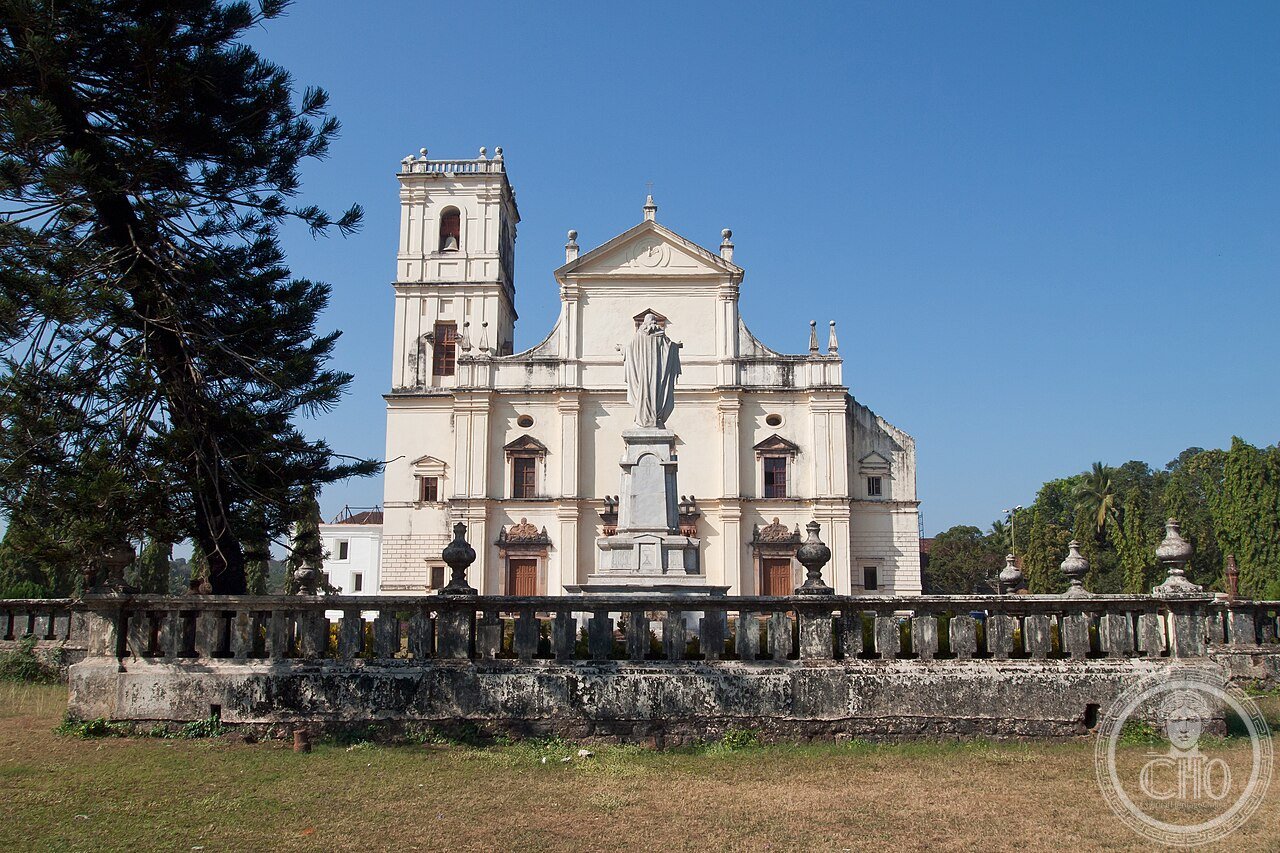
At Old Goa, in India, the Sé Cathedral, dedicated to Saint Catherine, commemorates the Portuguese victory over the forces of the Bijapur Sultanate that in 1510 brought Goa under Afonso de Albuquerque, won by tradition on the feast day of Saint Catherine of Alexandria. Building of the present structure began in 1562 at the order of King Sebastian I of Portugal, was completed in 1619 and the cathedral was consecrated in 1640: almost eighty years of work, in a style joining a Tuscan-order exterior of Manueline descent to a Corinthian-order interior. Originally fitted with two bell towers, the cathedral lost one in 1776, never rebuilt, leaving the facade with the asymmetry that marks it to this day. The surviving tower holds the “Sino de Ouro” (Golden Bell), the largest bell in Goa and, by tradition, in all of Asia, famous for its particularly rich tone: according to the account of the French traveller Charles Dellon, imprisoned by the Goa Inquisition in the seventeenth century, the bell was rung to announce the beginning of the Inquisition’s autos-da-fé. Some 76 metres long and about 55 metres wide, the cathedral is considered the largest church in the whole of Asia, and since 1986 has formed part, with six other monuments, of the UNESCO World Heritage “Churches and Convents of Goa”.
About Se Cathedral
Se Cathedral, formally the Cathedral of Santa Catarina, in Old Goa, India, commemorates the Portuguese victory over Bijapur Sultanate forces that led to the capture of Goa under Afonso de Albuquerque in 1510, a victory tradition holds was won on the feast day of Saint Catherine of Alexandria, giving the cathedral its dedication. Construction of the present building began in 1562 under the orders of King Dom Sebastião of Portugal, was completed in 1619, and the cathedral was consecrated in 1640 — a span of roughly seventy-eight years, in a style blending a Tuscan-order, Manueline-derived exterior with a Corinthian-order interior. Originally built with two bell towers, the cathedral lost one in 1776, when it collapsed and was never rebuilt, leaving the facade with the distinctive asymmetry it retains today. The surviving tower houses the “Golden Bell” (Sino de Ouro), the largest bell in Goa and, according to tradition, in all of Asia, renowned for its especially rich tone; according to the 17th-century account of the French traveller Charles Dellon, imprisoned by the Goa Inquisition, the bell was rung specifically to announce the start of Inquisition auto-da-fé proceedings. With a length of roughly 76 metres and a width of roughly 55 metres, Se Cathedral is widely regarded as the largest church anywhere in Asia, and since 1986 it has formed part, alongside six other monuments, of the UNESCO World Heritage Site “Churches and Convents of Goa.”
Key facts
- 1510: the cathedral commemorates the Portuguese capture of Goa under Afonso de Albuquerque
- 1562-1619: construction of the present cathedral, consecrated in 1640
- 1776: one of the two original bell towers collapses and is never rebuilt
- Sino de Ouro (“Golden Bell”): the largest bell in Goa, reputedly in Asia
- ~76 x 55 metres: dimensions making it the largest church in Asia
- 1986: becomes part of the UNESCO World Heritage Site “Churches and Convents of Goa”
History
Se Cathedral’s origins as a monument to the Portuguese conquest of Goa place it at the very foundation of Portuguese colonial and ecclesiastical authority in Asia, its nearly eighty-year construction reflecting the scale of ambition behind establishing Goa as the seat of the Archdiocese covering the entire Portuguese Asian empire. Its documented role in announcing Goa Inquisition proceedings, attested by a contemporary eyewitness account, adds a darker layer to the cathedral’s history, tying its famous bell directly to one of the more severe episodes of religious persecution in Portuguese colonial Asia.
What you see
The cathedral’s Tuscan-order exterior, with Manueline architectural roots, rises in an asymmetrical facade missing its second bell tower since 1776, while the interior’s Corinthian-order columns frame one of the largest church interiors in Asia. The surviving tower houses the Sino de Ouro, whose rich tone remains audible across Old Goa on significant occasions.
Practical information
- Opening hours: generally open daily with seasonal variation; free admission; check current hours before visiting
- Address: Old Goa, Goa, India
Getting there
Se Cathedral stands in Old Goa, near the Basilica of Bom Jesus, a short drive from the state capital Panaji. GPS: 15.5038° N, 73.9122° E.
Nearby
- Basilica of Bom Jesus — holding the remains of Saint Francis Xavier, a short walk away
- Church of St. Francis of Assisi — historic Franciscan church, nearby
- Panaji — the Goan state capital, a short drive away
Sources
- Wikipedia — “Se Cathedral” (en.wikipedia.org)
- UNESCO World Heritage Centre — “Churches and Convents of Goa” (whc.unesco.org)
- Wikipedia — “Churches and convents of Goa” (en.wikipedia.org)
Find it on the map
See this place and what’s around it →📷 Become a Cultural Heritage Online photographer
Share your photos of places: they stay published under your name as the author. The more they're seen, the more you get noticed — and soon a contest will reward the most appreciated photos.
Log in or sign up free to add a photo