

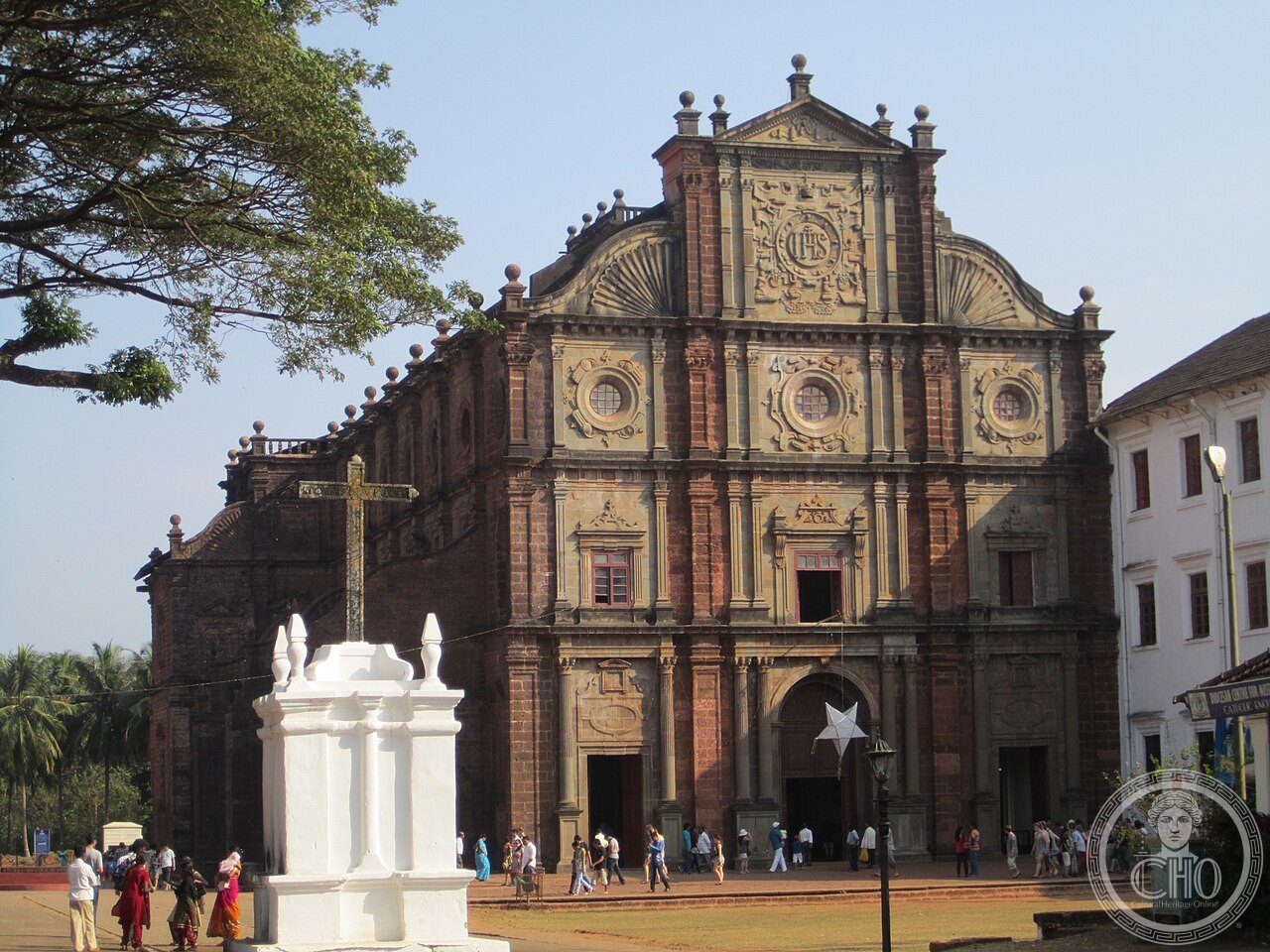
At Old Goa, in India, the Jesuits built the Basilica of Bom Jesus between 1594 and 1605, in a Mannerist-Baroque style, with a laterite facade deliberately left unplastered — the only one in Old Goa to show the red stone bare — decorated with Doric, Corinthian and Composite orders. The basilica holds the remains of the Jesuit missionary Saint Francis Xavier (1506–1552), who died in December 1552 on the Chinese island of Shangchuan while waiting to enter mainland China, and was buried there with quicklime so that his bones could later be carried away. Exhumed in February 1553, the body was found in a state of preservation considered exceptional, giving rise to the tradition of “incorruptibility” central to the saint’s cult; it was taken first to Malacca and then to Goa, where it arrived on 16 March 1554 to be met by great crowds. Over the following centuries the body deteriorated progressively, already documented between 1681 and 1686, and today appears largely skeletal; the right forearm was sent in 1614 to the Church of the Gesù in Rome, and other minor relics were distributed to various Jesuit missions. Since 1622 the body has rested in a silver casket decorated with scenes from the saint’s life, set on a mausoleum of jasper and marble given by Cosimo III de’ Medici and made by the Florentine sculptor Giovanni Battista Foggini, completed in 1698. Roughly every ten years, most recently between November 2024 and January 2025, the body is publicly displayed, drawing enormous crowds of pilgrims.
About the Basilica of Bom Jesus
The Basilica of Bom Jesus, in Old Goa, India, was built by the Jesuits between 1594 and 1605 in a Mannerist-Baroque style, its laterite stone facade left deliberately unplastered — the only church in Old Goa to display its bare red stone rather than a whitewashed surface — and decorated with Doric, Corinthian and Composite architectural orders across its three tiers. The basilica houses the remains of the Jesuit missionary Francis Xavier (1506-1552), who died in December 1552 on the Chinese island of Shangchuan while awaiting passage to the mainland, and was buried there with quicklime intended to allow his bones to be transported later. Exhumed in February 1553, his body was found in a condition widely regarded at the time as remarkably preserved, giving rise to the tradition of his “incorruptibility” that became central to his veneration; the body was carried first to Malacca and then on to Goa, arriving on 16 March 1554 to large crowds including the Portuguese viceroy. Over the following centuries the body underwent documented deterioration, noted as early as 1681-1686, and today survives in largely skeletal condition; the right forearm was removed and sent to the Jesuit church of the Gesù in Rome in 1614, with further minor relics distributed to various Jesuit missions over time. Since 1622, the body has rested in an ornate silver casket decorated with scenes from the saint’s life, set upon a jasper and marble mausoleum donated by Cosimo III de’ Medici, Grand Duke of Tuscany, and crafted by the Florentine sculptor Giovanni Battista Foggini, completed in 1698. Roughly every ten years — most recently between November 2024 and January 2025 — the body is publicly displayed in an Exposition of the Sacred Relics, drawing enormous crowds of pilgrims from across India and beyond.
Key facts
- 1594-1605: construction by the Jesuits
- 1552: Francis Xavier dies on Shangchuan Island, China, awaiting entry to the mainland
- 1554: his body arrives in Goa, following exhumation and transport via Malacca
- 1622: the body placed in a silver casket inside the basilica
- 1698: the Medici-donated marble mausoleum, by Giovanni Battista Foggini, completed
- Public expositions roughly every ten years, most recently November 2024-January 2025
- 1986: the basilica becomes part of the UNESCO World Heritage Site “Churches and Convents of Goa”
History
The Basilica of Bom Jesus stands as one of the most important pilgrimage sites in Asian Christianity, its long custodianship of Francis Xavier’s remains connecting Old Goa directly to the wider history of Jesuit missionary expansion across 16th-century Asia, from India to Japan and China. The body’s documented journey — from a lime-packed grave on a remote Chinese island, through Malacca, to centuries of veneration, deterioration and periodic public exposition in Goa — traces the physical afterlife of a single relic across nearly five centuries of Catholic devotional history.
What you see
The basilica’s unplastered laterite facade, unique among Old Goa’s churches, rises through three tiers of Doric, Corinthian and Composite pilasters, opening onto an interior dominated by the ornate silver casket and jasper-and-marble mausoleum holding Francis Xavier’s remains. Surrounding cloisters and a museum space display further religious art and artefacts connected to the Jesuit mission in Goa.
Practical information
- Opening hours: generally open daily with seasonal variation; free admission; expect very large crowds during exposition periods; check current hours before visiting
- Address: Old Goa, Goa, India
Getting there
The Basilica of Bom Jesus stands in Old Goa, a short drive from the state capital Panaji. GPS: 15.5005° N, 73.9069° E.
Nearby
- Se Cathedral — another major Old Goa church, part of the same UNESCO listing, nearby
- Church of St. Francis of Assisi — historic Franciscan church, adjacent
- Panaji — the Goan state capital, a short drive away
Sources
- Wikipedia — “Basilica of Bom Jesus” and “Francis Xavier” (en.wikipedia.org)
- UNESCO World Heritage Centre — “Churches and Convents of Goa” (whc.unesco.org)
- Vatican News — coverage of the 2024-2025 Exposition of the Sacred Relics (vaticannews.va)
Find it on the map
See this place and what’s around it →📷 Become a Cultural Heritage Online photographer
Share your photos of places: they stay published under your name as the author. The more they're seen, the more you get noticed — and soon a contest will reward the most appreciated photos.
Log in or sign up free to add a photo