
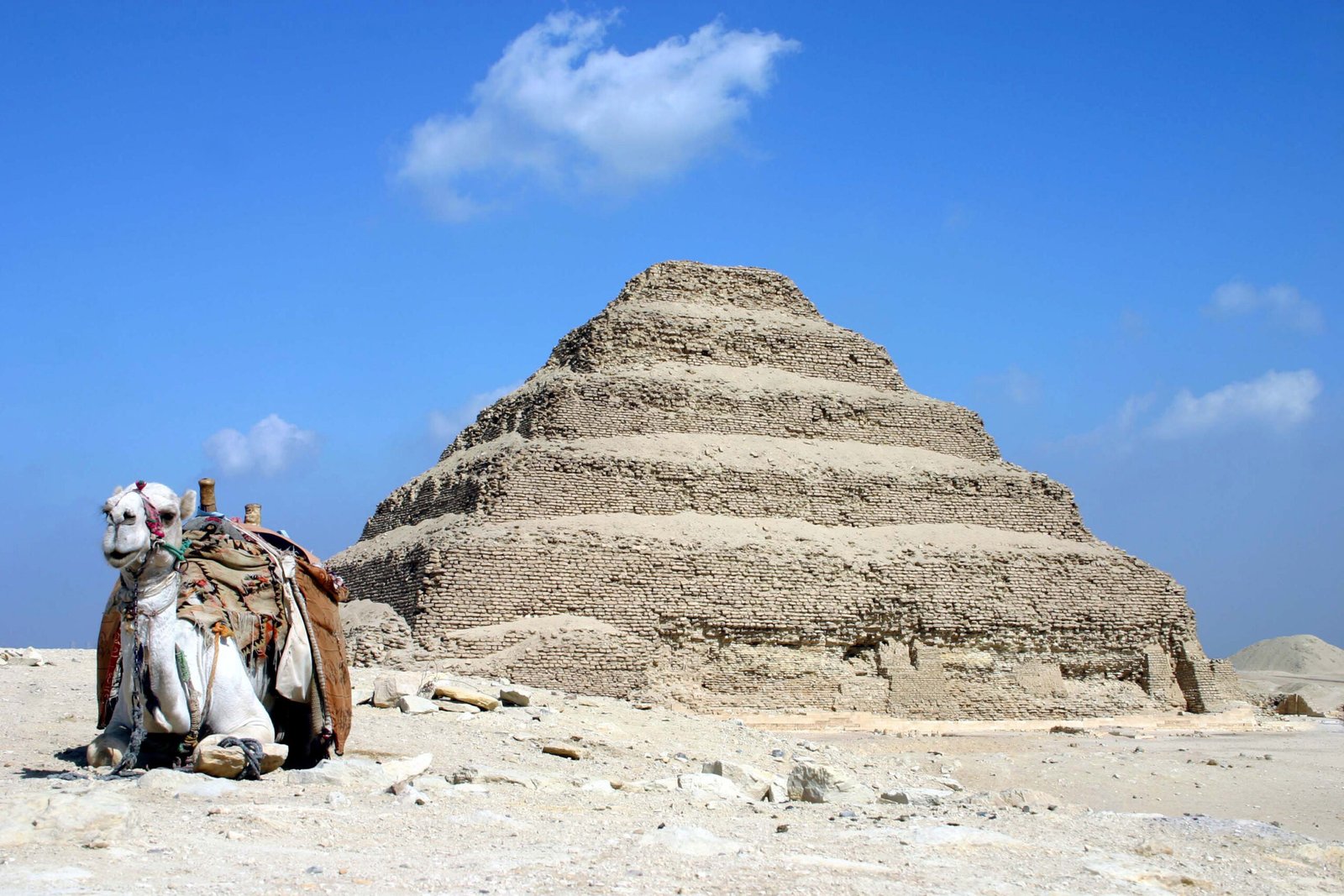
The necropolis where Imhotep invented stone architecture and the pyramid — a desert plateau that holds thirty dynasties of ambition in a single sweeping field of monuments.
At a glance
Saqqara stretches for eight kilometres along the western edge of the Nile floodplain, thirty kilometres south of Cairo. Its centrepiece — the Step Pyramid of Djoser, raised around 2650 BC — was the first large structure ever built from cut stone and the world’s oldest surviving pyramid. Around it, three dozen more pyramids spanning three thousand years of Egyptian history crowd a landscape still actively surrendering its dead: excavations in 2023 revealed a cache of 250 mummies, and no season passes without a new discovery. The site is listed as part of the ancient city of Memphis and its Necropolis, a UNESCO World Heritage Site since 1979.
Key facts
- Location: Giza Governorate, Egypt — 29.8712° N, 31.2156° E (Google Maps)
- Period: c. 2650 BC – 7th century AD (Old Kingdom to Late Antique)
- Key monument: Step Pyramid of Djoser, designed by Imhotep, c. 2650 BC — 62 m tall, six mastaba stages
- Serapeum: Underground galleries holding 24 granite sarcophagi of the Apis bulls, each weighing 60–80 tonnes
- Pyramid Texts: The oldest surviving corpus of religious texts in the world, inscribed inside 5th–6th Dynasty pyramids
- UNESCO: Part of Memphis and its Necropolis (WHS 1979)
- Modern excavation: Auguste Mariette discovered the Serapeum in 1851; active international missions continue today
History
Saqqara became Egypt’s royal necropolis during the 1st Dynasty, around 3100 BC, when pharaohs began constructing massive mud-brick mastaba tombs here. The decisive moment came under the 3rd Dynasty pharaoh Djoser, whose chief architect Imhotep transformed a standard flat-topped mastaba into six tapering stages of cut limestone — a stepped pyramid rising 62 metres. It was the first time human beings had deliberately built a large structure from quarried stone, and the logic Imhotep devised — column architecture, corbelled ceilings, dressed ashlar blocks — cascaded forward through every subsequent tradition of stone construction on earth.
Over the next two and a half millennia, Saqqara never lost its prestige. Old Kingdom pharaohs of the 5th and 6th Dynasties clustered their pyramids around Djoser’s, filling their interior chambers with the dense hieroglyphic inscriptions now known as the Pyramid Texts — spells, hymns, and astronomical observations that constitute the oldest religious literature known to survive. The Mastaba of Ti, a 5th Dynasty official buried here around 2400 BC, preserves painted reliefs of hunting, farming, and butchery scenes whose freshness of observation still surprises visitors who round its internal corridors.
In 1851 the French Egyptologist Auguste Mariette followed a half-buried sphinx’s head through the desert sand and excavated his way to the Serapeum — a subterranean labyrinth begun under Ramesses II around 1280 BC. Inside, the sequential burial vaults of the sacred Apis bulls held twenty-four monolithic granite sarcophagi, each weighing between sixty and eighty tonnes, transported from Aswan along the Nile and manoeuvred underground in an engineering feat scholars still struggle to fully explain. Saqqara has been excavated continuously since Mariette’s first season, and in 2023 a joint Egyptian-European mission uncovered 250 mummies along with gilded wooden coffins in a shaft tomb complex that had lain sealed since the Late Period.
What you see
The Step Pyramid commands the plateau from a distance — its six limestone stages, rising to sixty-two metres, are visible long before you pass through the reconstructed entrance colonnade of Imhotep’s mortuary complex. That complex, encircled by a 10.5-metre-high enclosure wall stretching 544 by 277 metres, contained dummy chapels, offering halls, and a broad courtyard for the Heb Sed royal jubilee ritual. Much of it is reconstruction, but Imhotep’s genius — the engaged limestone columns that influenced every subsequent Egyptian temple — is plainly legible in the North House colonnade.
East of the Step Pyramid, the dunes conceal and reveal: the descending corridor of the Serapeum is lit to a dim amber below ground, the silence between its granite chambers deep enough to feel the mass of the stone above you. The Pyramid Texts galleries of Unas (c. 2350 BC) are open by permit; the blue-green hieroglyphs covering every ceiling and wall surface were carved with a precision that has lost no sharpness in four thousand years. At the site’s northern edge, the Mastaba of Ti repays close attention — the painted relief of Ti watching his workers hunt hippopotamus from a papyrus skiff is one of the most dynamically observed images to survive from any ancient civilisation.
Practical information
- Opening hours: Daily 8:00–17:00 (last entry 16:00); extended in summer
- Tickets: General site entry plus separate tickets for the Serapeum and the Imhotep Museum; the Pyramid Texts galleries (Unas, Teti) require advance permit booking
- Best season: October–April; desert heat in June–August can exceed 40°C at noon
- What to wear: Closed shoes essential (uneven limestone rubble throughout); hat and sunscreen mandatory; long trousers required in some areas
- Time needed: Half day minimum; a full day to cover Step Pyramid complex, Serapeum, Mastaba of Ti, and Imhotep Museum
- Facilities: Snack kiosks near the main entrance; no shade inside the complex itself
Getting there
Saqqara lies thirty kilometres south of central Cairo. The most practical option is a private taxi or organised tour from Cairo (45–60 minutes depending on traffic). There is no direct public transport; the nearest town with microbus connections is Mit Rahina (Memphis), five kilometres away. Many visitors combine Saqqara with the adjacent Memphis open-air museum and the Dahshur pyramid field in a single day trip. Parking is available at the main site entrance. Cairo International Airport is 55 kilometres north-east; Giza is the closest major neighbourhood for overnight stays.
Nearby
- Memphis (Mit Rahina) — 5 km south: open-air museum containing the colossal limestone statue of Ramesses II and an alabaster sphinx; the original ancient capital of Egypt
- Dahshur — 10 km south: Sneferu’s Bent Pyramid (c. 2600 BC) and Red Pyramid, the first true smooth-sided pyramids, in a largely unvisited desert field
- Giza Pyramid Complex — 25 km north: the Great Pyramid of Khufu and the Sphinx; UNESCO World Heritage Site
- Abusir — 7 km north: 5th Dynasty sun temples and pyramids in a quiet, rarely crowded setting
Sources
- Lehner, Mark. The Complete Pyramids. Thames & Hudson, 1997.
- UNESCO World Heritage List — Memphis and its Necropolis: whc.unesco.org/en/list/86
- Wikipedia — Saqqara: en.wikipedia.org/wiki/Saqqara
- Supreme Council of Antiquities, Egypt — official site notices, 2023 excavation announcement
- Fagan, Brian. The Rape of the Nile. Westview Press, 2004 — on Mariette and the Serapeum discovery
Find it on the map
See this place and what’s around it →📷 Become a Cultural Heritage Online photographer
Share your photos of places: they stay published under your name as the author. The more they're seen, the more you get noticed — and soon a contest will reward the most appreciated photos.
Log in or sign up free to add a photo