
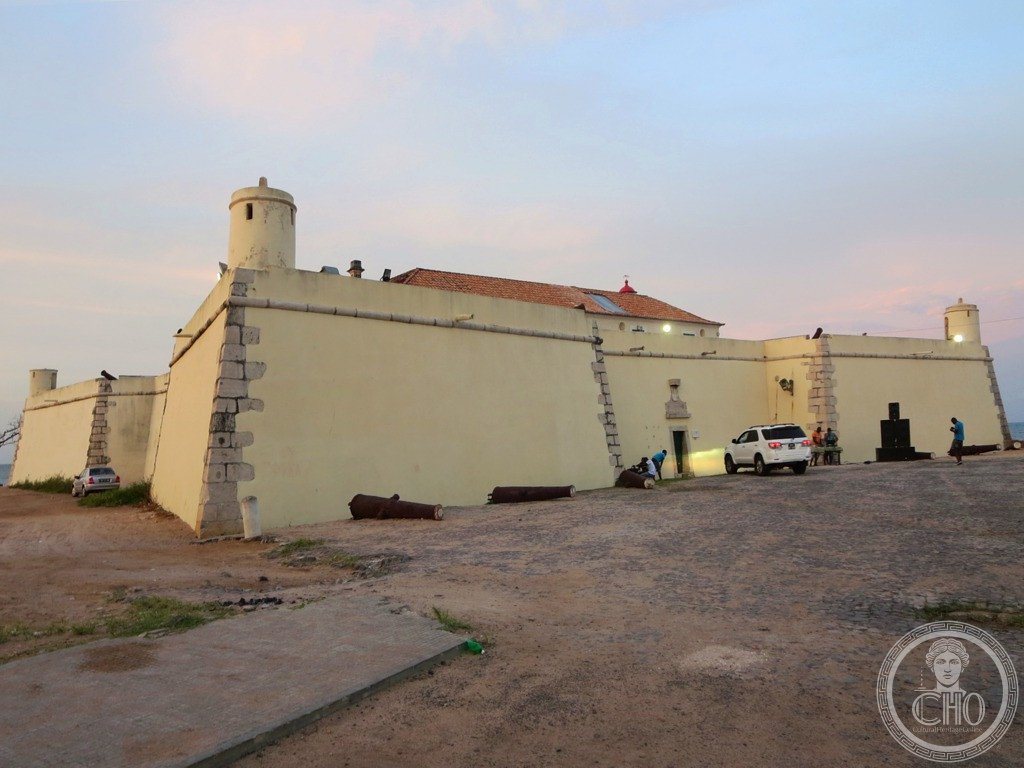
The star fort at the equator’s edge – guardian of the world’s first plantation economy, now the national museum of the cocoa islands.
At a glance
- Type
- Fortress, now National Museum
- Period
- 1575
- Style
- Portuguese colonial fortification
- Location
- Sao Tome city, Sao Tome and Principe
- Coordinates
- 0.3365, 6.7273
- Builder
- Portuguese crown
Overview
The Fortaleza de Sao Sebastiao closes the bay of Sao Tome city with whitewashed bastions begun in 1575 – the stronghold of the Gulf of Guinea islands where Portugal invented the sugar-plantation slavery model later exported to Brazil and the Caribbean. Since 1976 the fort houses the National Museum, narrating five centuries from caravels through cocoa to independence.
History
Settled from 1486 with colonists and enslaved Africans, Sao Tome ran the world’s first tropical plantation economy; the 1595 Amador rebellion – the islands’ enslaved king remembered as national hero – and Dutch assaults tested the fort. The 19th-20th century cocoa boom made the islands briefly the world’s top producer under the contract-labour scandals British chocolate boycotts exposed. Independence came in 1975; the fort’s museum keeps the whole arc.
Architecture and Design
The quadrilateral of corner bastions, parade court, and chapel follows the Atlantic fort pattern in rendered stone against the equatorial rains; cannon still aim down the roadstead. Galleries hold sacred art, plantation-era furnishings, and the independence collection; the ramparts give the bay panorama of fishing canoes and the misty Pico.
Cultural significance
The fort condenses the islands’ world-historical role – laboratory of the plantation Atlantic – and their creole forro culture’s endurance. It is the ceremonial heart of national memory on Amador’s day and independence anniversaries.
Visiting today
The National Museum opens Tuesday to Sunday with token entry; the city’s pastel colonial avenue, the cathedral, and the cocoa-broker mansions reward the seafront walk after.
Getting there
Sao Tome’s airport, with flights from Lisbon and Libreville, is ten minutes away; the fort anchors the capital’s bay road.
Sources and resources
Find it on the map
See this place and what’s around it →Record researched and written by Luigi De Marchi for Cultural Heritage Online, 2026.
📷 Become a Cultural Heritage Online photographer
Share your photos of places: they stay published under your name as the author. The more they're seen, the more you get noticed — and soon a contest will reward the most appreciated photos.
Log in or sign up free to add a photo