
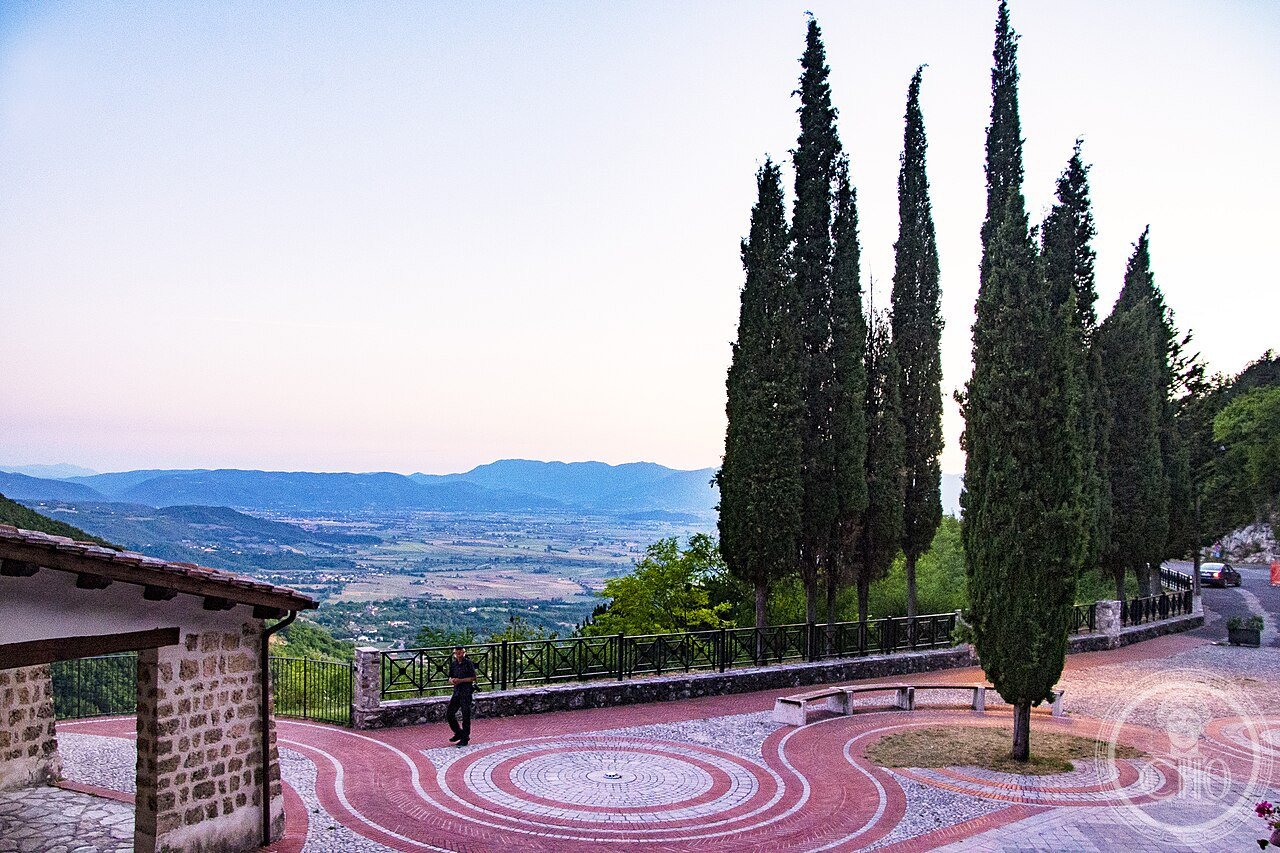
In the summer of 1208, arriving from Assisi by way of Cascia and Leonessa, Francis reached this village of the Valle Santa near Rieti for the first time. He greeted the inhabitants with the phrase that would become proverbial: “Buongiorno, buona gente!” He withdrew to pray in a cave on the mountain above. There, according to tradition, an angel visited him and announced the remission of his sins. Since then that place has been known as the Grotta delle Rivelazioni.
About the Sanctuary of Poggio Bustone
Francis of Assisi arrived at Poggio Bustone with a small group of his first companions in the summer of 1208, having travelled from Assisi through Cascia and Leonessa. It was his first arrival in the Rieti valley that would come to be known as the Valle Santa, or Holy Valley, and it came before his other three sanctuaries in the same region: Fonte Colombo, Greccio and La Foresta. Upon arrival, Francis is said to have greeted the local inhabitants with the now-proverbial phrase “Buongiorno, buona gente!” (“Good morning, good people!”), an episode still closely associated with the town today.
Seeking solitude for prayer, Francis withdrew to a cave in the mountains above the village. There, tradition holds, an angel appeared to him, delivering the assurance that God had forgiven his sins, along with a prophetic vision of his future order’s luminous growth. That event gave the site its enduring name, the Grotta delle Rivelazioni, the Cave of Revelations, and led the wider location to become known in later tradition as the “sanctuary of forgiveness”.
The sanctuary complex that developed around these events consists of two connected sites. The Lower Sanctuary, whose church dedicated to Saint James the Greater was built toward the end of the 14th century; and the Upper Sanctuary, the Sacred Grotto itself, reached by a path roughly 30 minutes from the town’s main square. Construction at the site began in the 13th century with an initial convent and small cloister church. It was substantially expanded in the 14th and 15th centuries with a new church, gained an additional storey to the convent in the 17th century, and received the modern “Tempietto della Pace”, the Little Temple of Peace, in the 20th century.
Key facts
- Summer 1208: Francis’s first arrival at Poggio Bustone, the earliest of the four Valle Santa sanctuaries.
- Greeting: “Buongiorno, buona gente!” — Francis’s proverbial welcome to the townspeople.
- Grotta delle Rivelazioni: the cave where an angel reportedly assured Francis of forgiveness for his sins.
- 13th century: initial convent and small church built.
- End of 14th century: Lower Sanctuary church, dedicated to Saint James the Greater, built.
- 14th-15th centuries: major expansion of the complex.
- 17th century: an additional floor added to the convent.
- 20th century: the “Tempietto della Pace” built.
History
As the site of Francis’s very first documented arrival in the Rieti valley in 1208, Poggio Bustone holds chronological priority among the region’s four Franciscan sanctuaries, situating the saint’s later, better-documented episodes at Fonte Colombo, Greccio, and La Foresta as later chapters in a relationship with the Valle Santa that began specifically here. The tradition of the Grotta delle Rivelazioni, in which Francis received explicit assurance of divine forgiveness for his past sins, gives Poggio Bustone a distinctive emotional and theological character among the four sanctuaries — less a site of institutional achievement (the Rule at Fonte Colombo) or public spectacle (the nativity at Greccio) than one of intensely personal spiritual reconciliation.
The enduring local memory of Francis’s simple greeting, “Buongiorno, buona gente,” turning an ordinary act of courtesy into a phrase still specifically associated with this town eight centuries later, reflects how thoroughly small, human details of Francis’s biography have been preserved and locally cherished across the Valle Santa’s collective memory, alongside its grander theological and institutional history.
What you see
The Lower Sanctuary’s church, dedicated to Saint James the Greater and built toward the end of the 14th century, anchors the complex alongside its associated convent, expanded across the 14th, 15th, and 17th centuries. A roughly 30-minute path leads up to the Upper Sanctuary, the Sacred Grotto or Cave of Revelations itself, set within the mountainside above the town with views across the surrounding Valle Santa. The 20th-century Tempietto della Pace adds a modern devotional space to the historic complex.
Practical information
- Opening hours: generally open daily with seasonal variation; check current hours before visiting; free admission (donations welcome).
- Address: Borgo San Pietro, Santuario di Poggio Bustone, 02018 Poggio Bustone, Italy.
Getting there
The Sanctuary of Poggio Bustone is reachable by car from Rieti (approximately 20 minutes) in the Valle Santa, Lazio. GPS: 42.5045° N, 12.8926° E.
Nearby
- Rieti — approximately 20 minutes away; the provincial capital.
- Sanctuary of La Foresta — another of the four Franciscan sanctuaries of the Valle Santa.
- Sanctuary of Fonte Colombo — where Francis wrote the Order’s definitive Rule.
Sources
- Wikipedia — “Santuario di Poggio Bustone” (it.wikipedia.org).
- Santuari della Valle Santa — “Santuario Poggio Bustone” (santuarivallesanta.com).
- Il Cammino di Francesco — “Poggio Bustone: Saint Francis Begins His Mission of Peace” (camminodifrancesco.it).
Find it on the map
See this place and what’s around it →📷 Become a Cultural Heritage Online photographer
Share your photos of places: they stay published under your name as the author. The more they're seen, the more you get noticed — and soon a contest will reward the most appreciated photos.
Log in or sign up free to add a photo