
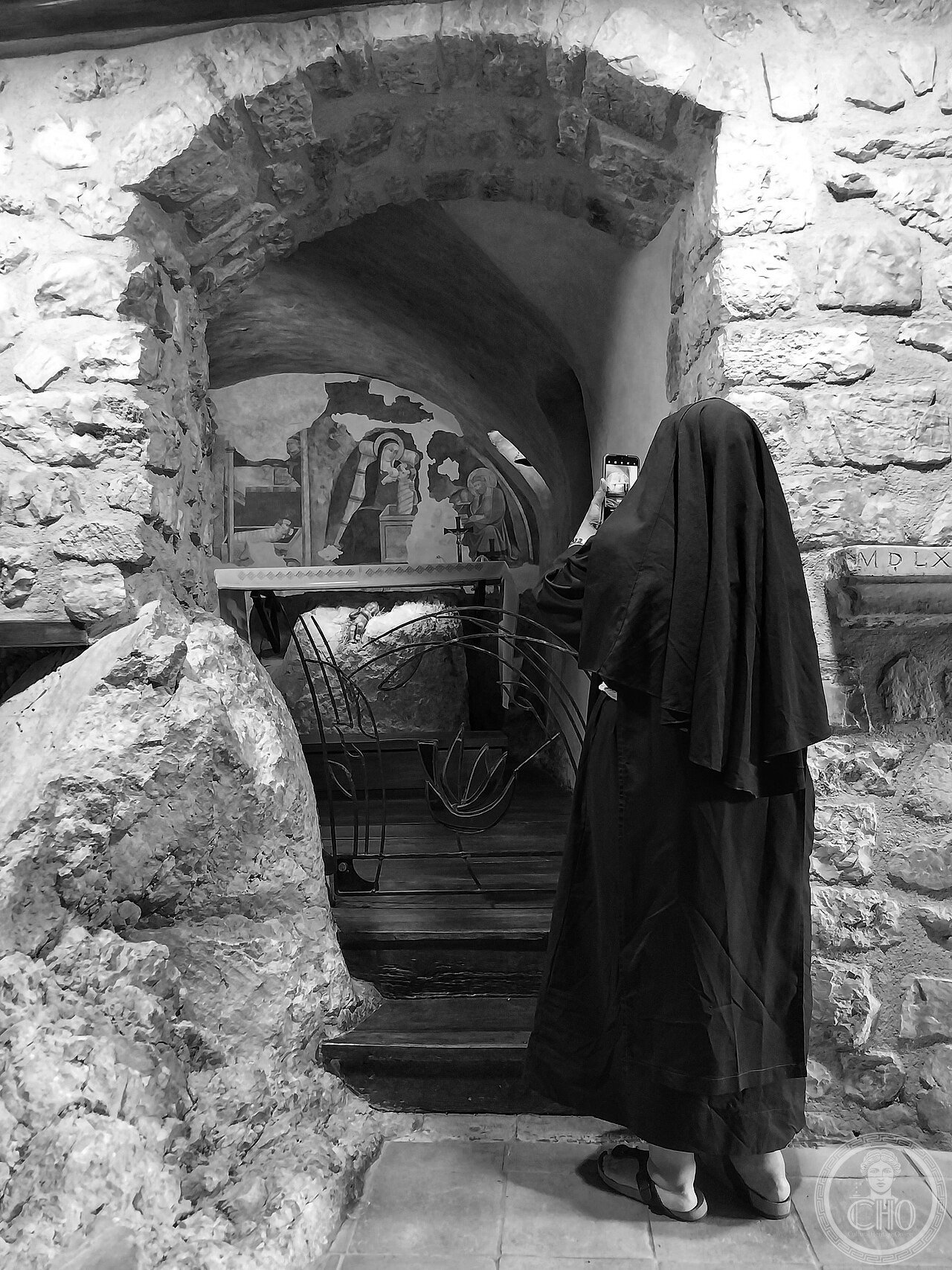
On Christmas night 1223, in a cave cut into the rock above Greccio, Francis of Assisi staged, with the help of the local lord Giovanni Velita, the first living representation of the Nativity in history: a manger, the hay, the ox and the ass, before a population gathered in prayer. From that single night descends, eight centuries later, the universal tradition of the nativity scene.
About the Sanctuary of Greccio
The Sanctuary of Greccio, known as the “Franciscan Bethlehem,” is a hermitage perched on a wooded rock face some two kilometres from the town of Greccio, in the province of Rieti, Lazio — one of the most significant sites in the entire history of the Franciscan movement. Francis of Assisi is said to have first arrived at Greccio as early as 1217, initially dwelling on nearby Monte Lacerone before local nobleman Giovanni Velita encouraged him to settle closer to the town’s inhabitants. According to tradition, Francis determined the exact site of his new retreat by having a child throw a burning ember, resolving to build wherever it landed — the ember is said to have fallen on the rocky slope where the hermitage now stands. On the night of 24 December 1223, Francis, together with Giovanni Velita, gathered the local population in a humble grotto and staged what is recognised as the first living nativity scene in Christian history: a manger resembling the stable at Bethlehem, filled with hay, alongside a live ox and donkey, around which the community celebrated Midnight Mass. According to the account preserved in Saint Bonaventure’s Legenda Maior, during the Mass a living infant reportedly appeared in the manger, whom Francis took into his arms. The Chapel of the Presepio, built in 1228 — the year of Francis’s canonisation — directly on the grotto where the event took place, forms the original nucleus of the sanctuary that grew up around it. Since 1972, a historical reenactment of the Greccio nativity has been staged at Christmas each year in the town, keeping alive, eight centuries later, the very tradition of the presepe that began on this single night.
Key facts
- c. 1217: Francis first arrives at Greccio, initially settling on Monte Lacerone
- Legend: a burning ember thrown by a child marks the exact site of the hermitage
- 24 December 1223: Francis and Giovanni Velita stage the first living nativity scene in Christian history
- Bonaventure’s account: a living infant reportedly appears in the manger during the Mass
- 1228: the Chapel of the Presepio built directly on the site of the original grotto
- Since 1972: an annual historical reenactment of the 1223 nativity is staged at Greccio each Christmas
History
The single night of 24 December 1223 at Greccio is widely credited as the direct origin of the entire Christian tradition of the presepe, or nativity scene — a devotional practice that would spread across the Catholic world and eventually well beyond it, making this small hermitage in rural Lazio the traceable point of origin for one of Christianity’s most globally recognisable Christmas customs. Francis’s specific choice to use a real manger, real hay, and live animals rather than a purely symbolic or painted representation reflects his broader theological emphasis on the physical, incarnate reality of Christ’s birth, a hallmark of Franciscan spirituality that the living nativity tradition continues to embody wherever it is staged today.
The sanctuary’s continuous physical connection to the original event — the 1228 chapel built directly over the grotto where Francis staged the first nativity — gives Greccio a rare degree of site-specific authenticity among medieval devotional locations, one reinforced today by the unbroken modern tradition of annual reenactment maintained since 1972, connecting each contemporary Christmas celebration directly back to the same physical rock face where the custom began eight centuries earlier.
What you see
The Chapel of the Presepio, built in 1228 directly over the original grotto, remains the sanctuary’s oldest and most significant structure, housing the site associated with Francis’s 1223 nativity scene. The wider hermitage complex, perched on its wooded rock face like an eagle’s nest above the valley, includes further chapels and monastic buildings added over subsequent centuries, along with frescoes depicting scenes from Francis’s life, including his ministry to lepers.
Practical information
- Opening hours: generally open daily with seasonal variation; check current hours before visiting; free admission (donations welcome)
- Address: Via dei Frati, Santuario di Greccio, 02045 Greccio, Italy
Getting there
The Sanctuary of Greccio is reachable by car from Rieti (approximately 20 minutes) in the Sabina region, Lazio. GPS: 42.4617° N, 12.7513° E.
Nearby
- Greccio — the nearby town, source of the sanctuary’s name
- Rieti — approximately 20 minutes away; the provincial capital
- Valle Santa — the “Holy Valley” of Rieti, home to several other Franciscan sanctuaries
Sources
- Wikipedia — “Santuario di Greccio” e “Presepe di Greccio” (it.wikipedia.org)
- VisitLazio — “Il Presepe Vivente a Greccio dal 1223” (visitlazio.com)
- I Luoghi del Silenzio — “Santuario (Eremo) del Presepe di Greccio” (iluoghidelsilenzio.it)
Find it on the map
See this place and what’s around it →📷 Become a Cultural Heritage Online photographer
Share your photos of places: they stay published under your name as the author. The more they're seen, the more you get noticed — and soon a contest will reward the most appreciated photos.
Log in or sign up free to add a photo