
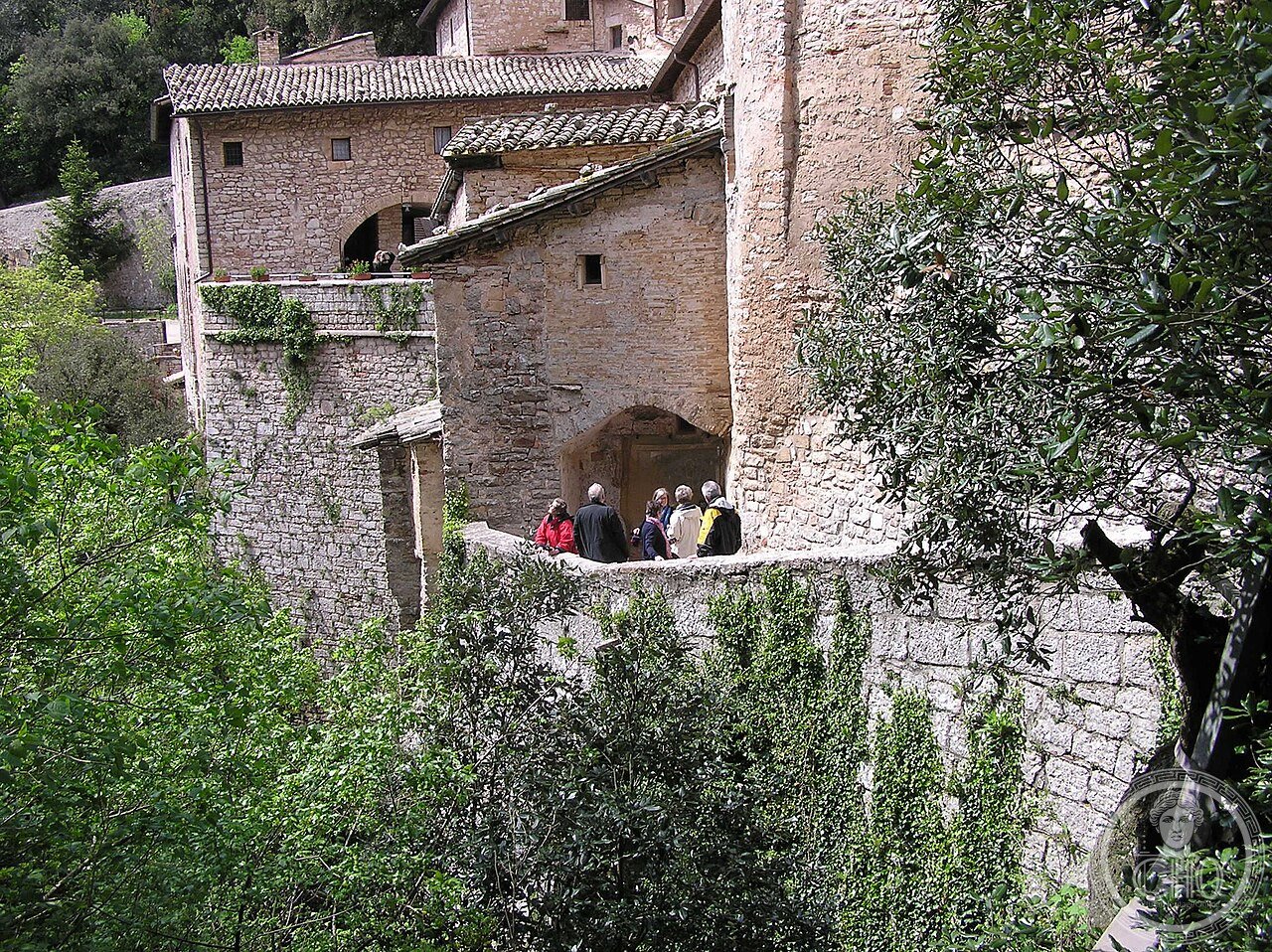
The name “Carceri” does not mean prisons, but the act of voluntarily “imprisoning oneself” in prayer and silence, far from the world. Just outside the cave where Francis slept on a stone bed opens a small hole in the rock, called the “Devil’s Hole”: legend has it that Brother Rufinus, tormented by the temptations of the evil one, drove him off with such force that he fell screaming down the cliff, leaving that opening still visible today.
About the Eremo delle Carceri
The Eremo delle Carceri is a hermitage complex set 791 metres above sea level within a steep, forested gorge on Monte Subasio, four kilometres above Assisi, surrounded by centuries-old holm oaks, caves, and small chapels where pilgrims still retreat in contemplation today. Francis of Assisi first discovered the site after his release from a year’s captivity following the battle between Perugia and Assisi in 1202, and began retreating there to pray in the early 1200s. In 1215, this wild and solitary place was formally donated to Francis by the Benedictine monks of Monte Subasio, so that he could, in the language of the time, “incarcerarsi” — voluntarily confine himself — in prayer and silence, giving the site its distinctive name, “Carceri.” A staircase descends to a narrow passage leading to the Cave of San Francesco, divided today into two spaces: one holds the simple stone bed on which the saint is said to have slept, the other a stone on which he likely sat to meditate. Just outside the cave, a small opening in the rock floor known as the “Buco del Diavolo” (Devil’s Hole) is associated with a vivid local legend: Brother Rufino, who lived there, was said to be tormented by the devil’s deceptions, until he drove the Evil One away with such force that he plunged, howling, over the cliff, leaving behind the hole still visible today. Other caves nearby housed Francis’s earliest companions — Leo, Anthony of Stroncone, Bernard of Quintavalle, Giles, Sylvester, and Andrew of Spello. In the 14th century, the site was formally granted to the Franciscans, and between 1370 and 1373 the friar Paoluccio Trinci had the first monastic cells built around the church of Santa Maria; the current convent complex reflects further expansion carried out by Saint Bernardino of Siena in the 15th century.
Key facts
- 1202: Francis released after a year’s captivity following the Perugia-Assisi battle; begins retreating to the site
- 1215: the Benedictines of Monte Subasio donate the hermitage to Francis
- Cave of San Francesco: preserves the saint’s stone bed and meditation stone
- “Buco del Diavolo”: the legendary hole left by the devil’s fall, near Brother Rufino’s cave
- 14th century: formally granted to the Franciscans
- 1370-1373: first monastic cells built around the church of Santa Maria by Paoluccio Trinci
- 15th century: further expansion by Saint Bernardino of Siena
History
The site’s very name, “Carceri” — derived from the Latin for imprisonment but referring here to voluntary spiritual confinement rather than punitive detention — captures a distinctive strand of Franciscan asceticism, in which withdrawal to a specific, physically demanding wilderness location became understood as a form of freely chosen self-imprisonment in prayer. The presence of separate caves for Francis’s earliest companions, alongside his own, illustrates how the hermitage functioned not merely as a single hermit’s retreat but as a genuine early monastic community, each friar occupying his own designated space within the same rugged landscape.
The legend of the “Buco del Diavolo,” situating a dramatic confrontation between a specific named friar and the devil directly beside Francis’s own cave, reflects the broader medieval Franciscan tradition of embedding vivid, morally instructive local legends into the physical landscape of the order’s most sacred sites — turning an ordinary geological feature into a permanent devotional reminder of spiritual struggle and its resolution.
What you see
A staircase leads down through the rock to the Cave of San Francesco, preserving the saint’s stone bed and meditation stone. The “Buco del Diavolo” opens in the rock floor just outside. The surrounding complex, built up from the 14th-century cells constructed under Paoluccio Trinci and expanded in the 15th century by Saint Bernardino of Siena, centres on the church of Santa Maria, set within the ancient holm oak forest of Monte Subasio alongside the separate caves once inhabited by Francis’s earliest companions.
Practical information
- Opening hours: generally open daily with seasonal variation; check current hours before visiting; free admission (donations welcome)
- Address: Strada Provinciale di San Benedetto, San Vitale, 06081 Assisi, Italy
Getting there
The Eremo delle Carceri is reachable by car or on foot from Assisi (approximately 4 km) on Monte Subasio, Umbria. GPS: 43.0630° N, 12.6521° E.
Nearby
- Monte Subasio — the mountain and regional park surrounding the hermitage
- Assisi — approximately 4 km away; the UNESCO-listed home of the Basilica of San Francesco
- Basilica of San Francesco — the saint’s principal basilica in the town below
Sources
- Wikipedia — “Eremo delle Carceri” (en.wikipedia.org)
- Umbria Tourism — “L’eremo delle Carceri” (umbriatourism.it)
- I Luoghi del Silenzio — “Eremo delle Carceri – Assisi (PG)” (iluoghidelsilenzio.it)
Find it on the map
See this place and what’s around it →📷 Become a Cultural Heritage Online photographer
Share your photos of places: they stay published under your name as the author. The more they're seen, the more you get noticed — and soon a contest will reward the most appreciated photos.
Log in or sign up free to add a photo