

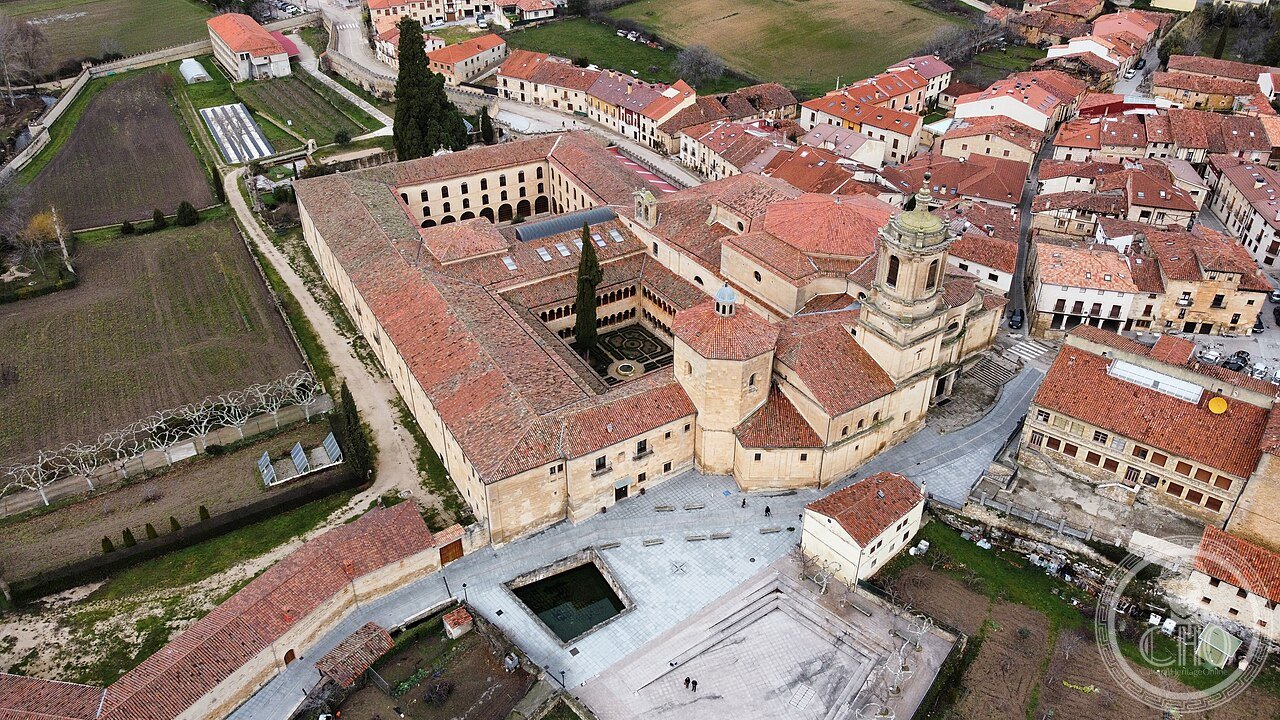
In 1994 an album of Gregorian chant recorded by the Benedictine monks of Silos reached number three on the Billboard 200 and sold more than six million copies, becoming the best-selling Gregorian chant record ever released. The monastery that produced it also holds one of the most admired Romanesque cloisters in Spain, rebuilt from 1041 by Abbot Dominic after the ancient Visigothic foundation had fallen almost into ruin.
About the Abbey of Santo Domingo de Silos
The monastery’s origins trace to the Visigothic 7th century, when it was known as San Sebastián de Silos. By 1041 it was nearly deserted and in ruins, prompting King Ferdinand I of Castile and León to send the monk Dominic to restore it. Dominic rebuilt the church, began construction of the cloister, enriched the library, and established a scriptorium, work for which the monastery was eventually renamed in his honour after his death in 1073; Abbot Fortunius completed the reconstruction that followed. The monastery’s scriptorium went on to produce one of the most significant illuminated manuscripts of medieval Spain, the Silos Beatus, a commentary on the Apocalypse whose text was completed by two monks in 1091, with its illuminations finished by the prior in 1109 — the manuscript is now held by the British Library. The abbey’s church was later rebuilt in neoclassical style by the architect Ventura Rodríguez. The monastery was suppressed in 1835 during Spain’s ecclesiastical disentailment, standing empty until 1880, when Benedictine monks from France revived the community. Over a century later, in 1994, an album of the monks’ Gregorian chant recordings, released simply as “Chant,” became an unexpected global phenomenon, peaking at number three on the Billboard 200 and achieving triple-platinum certification, making it the best-selling Gregorian chant recording in history.
Key facts
- Origins: Visigothic monastery, 7th century, originally San Sebastián de Silos
- Restoration: from 1041, by the monk Dominic (later Saint Dominic of Silos), who died in 1073
- Cloister: two-storey Romanesque masterpiece, lower level built late 11th-mid 12th century, dedicated 29 September 1088
- Silos Beatus manuscript: text completed 1091, illuminations finished 1109; now in the British Library
- 1835-1880: monastery suppressed during Spain’s disentailment; revived by French Benedictine monks in 1880
- 1994: the monks’ album “Chant” reaches #3 on Billboard 200, triple platinum, best-selling Gregorian chant record ever
History
The scale of Dominic of Silos’s 11th-century restoration — rebuilding a nearly ruined Visigothic foundation into one of medieval Castile’s most significant monastic centres, complete with a working scriptorium that would go on to produce the Silos Beatus — situates the abbey within the broader pattern of royally sponsored monastic refoundations that reshaped the religious landscape of the Iberian Peninsula during the Reconquista period. The cloister’s corner reliefs, depicting post-Passion scenes including the Doubting Thomas and the Road to Emmaus, have been attributed by some scholars to the same workshop responsible for related carvings at the Abbey of Saint-Pierre de Moissac in France, suggesting a genuine cross-Pyrenean circulation of Romanesque sculptural expertise during this period.
The monastery’s unlikely late-20th-century commercial success with “Chant” — an album of unaccompanied liturgical Gregorian chant that outsold the vast majority of contemporary popular music releases in 1994 — remains one of the most improbable crossover phenomena in the modern recording industry, introducing a centuries-old monastic musical tradition to a global mainstream audience largely unfamiliar with it.
What you see
The two-storey Romanesque cloister, an angled rectangle with sixteen semicircular arches on its north and south sides and fourteen on the east and west, is the monastery’s single greatest surviving treasure and the only part of the complex essentially unchanged since its medieval construction. Its capitals are densely carved with dragons, centaurs, lattice patterns, and mermaids, while its four corner piers bear large relief panels depicting scenes from the life of Christ. The monastery church itself, rebuilt in neoclassical style by Ventura Rodríguez, contrasts with the cloister’s Romanesque austerity. The monastery’s historic pharmacy is also preserved and open to visitors alongside the cloister.
Practical information
- Opening hours: the cloister and pharmacy are open to visitors on a scheduled basis; check current hours before visiting; admission fee applies
- Address: Monasterio de Santo Domingo de Silos, Calle las Condesas, 09610 Santo Domingo de Silos, Burgos, Spain
Getting there
Santo Domingo de Silos is reachable by car from Burgos (approximately 1 hour) in the province of Burgos, Castilla y León. GPS: 41.9616° N, -3.4202° E.
Nearby
- Garganta de la Yecla — a dramatic limestone gorge and walking trail near the village
- Burgos — approximately 1 hour away; home to Burgos Cathedral, a UNESCO World Heritage Site
- Covarrubias — a nearby historic medieval town
Sources
- Wikipedia — “Abbey of Santo Domingo de Silos” (en.wikipedia.org)
- Transromanica — “Monastery of Santo Domingo de Silos” (transromanica.com)
- spain.info — “Monastery of Santo Domingo de Silos” (spain.info)
Find it on the map
See this place and what’s around it →📷 Become a Cultural Heritage Online photographer
Share your photos of places: they stay published under your name as the author. The more they're seen, the more you get noticed — and soon a contest will reward the most appreciated photos.
Log in or sign up free to add a photo