

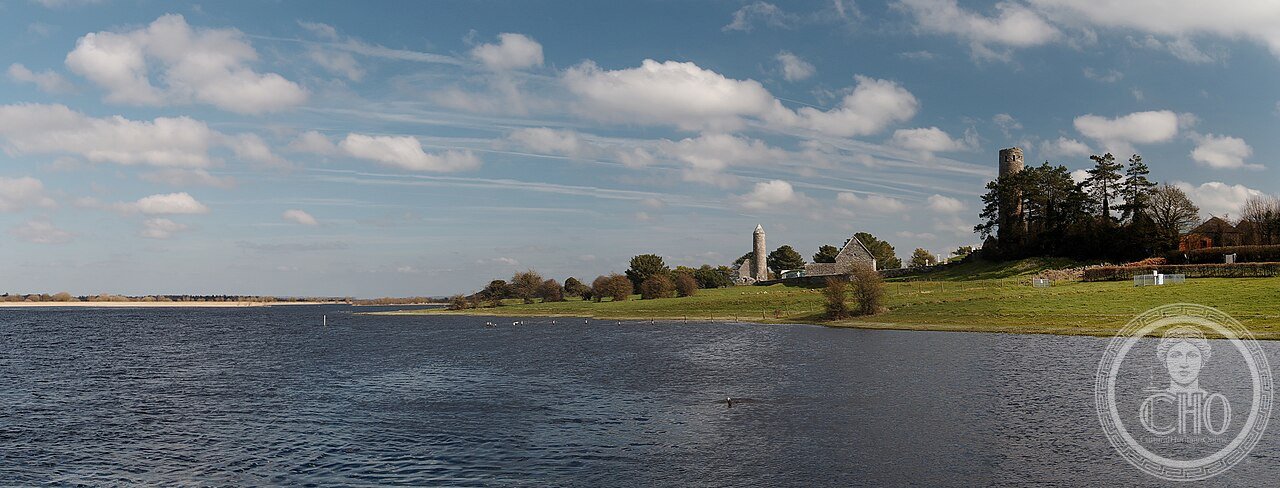
Founded in 544 by Saint Ciarán, the son of a craftsman and not of a nobleman, the monastery of Clonmacnoise grew into a true monastic city of 1,500–2,000 inhabitants, a centre of learning that drew students from across Europe. The last High Kings of Ireland were buried here, among them Rory O’Connor in 1198, before an English garrison destroyed it for good in 1552.
About Clonmacnoise
Clonmacnoise was founded in AD 544 by Saint Ciarán and seven companions, on the River Shannon at the point where the ancient east-west road Slighe Mhór crossed the river after threading through the bogs of central Ireland known as the Esker Riada. Unlike many contemporary Irish saints from privileged backgrounds, Ciarán was the son of a craftsman; he died of plague in September 549, not yet thirty-three years old, and was buried beneath the original wooden church, on the site of what became the 9th-century stone oratory Temple Ciarán. Despite his brief tenure, his successors built Clonmacnoise into one of early medieval Europe’s most significant centres of religion, learning, craftsmanship, and trade — a place where students travelled from across the continent to study, and whose population grew from fewer than ten monks to an estimated 1,500-2,000 people by the 11th century, including a large lay community around the monastic core. Its scriptorium produced major works including the Book of the Dun Cow (Lebor na hUidre), a 12th-century vellum manuscript whose principal compiler, Máel Muire mac Céilechair, was killed in a Viking raid in 1106. Across the 8th to 12th centuries, the site endured at least 27 Irish raids, 7 Viking attacks, and 6 Norman assaults, yet remained important enough that many high kings of Tara and Connacht chose to be buried there, including Rory O’Connor, the last High King of Ireland, in 1198. Its final destruction came in 1552, when the English garrison at Athlone looted and destroyed the site for good.
Key facts
- Foundation: AD 544, by Saint Ciarán, who died of plague in 549 aged not yet 33
- Peak population: estimated 1,500-2,000 by the 11th century
- Round towers: O’Rourke’s Tower (completed 1124) and MacCarthy’s Tower (12th century)
- Cross of the Scriptures: 4-metre sandstone high cross, carved c. 900, depicting the Crucifixion and Last Judgement
- Manuscripts: the Book of the Dun Cow (12th century); its compiler killed in an 1106 Viking raid
- Royal burials: multiple high kings, including Rory O’Connor, last High King of Ireland, buried 1198
- Attacks endured: at least 27 Irish raids, 7 Viking raids, 6 Norman assaults (8th-12th centuries); final destruction 1552
- Today: nine ruined churches, two round towers, high crosses; managed by Ireland’s Office of Public Works, visitor centre opened 1993
History
Saint Ciarán’s humble craftsman origins, unusual among the founders of Ireland’s great early monasteries, make Clonmacnoise’s subsequent rise to European intellectual prominence a particularly striking case of a foundation’s stature owing everything to its later community’s achievements rather than to its founder’s noble patronage. The site’s strategic position at the crossing of Ireland’s principal east-west route and its longest river gave it enduring commercial and political importance that repeatedly made it a target — the recorded tally of at least 40 distinct attacks across four centuries, from indigenous Irish rivals as much as from Viking raiders and Norman invaders, reflects how central Clonmacnoise had become to the wider power struggles of medieval Ireland, not merely a remote religious retreat.
The tradition of high king burials at Clonmacnoise, culminating in Rory O’Connor’s interment there in 1198 as the last High King of Ireland, situates the monastery at the symbolic end point of Ireland’s native royal tradition, on the eve of the Anglo-Norman conquest that would transform the island’s political structure. The final destruction of the site by the English garrison at Athlone in 1552 closed the loop on a monastery that had survived Viking, Irish, and Norman assaults for a thousand years, only to fall during the Tudor conquest of Ireland.
What you see
The site preserves nine ruined churches, the largest being the cathedral (Temple McDermot), begun around 909 under King Flann Sinna and Abbot Colmán. Two round towers survive: O’Rourke’s Tower, completed in 1124, and MacCarthy’s Tower, built in the 12th century, possibly incorporating masonry from an earlier tower damaged by lightning in 1135. The original Cross of the Scriptures, carved around 900 with scenes of the Crucifixion, the Last Judgement, and Christ in the Tomb, is preserved in the on-site visitor centre, with a replica standing in its original outdoor location; numerous other carved high crosses and cross-slabs survive across the grounds.
Practical information
- Opening hours: generally open daily, visitor centre with seasonal hours; admission fee applies
- Address: Clonmacnoise, Shannonbridge, Co. Offaly, Ireland
Getting there
Clonmacnoise is reachable by car from Athlone (approximately 25 minutes) in County Offaly, on the banks of the River Shannon. GPS: 53.3263° N, -7.9857° E.
Nearby
- Athlone — approximately 25 minutes away; historic town on the Shannon with its own castle
- Shannonbridge — the nearest village, with a restored 19th-century fort
- River Shannon — Ireland’s longest river, navigable past the monastic site
Sources
- Wikipedia — “Clonmacnoise” (en.wikipedia.org)
- Heritage Ireland — “Clonmacnoise Monastic Site” (heritageireland.ie)
- Tuatha — “Clonmacnoise Monastery: History” (tuatha.ie)
Find it on the map
See this place and what’s around it →📷 Become a Cultural Heritage Online photographer
Share your photos of places: they stay published under your name as the author. The more they're seen, the more you get noticed — and soon a contest will reward the most appreciated photos.
Log in or sign up free to add a photo