
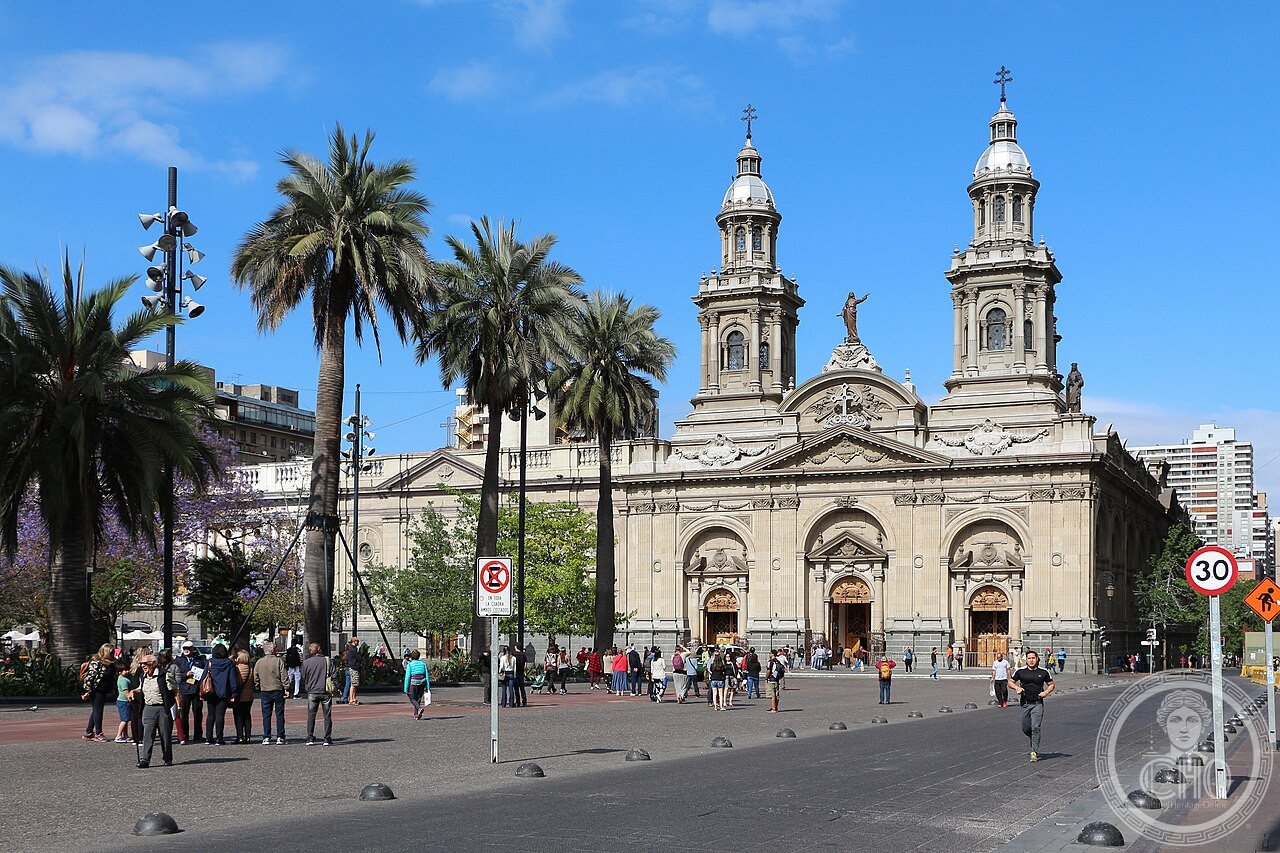
Sulla Plaza de Armas di Santiago, in Cile, la cattedrale attuale è la quinta chiesa costruita su questo sito da quando il conquistador Pedro de Valdivia assegnò il lato nord-ovest della piazza principale a un edificio religioso, il 12 febbraio 1541, giorno stesso della fondazione della città. Le chiese precedenti furono danneggiate dai terremoti del 1647 e del 1657, e la vecchia cattedrale andò completamente distrutta da un incendio il 22 dicembre 1769. Il corpo principale dell’edificio attuale fu costruito tra il 1748 e il 1800, con l’architetto italiano Joaquín Toesca che assunse la direzione dei lavori dal 1779, definendone lo stile neoclassico; le due torri campanarie, però, furono aggiunte solo tra il 1898 e il 1906, sotto la direzione di un altro architetto italiano, Ignacio Cremonesi, che dipinse anche gli affreschi del soffitto nel 1906. L’esterno è prevalentemente neoclassico, mentre l’interno, a tre navate separate da colonne e archi a tutto sesto, unisce elementi neoclassici a decorazioni più barocche, tra cui colonne dorate. L’altare maggiore è in marmo con lapislazzuli; alcune fonti citano inoltre pezzi liturgici in argento, tra cui un tabernacolo e un leggio, attribuiti ad argentieri gesuiti e oggi esposti nel Museo di Arte Sacra adiacente, sebbene le fonti non siano del tutto concordi su questo dettaglio rispetto a un tabernacolo marmoreo del 1912 realizzato a Monaco di Baviera. Otto cappelle laterali costeggiano le navate, dedicate tra gli altri a san Giuseppe, all’apostolo Giacomo (patrono della cattedrale), a san Michele e a Nostra Signora dei Dolori. Sede dell’Arcidiocesi di Santiago, la cattedrale è oggi monumento nazionale del Cile.
About Santiago Metropolitan Cathedral
On the Plaza de Armas in Santiago, Chile, the present cathedral is the fifth church built on this site since the conquistador Pedro de Valdivia assigned the northwest side of the main square to a religious building on 12 February 1541, the very day of the city’s founding. Earlier churches were damaged by the earthquakes of 1647 and 1657, and the old cathedral was entirely destroyed by fire on 22 December 1769. The main body of the current building was constructed between 1748 and 1800, with the Italian architect Joaquín Toesca taking charge of the works from 1779 and establishing its Neoclassical design; the twin bell towers, however, were not added until 1898 to 1906, under the direction of another Italian architect, Ignacio Cremonesi, who also painted the ceiling frescoes in 1906. The exterior is predominantly Neoclassical, while the interior, with its three naves divided by columns and semicircular arches, blends Neoclassical form with more Baroque decorative elements, including gilded columns. The main altar is crafted from marble with lapis lazuli inlay; some sources also describe silver liturgical pieces, including a tabernacle and lectern attributed to Jesuit silversmiths and now displayed in the adjoining Museum of Sacred Art, though sources are not fully consistent on this detail against a separate marble tabernacle dated 1912 and made in Munich. Eight side chapels line the naves, dedicated among others to Saint Joseph, the Apostle Santiago (the cathedral’s patron), Saint Michael and Our Lady of Sorrows. Seat of the Archdiocese of Santiago, the cathedral today holds the status of a Chilean national monument.
Key facts
- 1541: the site assigned to a church on the day Santiago was founded
- Fifth church on the site, following earthquake and fire damage to its predecessors
- 1748-1800: construction of the main body, directed from 1779 by Joaquín Toesca
- 1898-1906: the twin bell towers added under Ignacio Cremonesi
- Eight side chapels dedicated to various saints, including patron Apostle Santiago
- National monument, seat of the Archdiocese of Santiago
History
Santiago Metropolitan Cathedral’s status as the fifth church raised on this site since the city’s 1541 founding reflects the recurring destruction wrought by Chile’s seismic activity and, on one occasion, fire, across more than two centuries of colonial-era rebuilding. The extended, century-and-a-half construction timeline of the present building, spanning multiple architects from Toesca’s original Neoclassical design to Cremonesi’s later bell towers and frescoes, illustrates the sustained institutional commitment required to complete a major cathedral in a city repeatedly disrupted by earthquakes.
What you see
The cathedral’s Neoclassical facade, designed by Joaquín Toesca, fronts the Plaza de Armas with twin bell towers completed only in 1906, framing a central dome above the three-naved interior. Inside, gilded columns, a marble and lapis lazuli main altar, and eight side chapels dedicated to various saints combine Neoclassical structure with richer Baroque decorative touches accumulated across the building’s long construction history.
Practical information
- Opening hours: generally open daily with seasonal variation; free admission; check current hours before visiting
- Address: Plaza de Armas, Santiago, Chile
Getting there
Santiago Metropolitan Cathedral stands on the northwest side of the Plaza de Armas in central Santiago, easily reached via Plaza de Armas metro station. GPS: 33.4377° S, 70.6518° W.
Nearby
- Archbishop’s Palace — adjoining the cathedral, part of the same protected ensemble
- Palacio de la Real Audiencia — historic colonial-era building, on the same square
- Plaza de Armas — Santiago’s central square, the historic heart of the city
Sources
- Wikipedia — “Santiago Metropolitan Cathedral” (en.wikipedia.org)
- Wikipedia (Spanish) — “Catedral Metropolitana de Santiago” (es.wikipedia.org)
- Consejo de Monumentos Nacionales de Chile — official heritage listing (monumentos.gob.cl)
Find it on the map
See this place and what’s around it →📷 Become a Cultural Heritage Online photographer
Share your photos of places: they stay published under your name as the author. The more they're seen, the more you get noticed — and soon a contest will reward the most appreciated photos.
Log in or sign up free to add a photo