
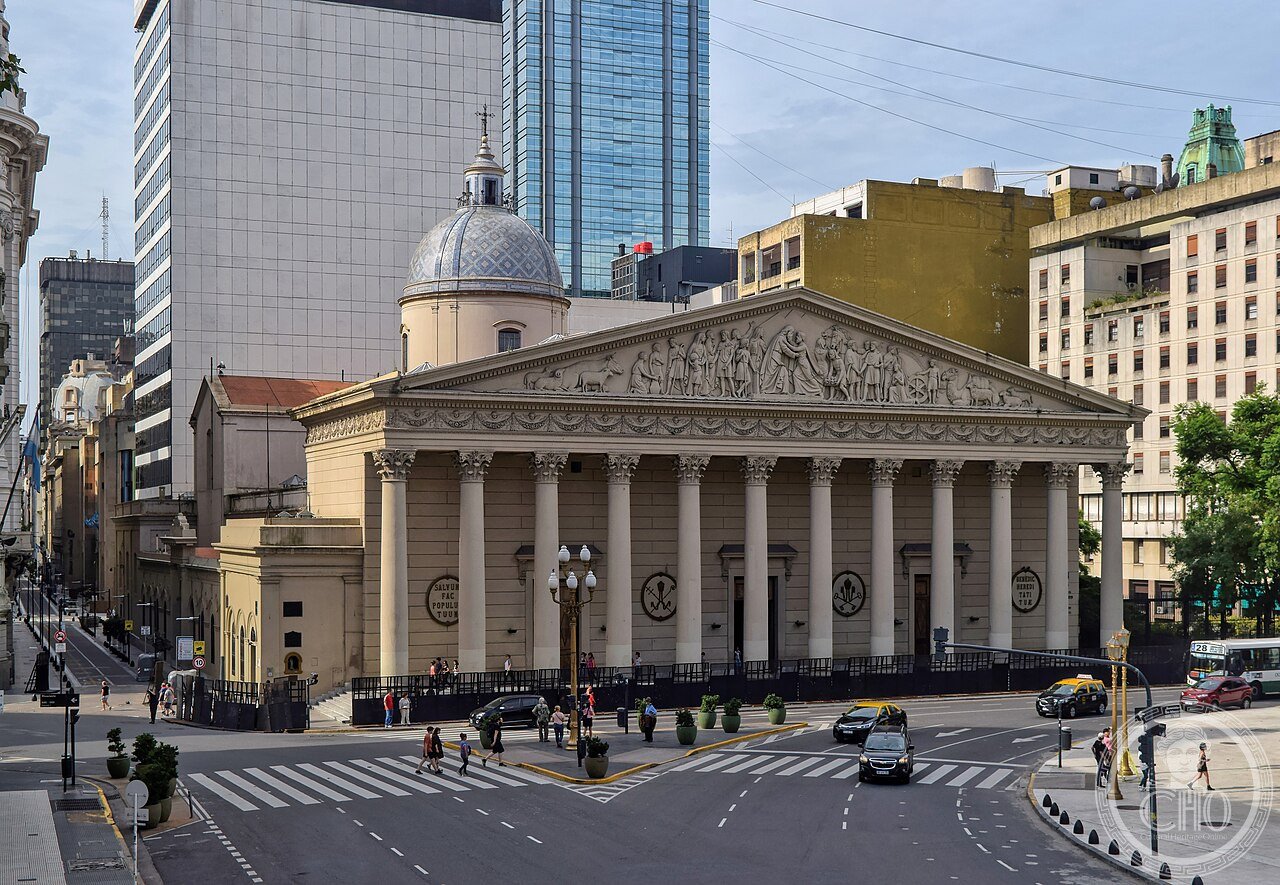
On the Plaza de Mayo, in Buenos Aires, several churches stood on the site of the present cathedral from the late sixteenth century; the present building began to be raised in the mid-eighteenth century (the work dates from around 1754) and was consecrated as a cathedral in the years that followed. Its most distinctive feature is the Neoclassical facade, with no bell towers or dome visible from the front, with a portico of twelve columns and a triangular pediment that give it the look of a Greek or Roman temple rather than a typical cathedral: the design, begun by the Spanish architect Tomás Toribio, was completed by the French architects Prosper Catelin and Pierre Benoit from 1826, drawing on the Palais Bourbon in Paris, with work continuing until 1860–1863 on the decorative reliefs of the pediment. According to an interpretation that is widely repeated but not confirmed by primary architectural sources, the twelve columns are said to symbolise the twelve apostles. Inside the cathedral is the mausoleum of General José de San Martín, liberator of Argentina, Chile and Peru, who died in France in 1850 and whose remains were brought here on 29 May 1880: the monument has three female figures representing the three liberated nations, and is guarded day and night by the Granaderos, the cavalry regiment San Martín himself founded. From February 1998 to March 2013, when he was elected Pope under the name of Francis, Jorge Mario Bergoglio led the archdiocese of Buenos Aires from this very cathedral, where a museum devoted to him now stands. The cathedral, facing the Casa Rosada, remains a landmark as much political as religious in Argentine history.
About the Metropolitan Cathedral of Buenos Aires
On the Plaza de Mayo in Buenos Aires, several earlier churches occupied the site of the present cathedral from as early as the late 16th century; construction of the current building began around the mid-18th century, roughly 1754, and it was consecrated as a cathedral in the years that followed. Its most distinctive feature is a Neoclassical facade, lacking bell towers or any dome visible from the front, presenting a portico of twelve columns beneath a triangular pediment that gives the building the appearance of a Greek or Roman temple rather than a conventional cathedral; the design, begun by the Spanish architect Tomás Toribio, was completed by French architects Prosper Catelin and Pierre Benoit from 1826 onward, drawing inspiration from the Palais Bourbon in Paris, with work on the pediment’s decorative reliefs continuing until 1860-1863. According to a widely repeated but not authoritatively confirmed interpretation, the twelve columns symbolise the twelve apostles. Inside the cathedral stands the mausoleum of General José de San Martín, liberator of Argentina, Chile and Peru, who died in France in 1850 and whose remains were transferred here on 29 May 1880; the monument features three female figures representing the three liberated nations, and is guarded day and night by the Granaderos, the cavalry regiment San Martín himself founded. From February 1998 until March 2013, when he was elected pope under the name Francis, Jorge Mario Bergoglio led the Archdiocese of Buenos Aires from this cathedral, which today houses a museum dedicated to him. Facing the Casa Rosada, the cathedral remains as much a political as a religious landmark in Argentine history.
Key facts
- c. 1754: construction of the current cathedral begins
- Neoclassical facade, twelve columns, no visible bell towers or dome, from 1826
- 29 May 1880: the remains of José de San Martín transferred to the cathedral
- Guarded by the Granaderos, the cavalry regiment San Martín founded
- 1998-2013: Jorge Mario Bergoglio serves as Archbishop of Buenos Aires, based here, before becoming Pope Francis
- Located on the Plaza de Mayo, facing the Casa Rosada presidential palace
History
The Metropolitan Cathedral’s unconventional Neoclassical facade, deliberately evoking a Greek or Roman temple rather than a typical Latin American colonial church, sets it apart architecturally among the continent’s major cathedrals, its French-designed portico reflecting the cosmopolitan cultural currents shaping post-independence Buenos Aires. The cathedral’s role as the resting place of José de San Martín and, over a century later, as the seat from which Jorge Mario Bergoglio rose to the papacy, has made it a focal point of Argentine national memory that extends well beyond its religious function.
What you see
The cathedral’s twelve-column Neoclassical portico, completed under Catelin and Benoit from 1826, dominates the facade facing the Plaza de Mayo, its temple-like profile unusual among South American cathedrals. Inside, the elaborate mausoleum of José de San Martín, flanked by an eternal honour guard of Granaderos, stands alongside a museum dedicated to Pope Francis’s years as archbishop of the city.
Practical information
- Opening hours: generally open daily with seasonal variation; free admission; check current hours before visiting
- Address: Plaza de Mayo, San Martín 27, Buenos Aires, Argentina
Getting there
The Metropolitan Cathedral stands on the Plaza de Mayo in central Buenos Aires, easily reached via Catedral subway station. GPS: 34.6074° S, 58.3733° W.
Nearby
- Casa Rosada — the Argentine presidential palace, directly across the Plaza de Mayo
- Cabildo — the historic colonial-era town hall, nearby
- Plaza de Mayo — Buenos Aires’s central square, site of major events in Argentine history
Sources
- Wikipedia — “Buenos Aires Metropolitan Cathedral” (en.wikipedia.org)
- City of Buenos Aires official tourism site — “The Metropolitan Cathedral” (turismo.buenosaires.gob.ar)
- Atlas Obscura — “Mausoleum of José de San Martín in Buenos Aires” (atlasobscura.com)
Find it on the map
See this place and what’s around it →📷 Become a Cultural Heritage Online photographer
Share your photos of places: they stay published under your name as the author. The more they're seen, the more you get noticed — and soon a contest will reward the most appreciated photos.
Log in or sign up free to add a photo