

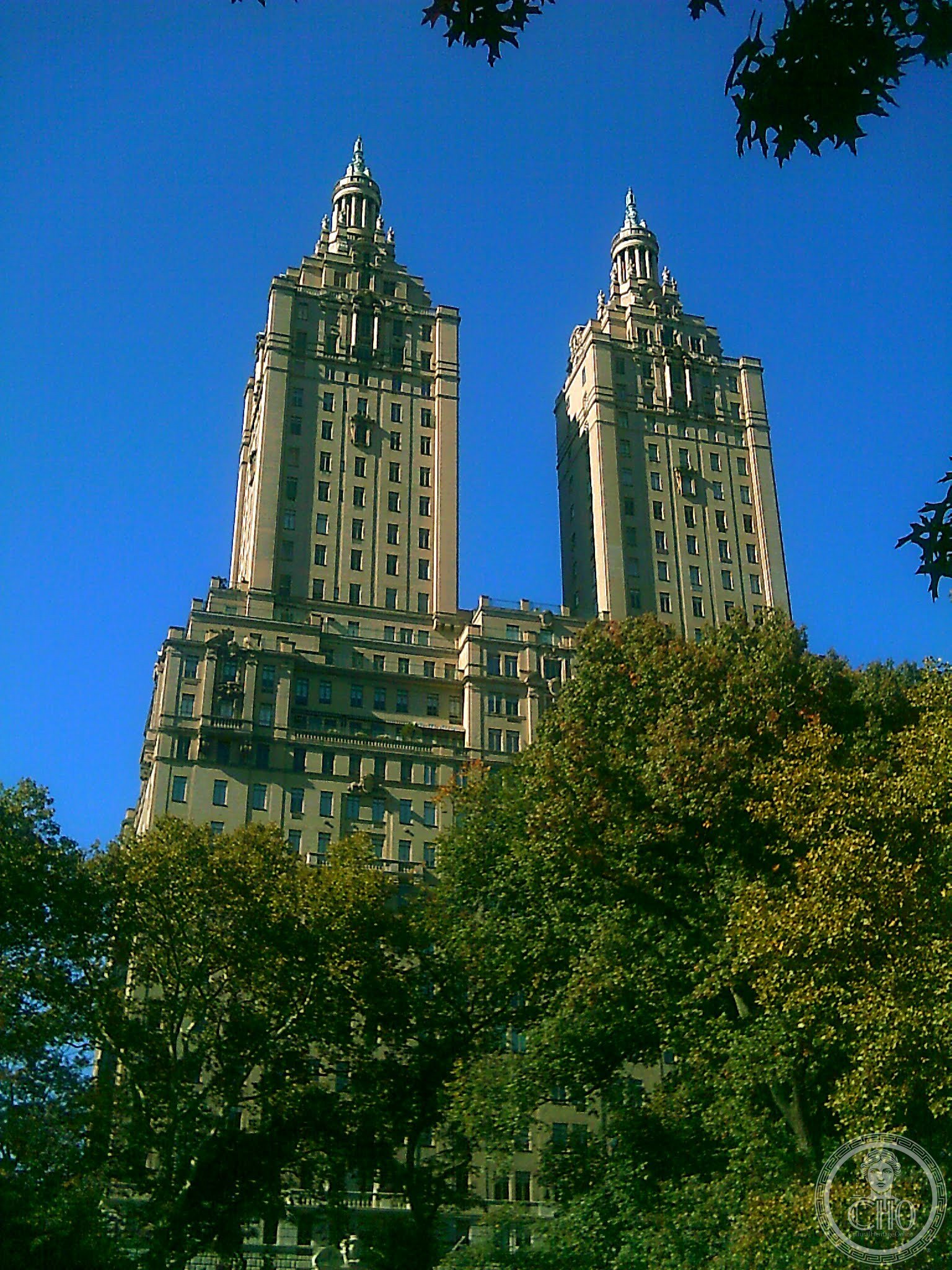
The San Remo’s two towers, each crowned by a circular colonnaded temple capping a tall mechanical drum, give Central Park West its most recognisable skyline feature — Emery Roth’s masterwork of the twin-tower form, completed in 1930 at 145 Central Park West.
At a glance
The San Remo stands at 145 Central Park West between 74th and 75th Streets, its two Art Deco towers rising to 27 stories from a wide base that occupies an entire city block. Designed by Emery Roth and completed in 1930, it was one of the first residential buildings to adopt the twin-tower format that would become the signature of Central Park West’s prewar skyline — a design choice driven as much by zoning law requirements for setbacks as by aesthetic ambition. The towers’ crowns, each consisting of a circular colonnade topped by a dome, are Roth’s most recognised architectural invention: a Baroque-derived form integrated into an otherwise Art Deco building, creating a complex visual identity that reads differently from the street, from the park, and from a distance. The building has been a New York City Landmark since 1987.
Key facts
- Address: 145 Central Park West, New York, NY 10023
- Architect: Emery Roth (1871–1948)
- Completed: 1930
- Height: Approximately 27 stories with twin towers
- Style: Art Deco with Baroque-derived crown detail
- Status: New York City Landmark (designated 1987)
- Use: Residential cooperative apartments
History
Emery Roth had established himself as the leading designer of Upper West Side apartment buildings throughout the 1920s, and the San Remo represented his most resolved statement on the form. The twin-tower configuration had been used in earlier buildings but Roth elevated it into a compositional principle: the two towers permitted both the vertical massing demanded by the zoning envelope and the setbacks required by the 1916 zoning law, while creating the skyline presence that justified the premium rental rates a Central Park West address commanded.
The building was financed by one of New York’s major real estate investors of the period. The San Remo opened in 1930 to a market that had already begun its Depression-era contraction but retained its desirability because of its quality and location. It converted from rental to cooperative in the postwar decades and has remained among the most prestigious residential addresses in New York ever since, with a board approval process that has been among the most selective in the city.
What you see
Seen from Central Park, the San Remo presents its clearest reading: a wide limestone base from which two shafts of identical width rise at the building’s north and south corners, separated by a lower middle section whose roof terrace is visible from the upper park paths. The towers step back at regular intervals in the Art Deco setback manner and culminate in the circular crowns — each a colonnade of Ionic columns encircling a cylindrical drum, topped by a shallow dome. At night, the crowns were originally illuminated and served as landmarks for navigation on the Hudson River.
At street level, the Central Park West entrance portal is framed in ornate limestone carving; the building’s lobby continues the quality of the exterior ornament. The mechanical floors between the office-floor base and the residential upper floors allowed Roth to hide the water towers and other roof-top equipment inside the circular crown structures, maintaining the visual fiction of inhabited temple crowns — each in fact concealing a mechanical room.
Practical information
- Access: Private residential cooperative; exterior and entrance area viewable from the street and from Central Park.
- Best view: From the Great Lawn or Turtle Pond area of Central Park (mid-70s transverse path), looking west — the full width of the building and both towers read clearly from this distance.
- Time needed: 15–20 minutes for exterior viewing; combine with the Museum of Natural History (one block west) or the Dakota apartment building (two blocks south at 72nd Street) for a Central Park West architectural walk.
Getting there
The San Remo faces Central Park at 74th and 75th Streets on the Upper West Side. The nearest subway station is 72nd Street on the 1/2/3 trains (Broadway and 72nd Street), approximately three blocks south and west. The B/C train station at 72nd Street and Central Park West is two blocks south of the building, the closest to the front entrance. The Dakota apartment building (1884, famous for its connection to John Lennon) is two blocks south at 72nd Street.
Nearby
- The Dakota (1884) — The earliest and most famous of Central Park West’s landmark apartment buildings, two blocks south at 72nd Street and a constant point of historical comparison for the San Remo’s Art Deco idiom.
- American Museum of Natural History — The museum’s main entrance on Central Park West is three blocks south, the Rose Center for Earth and Space visible from the street.
- Eldorado Apartments (1931) — Emery Roth’s other twin-tower masterwork, sixteen blocks north at 90th Street, with taller and more pointed tower finials.
- New-York Historical Society — Museum and library three blocks north at 77th Street, with collections related to New York’s architectural and urban history.
Sources
- New York City Landmarks Preservation Commission, The San Remo Designation Report (1987).
- Steven Ruttenbaum, Mansions in the Clouds: The Skyscraper Palazzi of Emery Roth, Balsam Press, 1986.
- Robert A.M. Stern, Gregory Gilmartin, Thomas Mellins, New York 1930: Architecture and Urbanism Between the Two World Wars, Rizzoli, 1987.
- Wikipedia contributors, “San Remo (New York City),” Wikipedia, The Free Encyclopedia.
Find it on the map
See this place and what’s around it →📷 Become a Cultural Heritage Online photographer
Share your photos of places: they stay published under your name as the author. The more they're seen, the more you get noticed — and soon a contest will reward the most appreciated photos.
Log in or sign up free to add a photoIs this page about you?
This page is read by travellers and heritage enthusiasts who find it on Google. Tell us how you are connected to this place and we will take it from there.