
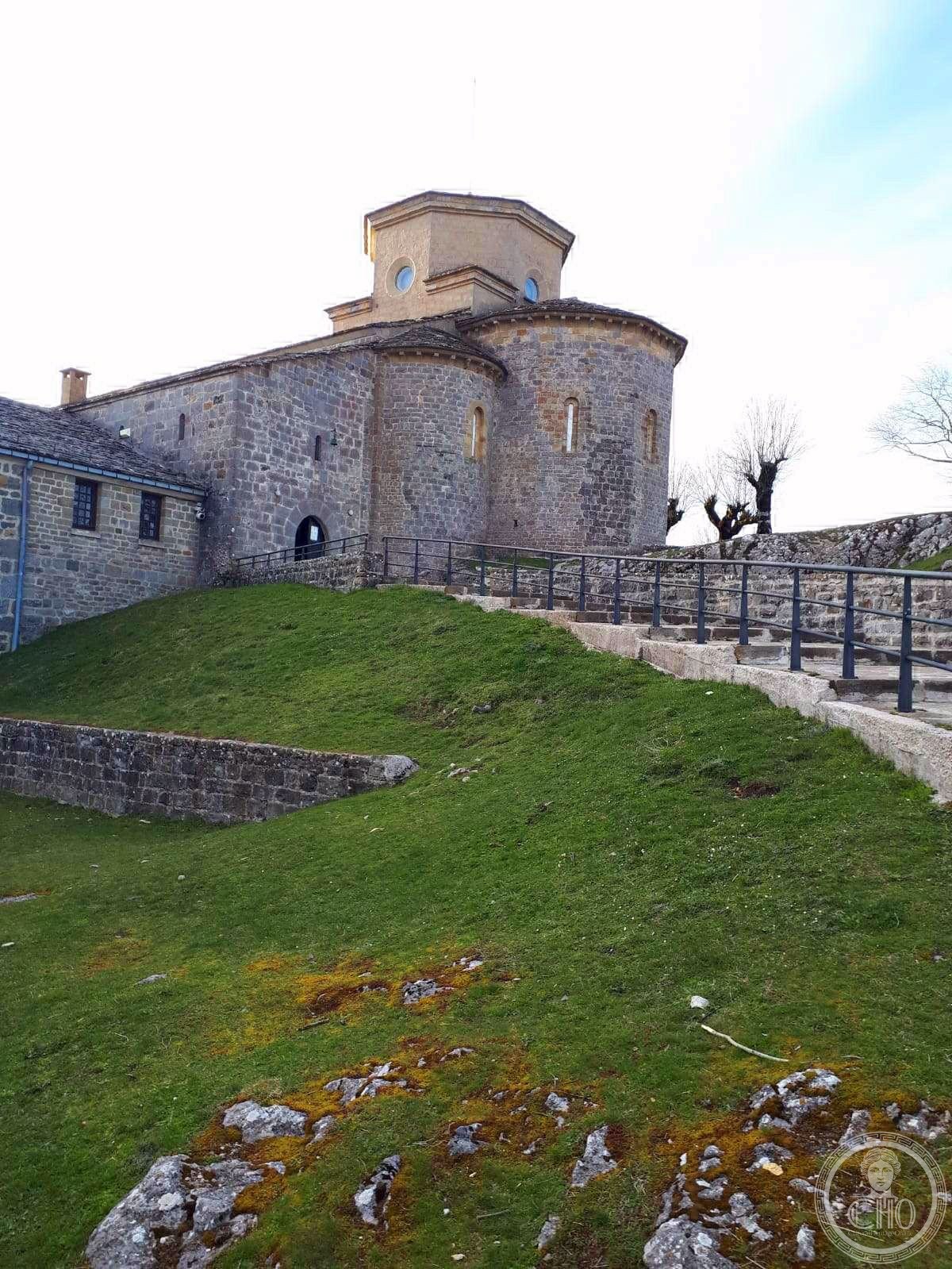
At 1,200 metres, on the karst plateau of the Aralar massif where golden eagles fly over mountain pastures and prehistoric dolmens, the Sanctuary of San Miguel de Aralar is the oldest and most venerated holy place of the Basque and Navarrese country. It is not one of the great monuments of Spanish Romanesque art, but it is something rare: a rock sanctuary cut into the limestone and later turned into a three-aisled church in the twelfth century, which holds inside one of the most precious treasures of medieval Spanish goldsmithing — an altar in cloisonné enamel of Franco-Visigothic origin. Every September thousands of Basque and Navarrese pilgrims walk up to the sanctuary. The site is a component of the UNESCO inscription “Routes of Santiago de Compostela in Spain” (1993).
At a glance
The Sanctuary of San Miguel de Aralar is a Romanesque church and pilgrimage site on the Aralar mountain range (sierra) in Navarre (municipality of Uharte-Arakil). It stands at approximately 1,200 m above sea level on a limestone plateau (kar) and commands panoramic views over the Ultzama and Larraun valleys. The sanctuary is a component of the UNESCO World Heritage inscription “Routes of Santiago de Compostela in Spain” (1993, ref. 669). It contains the celebrated Aralar Antependium — a 12th-century enamel altar frontal in Limoges/Byzantine style — one of the finest examples of medieval Romanesque metalwork in the Iberian Peninsula.
Key facts
- UNESCO: component of “Routes of Santiago de Compostela in Spain” (World Heritage 1993, ref. 669)
- Aralar Antependium: 12th-century enamel altar frontal with 27 medallions; probably Limoges work with Byzantine influence; one of the great treasures of Navarrese art
- Architecture: three-nave Romanesque church (12th century) built over a pre-Romanesque cave chapel (8th–9th century) carved into the limestone
- Altitude: 1,200 m; on the Aralar limestone massif; accessible by paved road or on foot via traditional pilgrimage routes
- Legend: the sanctuary is associated with the legend of Teodosio de Goñi — a knight who killed his parents accidentally and was freed from a dragon by archangel Michael
- Dolmens: the Aralar massif contains numerous Neolithic dolmens and menhirs; the landscape was sacred long before Christianity
History
The Aralar massif was a sacred landscape for Neolithic and Bronze Age peoples, who left dozens of dolmens (megalithic burial chambers) and menhirs scattered across the plateau. The pre-Christian Basque deity Maju (a serpent god of storms) was traditionally associated with the caves of Aralar. The earliest Christian sanctuary on the site is recorded in documents from the 9th century; the current Romanesque church was built in the 12th century by the Kingdom of Navarre, incorporating an older cave sanctuary into its structure.
The Aralar Antependium — the gilded and enamelled altar frontal that is the sanctuary’s most celebrated treasure — was probably commissioned in the late 12th century, possibly in Limoges (France) or by a Limoges-trained workshop. It depicts the Archangel Michael in the central medallion surrounded by scenes from the life of Christ. It remained at the sanctuary until 1942, when it was transferred to the Museum of Navarre in Pamplona for conservation (a replica is on display in the church).
What you see
The sanctuary consists of three parallel Romanesque naves ending in semi-circular apses, built in warm golden limestone. The entrance is through a Romanesque portal with decorated capitals. The interior is austere — whitewashed walls, simple column capitals, small windows — with the altar area at the heart of the cave rock. The replica of the Antependium (the original is in Pamplona) dominates the main altar.
Outside: the open plateau of Aralar, with its grazing flocks of sheep and cows, scattered dolmens, and panoramic views of the Pyrenees to the north and the Navarrese pre-Pyrenees to the east. The road to the sanctuary climbs through beech forest and emerges suddenly onto the open limestone karst.
Practical information
- Access: 50 km from Pamplona (1 hr); via Lecumberri; paved road to the sanctuary (open year-round; snow possible December–March)
- Mass: daily in summer; Sundays year-round; main pilgrimage September 29 (feast of St. Michael)
- Dolmen trail: a marked walking route across the Aralar plateau connects the main dolmen sites (2–3 hrs)
- Combined visit: pair with the medieval town of Estella (Lizarra, on the Camino Francés, 60 km south-west) and the Monastery of Irache
Getting there
From Pamplona: drive north on the NA-150 to Lecumberri (40 km), then west on the NA-7510 up to the sanctuary (10 km). From San Sebastián: via Tolosa and Beasain (60 km). GPS: 42.95° N, 1.97° W.
Nearby
- Pamplona — the Navarrese capital; the San Fermín festival; old city walls; Cathedral of Santa María la Real (Romanesque cloister)
- Estella-Lizarra — the medieval “Navarrese Toledo” on the Camino Francés; 60 km south-west
- Aizkorri-Aratz — the adjacent mountain range eastward; highest point of Navarre; Aketegi mountain
Sources
- UNESCO World Heritage Centre — “Routes of Santiago de Compostela in Spain” (ref. 669); component: Santuario de San Miguel de Aralar
- Gobierno de Navarra — Patrimonio Cultural de Navarra: Santuario de San Miguel de Aralar
- Museo de Navarra — El Frontal de San Miguel de Aralar
Find it on the map
See this place and what’s around it →📷 Become a Cultural Heritage Online photographer
Share your photos of places: they stay published under your name as the author. The more they're seen, the more you get noticed — and soon a contest will reward the most appreciated photos.
Log in or sign up free to add a photo