
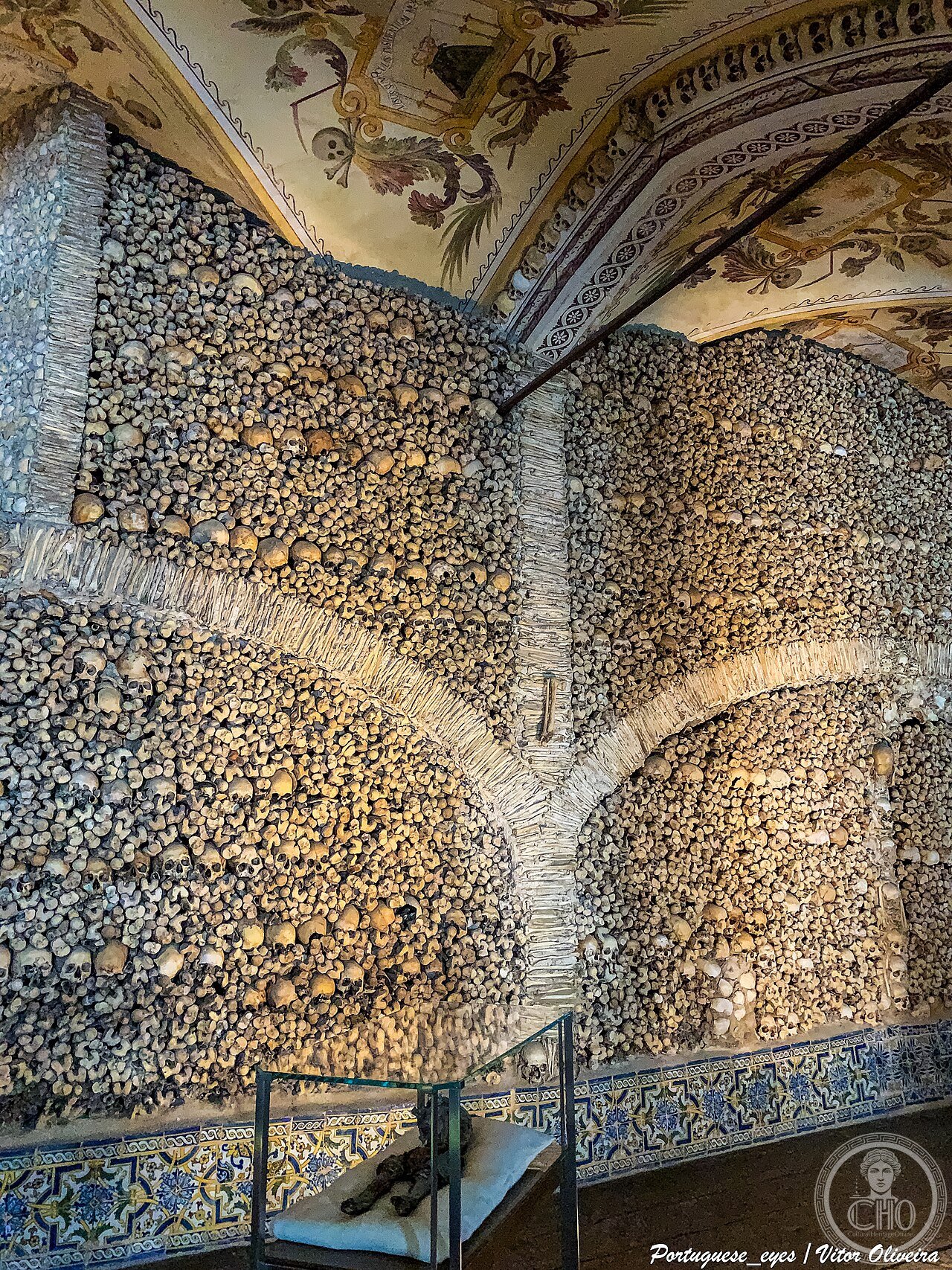
At Évora, in Portugal, the Capela dos Ossos, the «Chapel of Bones», adjoins the far older Royal Church of Saint Francis. That church was built mostly between 1480 and 1510 by the master builders Martim Lourenço and Pero de Trilho, in late Gothic style with Manueline elements, the portal bearing the pelican of João II and the armillary sphere of Manuel I, in place of an earlier Romanesque church of 1226. The chapel itself was built by Franciscan friars between the end of the sixteenth century and the beginning of the seventeenth, on the dating most commonly cited. It arose, according to tradition handed down rather than to precise archival documents, as a space for meditation on the shortness of earthly life, reusing bones exhumed from the many monastic and parish cemeteries of the city, overcrowded at the time. Its walls and columns are lined with a number of skeletons and skulls estimated at about 5,000, a figure repeated almost everywhere but to be taken as an estimate and not an archival count. Two mummified bodies are also on show inside, kept in a glass case since 2019. Popular legend identifies them as an unfaithful father and son, cursed by a betrayed wife and mother, but a modern forensic examination is said to have established that both mummies are female, contradicting the traditional story: their real identity and origin remain undocumented. Above the entrance is the famous inscription «Nós ossos que aqui estamos, pelos vossos esperamos», «We bones that lie here await yours», while over the door there is also a Latin phrase from Ecclesiastes, «Melior est dies mortis die nativitatis», «Better is the day of death than the day of birth». A longer poem inside is instead attributed to a nineteenth-century parish priest, Father António da Ascenção Teles, active between 1845 and 1848. No source documents with certainty the name of the friar or friars who commissioned the building, generally attributed in generic terms to the Franciscans of the adjoining convent. The chapel remains today part of the active church of Saint Francis, among the most visited tourist destinations of Évora, while keeping a devotional as well as a museum character.
About the Chapel of Bones
In Évora, Portugal, the Chapel of Bones (Capela dos Ossos) adjoins the much older Royal Church of St. Francis, built mostly between 1480 and 1510 by master builders Martim Lourenço and Pero de Trilho in late Gothic style with Manueline elements — its portal bears the pelican of João II and the armillary sphere of Manuel I — replacing an earlier Romanesque church from 1226. The chapel itself, built by Franciscan friars between the late 16th and early 17th centuries according to the most commonly cited dating, arose, according to tradition more than precise archival documentation, as a meditation space on the transience of earthly life, reusing bones exhumed from the city’s numerous, then-overcrowded monastic and parish cemeteries. Its walls and columns are lined with an estimated 5,000 skeletons and skulls, a figure repeated almost everywhere but best treated as an estimate, not an archival count. Also displayed inside are two mummified bodies, now kept in a glass case since 2019; popular legend identifies them as an unfaithful father and son, cursed by a betrayed wife and mother, but modern forensic examination reportedly found both mummies to be female, contradicting the traditional story: their actual identity and origin remain undocumented. Above the entrance appears the famous inscription “Nós ossos que aqui estamos, pelos vossos esperamos” (“We bones that are here await yours”), while a Latin phrase from Ecclesiastes also appears over the door, “Melior est dies mortis die nativitatis” (“Better is the day of death than the day of birth”); a longer interior poem is instead attributed to a 19th-century parish priest, Father António da Ascenção Teles, active 1845-48. No source reliably documents the name of the friar or friars who commissioned its construction, generally attributed only generically to the Franciscans of the adjoining monastery. The chapel remains today part of the active Church of St. Francis, among Évora’s most visited tourist sites, while retaining a devotional as well as museum-like character.
Key facts
- Late 1500s-early 1600s: the chapel built by Franciscan friars, most commonly cited dating.
- An estimated 5,000 skeletons line the walls and columns, a widely repeated but unverified figure.
- Two mummified bodies, their identity undocumented despite popular legend.
- “Nós ossos que aqui estamos, pelos vossos esperamos” — the famous entrance inscription.
- Attached to the Royal Church of St. Francis, built mainly 1480-1510.
- Still an active devotional space within a working church, alongside its role as a major tourist site.
History
The chapel’s origin story — bones relocated from overcrowded cemeteries repurposed into a deliberate memento mori — reflects a genuine and recurring European tradition of ossuary architecture, even where the precise founding details of this particular example are recorded more through tradition than archival documentation. The forensic contradiction of its two mummies’ popular legend, revealing both to be female against a story built around a father and son, is a reminder of how readily folklore attaches itself to unexplained human remains over centuries.
What you see
Every wall and column of the small chapel is faced with human bone and skull, arranged in dense decorative patterns beneath the famous inscription warning visitors of their own mortality. Two mummified bodies, now enclosed in glass, hang near the entrance, their true identities lost despite the specific legend attached to them.
Practical information
- Opening hours: generally open daily with seasonal variation; admission fee applies; check current hours before visiting.
- Address: Praça 1º de Maio, Évora, Portugal.
Getting there
The chapel stands within the Church of St. Francis in central Évora, easily reached on foot within the historic centre. GPS: 38°34′08″N, 7°54′32″W.
Nearby
- Royal Church of St. Francis — the larger church to which the chapel is attached.
- Historic Centre of Évora — the surrounding UNESCO World Heritage old town.
- Sé de Évora — the city’s main cathedral, a short walk away.
Sources
- Wikipedia — “Capela dos Ossos” and “Igreja de São Francisco (Évora)” (en.wikipedia.org).
- Atlas Obscura — “Portugal’s Chapel of Bones”
- Dark-Tourism.com — “Capela dos Ossos, Evora”
Find it on the map
See this place and what’s around it →📷 Become a Cultural Heritage Online photographer
Share your photos of places: they stay published under your name as the author. The more they're seen, the more you get noticed — and soon a contest will reward the most appreciated photos.
Log in or sign up free to add a photo