

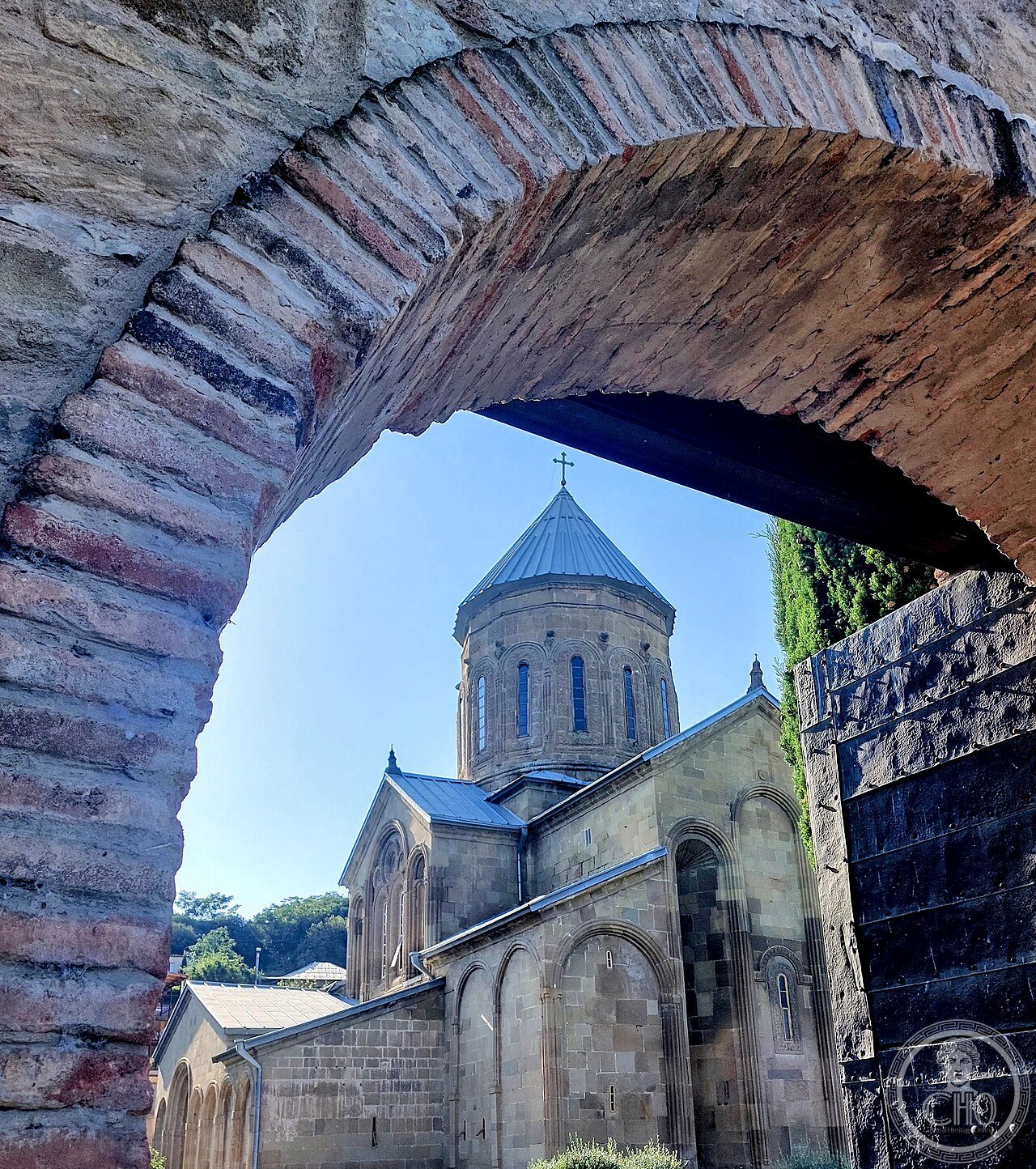
The name Samtavro means “royal domain”. By tradition the monastery stands on the exact spot in the royal gardens where a blackberry bush grew, and where Saint Nino — the enlightener who brought Christianity to ancient Iberia (eastern Georgia) — chose to live, with the help of the king’s gardener, in a humble shelter woven from the brambles themselves: a place called Makvlovani, “the place of blackberries”. It was thanks to Saint Nino that, in the fourth century, King Mirian III and Queen Nana were converted to Christianity, becoming the first Christian rulers in Georgian history; both are buried at Samtavro. Founded in the fourth century, at the dawn of Georgian Christianity, the monastery passed through centuries of destruction and rebuilding before taking its present form in the eleventh century, under King George I.
About Samtavro Monastery
Samtavro Monastery, whose name translates as “royal domain,” has stood in Mtskheta, Georgia’s ancient capital, as a centre of devout faith for nearly 1,700 years. According to tradition, the monastery was built on the exact spot in the royal gardens where a blackberry bush once thrived — the very place where Saint Nino, the enlightener credited with bringing Christianity to ancient Iberia (eastern Georgia), chose to settle, assisted by the king’s own gardener. Retreating to a secluded area near the northern boundary of the city, Nino is said to have lived humbly in a shelter woven directly from the branches of the blackberry bush itself, a site remembered as Makvlovani, “the place of the blackberry.” It was through Saint Nino’s influence that King Mirian III and Queen Nana embraced Christianity in the 4th century, becoming Georgia’s first Christian royal converts and playing a decisive role in the wider Christianisation of the Iberian kingdom; both are buried within Samtavro Monastery, making it one of the most historically significant royal burial sites in the entire history of Georgian Christianity. Founded in the 4th century, at the very earliest stage of Georgia’s Christian history, Samtavro subsequently endured cycles of destruction and restoration across the following centuries before acquiring its present architectural form in the 11th century, under the patronage of King George I. The monastery complex today combines the Samtavro Transfiguration Church with an adjoining Nunnery of St Nino, and forms part of the historic monuments of Mtskheta collectively inscribed on the UNESCO World Heritage List in 1994.
Key facts
- 4th century: monastery founded, at the dawn of Georgian Christianity
- Legend: built on the site of Saint Nino’s blackberry-bush shelter (Makvlovani)
- King Mirian III and Queen Nana: Georgia’s first Christian rulers, converted through Saint Nino, buried here
- 11th century: present form of the monastery built under King George I
- Complex: combines Samtavro Transfiguration Church and the Nunnery of St Nino
- 1994: inscribed as part of the Historic Monuments of Mtskheta UNESCO World Heritage Site
History
As the burial site of King Mirian III and Queen Nana, whose conversion through Saint Nino’s influence marked the formal beginning of Georgia’s identity as a Christian nation in the 4th century, Samtavro occupies a foundational place in Georgian religious and national history comparable to the country’s most significant Christian sites, including nearby Svetitskhoveli Cathedral and Jvari Monastery. The persistent tradition linking the monastery’s origin to Saint Nino’s humble blackberry-bush dwelling situates Samtavro within the broader hagiographic landscape of early Georgian Christianity, in which specific, tangible sites across Mtskheta are each associated with a distinct episode of the faith’s arrival in the kingdom.
The monastery’s reconstruction in the 11th century under King George I reflects the broader architectural and religious flourishing of the unified Kingdom of Georgia during this period, adding a mature medieval Georgian ecclesiastical structure atop the foundational 4th-century site associated with the country’s very earliest royal converts.
What you see
The monastery’s main church, in its present 11th-century form, stands within the wider complex alongside the Nunnery of St Nino, its stone construction and cross-in-square plan reflecting mature medieval Georgian ecclesiastical architecture. The tombs of King Mirian III and Queen Nana remain within the church, while the site’s association with Saint Nino’s original blackberry-bush shelter continues to draw pilgrims to Mtskheta’s cluster of foundational Georgian Christian monuments.
Practical information
- Opening hours: generally open daily with seasonal variation; free admission; check current hours before visiting
- Address: Mirian Mefis Street, Mtskheta 3300, Georgia
Getting there
Samtavro Monastery stands in Mtskheta, Georgia’s ancient religious capital, roughly 20 kilometres northwest of Tbilisi, reachable by marshrutka minibus or car. GPS: 41.8461° N, 44.7183° E.
Nearby
- Svetitskhoveli Cathedral — Georgia’s principal cathedral, a short walk away in Mtskheta
- Jvari Monastery — hilltop monastery overlooking Mtskheta, a short drive away
- Tbilisi — Georgia’s capital, roughly 20 km to the southeast
Sources
- Wikipedia — “Samtavro Monastery” (en.wikipedia.org)
- OrthoChristian — “The Samtavro Monastery of St. Nina” (orthochristian.com)
- Georgia.to — “Samtavro Monastery: An Emblem of Spirituality & Architecture” (georgia.to)
Find it on the map
See this place and what’s around it →📷 Become a Cultural Heritage Online photographer
Share your photos of places: they stay published under your name as the author. The more they're seen, the more you get noticed — and soon a contest will reward the most appreciated photos.
Log in or sign up free to add a photo