

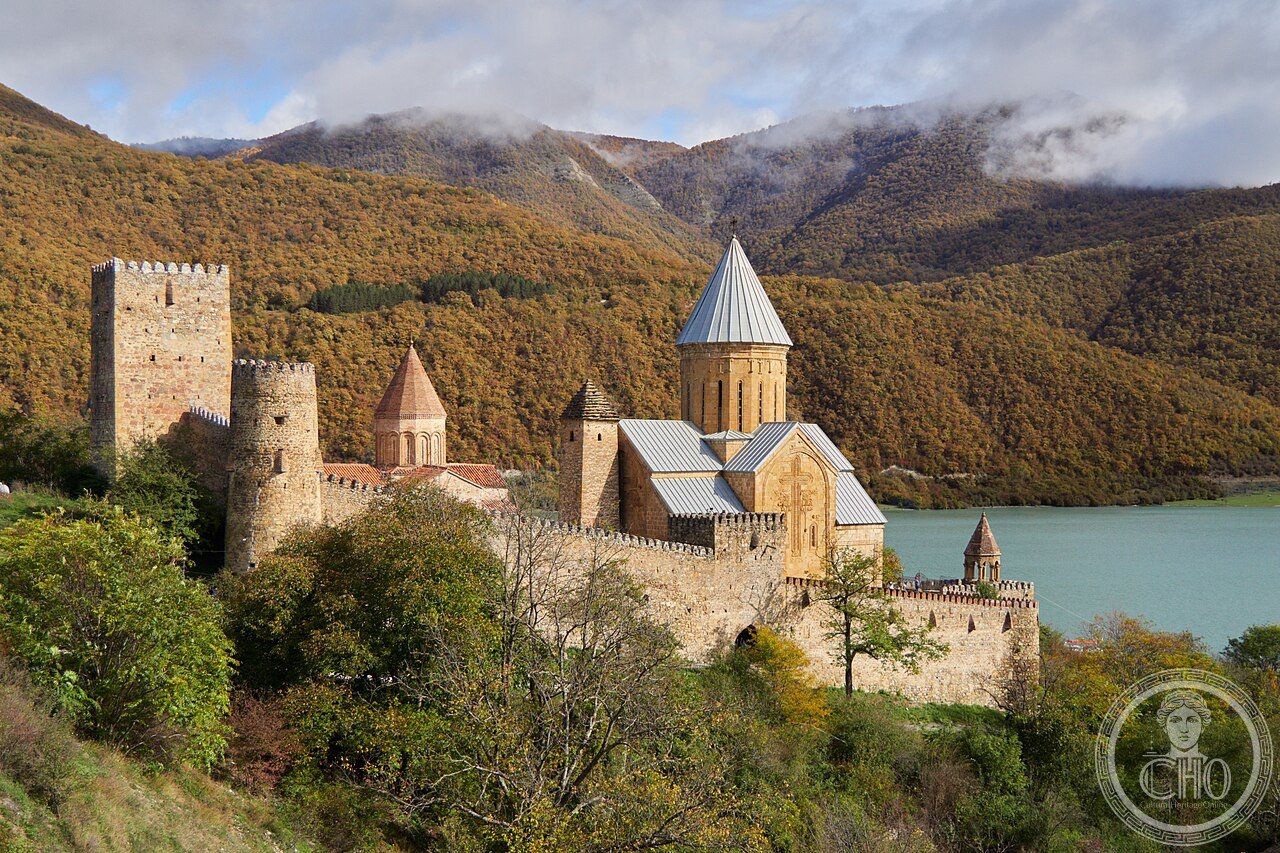
From the 13th century Ananuri was the castle and the seat of the Eristavis, the dukes of Aragvi, a feudal dynasty that ruled this region. The complex standing today was built between the 16th and the 17th centuries, and joins two fortifications. The upper one is dominated by the massive square tower called Sheupovari, «the Unassailable»: it was the last refuge in a siege. In 1739 the forces of a rival duchy, led by Shanshe of Ksani, attacked Ananuri and set it on fire, massacring the Aragvi clan. The siege had dragged on, and force alone was not enough. It ended only when the besiegers cut the underground pipe, leaving the defenders without drinking water. Four years later, however, the local peasants rose against Shanshe’s rule, killed the usurpers and invited King Teimuraz II to govern them directly. The main church of the complex, that of the Assumption (Ghvtismshobeli), is a masterpiece of late medieval Georgian architecture. Its facades are richly carved in stone, with a great cross and a Tree of Life motif entwined with vine shoots.
About Ananuri
Ananuri served from the 13th century as the castle and seat of the Eristavis (Dukes) of Aragvi, a powerful feudal dynasty that ruled this section of the Georgian Military Road region for centuries. The complex standing today, built up over the 16th and 17th centuries, consists of two interconnected fortifications: the older, upper fortress, dominated by a massive square tower known as Sheupovari (“the Unassailable”), served as the community’s final refuge during any siege. The dynasty’s fortunes turned violently in 1739, when Ananuri was attacked by forces from a rival Georgian duchy commanded by Shanshe of Ksani; the fortress was set ablaze and the Aragvi clan massacred. According to local accounts, the siege initially dragged on ineffectively, until Ksani’s forces identified and destroyed the underground pipe supplying the fortress with drinking water, depriving the defenders of any means of holding out further. The aftermath proved short-lived for the victors, however: four years later, in 1743, local peasants rose up against Shanshe’s imposed rule, killing the usurpers and formally inviting King Teimuraz II to assume direct royal rule over the territory, restoring a measure of stability to the region. Within the fortress walls, the complex’s main church, the large Church of the Assumption (Ghvtismshobeli), stands as a masterpiece of late medieval Georgian ecclesiastical architecture, its facades richly decorated with elaborate stone carving, including a prominent cross and an intricate Tree of Life motif entwined with grapevine ornamentation — a recurring symbol in Georgian Christian art reflecting the country’s ancient winemaking traditions.
Key facts
- 13th century onward: seat of the Eristavi Dukes of Aragvi.
- 16th-17th centuries: present fortress complex built.
- Sheupovari Tower, “the Unassailable” — the older upper fortress’s central keep.
- 1739: Ananuri besieged and burned by rival duke Shanshe of Ksani; Aragvi clan massacred.
- Siege tactic: attackers cut the underground water supply to force submission.
- 1743: local peasants revolt, kill the usurpers, invite King Teimuraz II to rule directly.
- Church of the Assumption: richly carved facades, including a Tree of Life motif.
History
Ananuri’s centuries as the fortified seat of the Eristavi dukes of Aragvi situates the complex within the broader pattern of Georgian feudal dynasties controlling strategic points along the Georgian Military Road, the vital mountain route connecting Georgia to the North Caucasus. The 1739 siege and massacre, resolved not through direct assault but through the deliberate destruction of the fortress’s water supply, illustrates the sophisticated siege tactics employed in inter-dynastic Georgian feudal warfare, while the swift 1743 peasant uprising against the victorious Ksani usurpers reveals the fragility of conquest without genuine local legitimacy.
The restoration of direct royal authority under King Teimuraz II following the 1743 revolt marks a significant moment in the consolidation of centralised Georgian royal power over previously autonomous feudal duchies, with Ananuri’s own violent mid-18th-century history serving as a microcosm of this wider political transformation.
What you see
The fortress’s two interconnected castles, crowned by the massive Sheupovari tower, rise above the Aragvi River and the modern Zhinvali Reservoir, their defensive walls and guard towers still clearly legible against the mountain landscape. Within the walls, the Church of the Assumption’s elaborately carved stone facades, featuring crosses and the distinctive grapevine-entwined Tree of Life motif, represent one of the finest surviving examples of decorative stonework in late medieval Georgian religious architecture.
Practical information
- Opening hours: generally open daily with seasonal variation; admission fee applies; check current hours before visiting.
- Address: Ananuri, Dusheti Municipality, Mtskheta-Mtianeti, Georgia.
Getting there
Ananuri stands on the Georgian Military Road beside the Zhinvali Reservoir, roughly 72 kilometres north of Tbilisi, reachable by car or organised tour. GPS: 42.1588° N, 44.7157° E.
Nearby
- Zhinvali Reservoir — the artificial lake bordering the fortress.
- Georgian Military Road — the historic mountain route connecting Georgia to the North Caucasus.
- Mtskheta — Georgia’s ancient religious capital, further south toward Tbilisi.
Sources
- Wikipedia — “Ananuri” (en.wikipedia.org).
- The Georgian Guide — “Ananuri Fortress: The Complete Guide” (thegeorgianguide.com).
- Georgia About — “About Sights – Ananuri Fortress” (georgiaabout.com).
Find it on the map
See this place and what’s around it →📷 Become a Cultural Heritage Online photographer
Share your photos of places: they stay published under your name as the author. The more they're seen, the more you get noticed — and soon a contest will reward the most appreciated photos.
Log in or sign up free to add a photo