
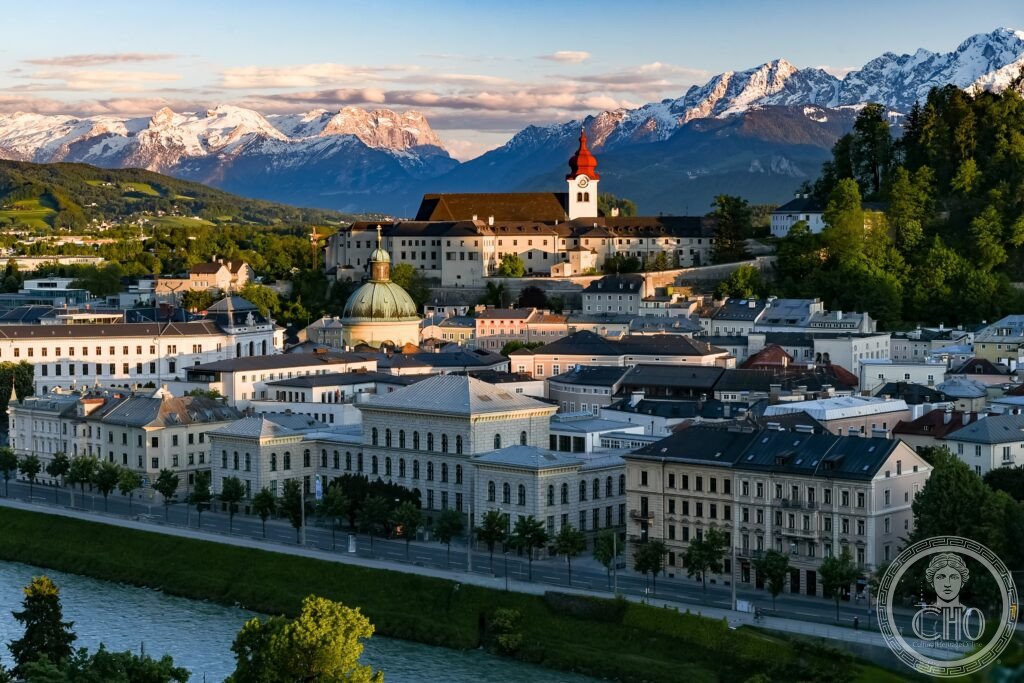
Salzburg
The best-preserved Baroque city north of the Alps and the birthplace of Wolfgang Amadeus Mozart — Salzburg (Salzburg State, Austria; UNESCO WHS 1996) was the capital of the Prince-Archbishopric of Salzburg (an independent ecclesiastical state) for over a thousand years (798-1816 CE) and was shaped by a succession of archbishop-builders who turned it into the most elaborate Baroque ensemble outside Rome and Naples.
At a glance
Salzburg (the most precisely SalzburgAustria single Baroque city north Alps Prince-Archbishopric independent ecclesiastical state 798 1816 CE Archbishop ruler both spiritual temporal power population 155000 Salzburger Festspiele Salzburg Festival 1920 CE Herbert von Karajan Karl Böhm Wilhelm Furtwängler international opera classical music festival premiere venue since 1920 Mozart Wolfgang Amadeus 1756 1791 CE born Getreidegas 9 Salzburg died Vienna 35 years old Geburtshaus birthplace museum Wohnhaus residence museum salt trade Salzburg = Salt Castle Salzach = Salt River Celts Romans Salzburger Salzkammergut salt mines Hallstatt Hallein historic salt income funded Baroque building program archbishop revenue Hohensalzburg Fortress 1077 CE Archbishop Gebhard best preserved medieval castle Central Europe summit 506m views all city Salzach River divides old town Altstadt cliff Mönchsberg west north Sound of Music 1965 film Julie Andrews Robert Wise filming locations Do-Re-Mi Mirabellgarten Mirabell Palace gardens UNESCO heritage: the Prince-Archbishopric of Salzburg (the political structure that built the city): the Prince-Archbishopric of Salzburg (Fürsterzbistum Salzburg) was an unusual state — an ecclesiastical principality where the Archbishop was simultaneously the spiritual head of the church AND the secular ruler (Prince) of the territory; this dual role made the Archbishop one of the most powerful figures in the Holy Roman Empire; the revenue from the Salzburg salt trade (Hallein and Hallstatt salt mines; the salt trade controlled the critical Alpine crossing point) funded one of the most ambitious Baroque building programs in Central Europe; the architects imported from Italy (Giovanni Antonio Dario, Santino Solari, Johann Bernhard Fischer von Erlach) turned Salzburg into an Italian Baroque city transplanted to the northern Alps)) — the most precisely SalzburgAustria single 798 1816 CE Prince-Archbishopric independent ecclesiastical state 155000 Salzburg Festival 1920 CE Mozart 1756 1791 CE born Getreidegasse 9 35 years old died Vienna salt Salzach salt mines Hallstatt Hallein Italian architects Santino Solari Fischer von Erlach Italian Baroque north Alps Archbishop both spiritual temporal power salt revenue funded building program Hohensalzburg Fortress 1077 CE 506m summit Sound of Music 1965 CE filming UNESCO heritage in any UNESCO world heritage site)).
Key facts
- Mozart in Salzburg (1756-1781 CE): the most precisely SalzburgAustria single Wolfgang Amadeus Mozart 1756 1791 CE born January 27 1756 CE Getreidegasse 9 Salzburg father Leopold Mozart court musician Archbishop Colloredo violin teacher 3 years old Leopold realized extraordinary musical talent 4 years old began composing 5 years old performed harpsichord before Elector of Bavaria 6 years old performed before Emperor Francis I Vienna Leopold took children on touring European courts 3 major tours 1763 1766 CE London Paris Versailles toured 1769 1771 CE Italy Venice Rome Naples Milan 17 years old composed Mitridate Re di Ponto opera premiered Milan Teatro Regio Ducal 1770 CE 1771 1777 CE worked Salzburg court musician Archbishop Colloredo position Konzertmeister low pay restricted travel frustrated 1781 CE fired resigned Archbishop service moved Vienna freelance career 1782 1791 CE greatest works Vienna The Abduction from the Seraglio Marriage of Figaro Don Giovanni Symphony 40 41 Jupiter Requiem died December 5 1791 CE Vienna 35 years old pauper funeral no money UNESCO heritage — the most extraordinary musical prodigy in history and Salzburg’s most famous resident: Leopold Mozart (1719-1787 CE) recognized the extraordinary talent of his son (who began playing the harpsichord at 3, composing at 4, and performing before Emperor Francis I at 6) and devoted his career to promoting Wolfgang; the three major European tours (1763-1766 CE) exposed Wolfgang to the courts of London, Paris, Versailles, Amsterdam, and Brussels; Wolfgang met Johann Christian Bach in London (1764 CE); the influence of Italian opera led to the Italian tour (1769-1771 CE) where at 17, he composed Mitridate, Rè di Ponto for Milan; the conflict with Archbishop Colloredo (who regarded Mozart as a mere servant) led to the famous public dismissal (1781 CE) that freed Mozart for Vienna
- GPS: 47.7981° N, 13.0456° E
History
From Celtic salt trade to Roman Iuvavum to Prince-Archbishopric to Napoleonic end (the most precisely SalzburgAustria single 2000 BCE Bronze Age settlement Salzburg area Celtic Hallstatt culture 800 500 BCE Iuvavum Roman 15 BCE Augustus established Roman province Noricum Iuvavum 200 CE Roman town baths forum temples theatre 477 CE Odoacer took Noricum Germanic ruler end Western Roman Empire 696 CE Saint Rupert Bishop Worms arrived founded Benedictine abbey Peterskirche Abbey Saint Peter founded 696 CE Rupert missionary Christianity Bavarian tribes 739 CE Boniface organized Carolingian church Salzburg bishopric founded 798 CE Archbishop dignity Archdiocese 11th 12th century CE Prince-Archbishop created independent ecclesiastical state Hohensalzburg Fortress 1077 CE 1587 1612 CE Wolf Dietrich von Raitenau Archbishop greatest Baroque builder burned old medieval town center built Italian Baroque Residenz Palace Cathedral rebuilt 1620 1653 CE Paris Lodron Archbishop during Thirty Years War kept Salzburg neutral 1731 CE Archbishop Firmian expelled 21000 Protestants Salzburg Protestants had survived 16th century CE underground secret 1756 CE Mozart born 1803 CE Napoleon secularized ecclesiastical state 1816 CE Peace of Paris Salzburg incorporated Austrian Empire 1920 CE Salzburg Festival founded Max Reinhardt Hugo von Hofmannsthal Richard Strauss UNESCO heritage: the expulsion of the Salzburg Protestants (1731-1732 CE): one of the largest forced migrations in 18th-century Europe: despite the Peace of Westphalia (1648 CE) which had established the principle cuius regio eius religio (whoever rules determines the religion of the territory), Protestant communities had survived covertly in the Salzburg archbishopric for nearly two centuries; in 1731 CE, Archbishop Leopold Anton von Firmian issued an expulsion edict (Emigrationspatent) requiring all Protestant subjects to convert to Catholicism or leave within eight days (for property owners) or three days (for workers and servants); approximately 20,000-22,000 Salzburgers were expelled; they walked north across Germany in winter; many died; they were welcomed primarily by Prussia (Frederick William I gave them land in depopulated East Prussia); their descendants in East Prussia survived until the German expulsions of 1945 CE)) — the most precisely SalzburgAustria single 2000 BCE Bronze Age Celtic Hallstatt 696 CE Saint Rupert Peterskirche Abbey 739 CE Boniface 798 CE Archbishop dignity 1077 CE Hohensalzburg Fortress 1587 1612 CE Wolf Dietrich von Raitenau burned medieval built Italian Baroque Residenz Cathedral 1620 1653 CE Paris Lodron Thirty Years War neutral 1731 CE Firmian expelled 21000 Protestants expelled eight days workers three days winter Prussia Frederick William I East Prussia 1756 CE Mozart born 1803 CE Napoleon secularized 1816 CE Austrian Empire 1920 CE Salzburg Festival Reinhardt Hofmannsthal Strauss UNESCO heritage in any UNESCO world heritage site)).
What you see
Cathedral, Hohensalzburg, Residenz, and Mirabell Palace gardens (the most precisely SalzburgAustria single Salzburg Cathedral Dom 1614 1628 CE Archbishop Wolf Dietrich burned previous Romanesque cathedral 1598 CE fire Santino Solari Italian architect first Baroque cathedral north Alps twin towers 79m Baroque façade dome 69m nave 1628 CE consecration Holy Roman Emperor Ferdinand II first performances Jedermann by Hugo von Hofmannsthal on Cathedral steps 1920 CE Salzburg Festival tradition still annual production Hohensalzburg Fortress 1077 CE Archbishop Gebhard Mönchsberg rock 120m above Salzach best preserved medieval castle Central Europe extended 15th 16th century CE Archbishop Leonhard von Keutschach 1495 1519 CE added Golden Hall Goldene Stube apartments lavish interior Golden Hall gilded green tiles Kachelofen stove hand-turned wooden barrel organ 1502 CE still working funicular 1892 CE cable car Mönchsberg Rock Residenz Palace 1596 CE Archbishop Wolf Dietrich northern wing extension early 17th century CE Residenz State Rooms Hall of the Prince Archbishop reception history Residenz Gallery museum Mirabell Palace 1606 CE Wolf Dietrich for mistress Salome Alt together 15 children Schloss Mirabell current name Baroque garden Mirabell Garten 1730 CE Fischer von Erlach flower parterres hedge mazes central fountain Sound of Music Do-Re-Mi filming 1965 CE Getreidegasse pedestrian street Mozart birthplace Geburtshaus no 9 Mozart Museum Pferdeschwemme Horse Trough fountain 1695 CE Fischer von Erlach Kollegienkirche 1696 1707 CE finest Austrian Baroque façade Fischer von Erlach UNESCO heritage: the Salzburg Festival (the world’s greatest classical music and opera festival): the Salzburg Festspiele was founded in 1920 CE by the theatre director Max Reinhardt, the dramatist Hugo von Hofmannsthal, and the composer Richard Strauss; the first production: Jedermann (Everyman), a morality play by Hofmannsthal, performed on the Cathedral steps (still performed every summer); the festival now runs approximately 5-6 weeks (late July to end of August) with approximately 200 performances of opera, orchestral concerts, recitals, and drama; the most prestigious opera productions (performed at the Grosses Festspielhaus and the Felsenreitschule (the rock riding school; a unique outdoor auditorium carved into the Mönchsberg cliff in 1693 CE)); the associated conductors and artists: Herbert von Karajan (1956-1989 CE; the dominant artistic director; he transformed the festival into the world’s most prestigious music event); tickets (€10-€450; the most-sought tickets in the classical music world; many performances sell out months in advance))) — the most precisely SalzburgAustria single Cathedral Dom 1614 1628 CE Santino Solari Italian first Baroque north Alps twin towers 79m dome 69m Jedermann 1920 CE Cathedral steps tradition Hohensalzburg Fortress 1077 CE 120m Mönchsberg best preserved Central Europe Keutschach 1495 1519 CE Golden Hall Goldene Stube Golden Barrel Organ 1502 CE funicular 1892 CE Residenz 1596 CE Wolf Dietrich Mirabell 1606 CE 15 children Salome Alt Mirabell Garden 1730 CE Fischer von Erlach Sound of Music Do-Re-Mi 1965 CE Getreidegasse 9 Mozart Birthplace Kollegienkirche 1696 1707 CE finest Austrian Baroque façade Felsenreitschule 1693 CE cliff auditorium Karajan 1956 1989 CE UNESCO heritage in any UNESCO world heritage site)).
Practical information
- Getting there: fly to Salzburg Airport (SZG; direct connections from London Heathrow, London Gatwick, Amsterdam, Frankfurt, Zurich, Rome, Dublin; 4 km from the historic centre; Bus 10 or taxi to Hauptbahnhof); by train from Vienna (2h30m; ÖBB Railjet; €25-50); by train from Munich (1h30m; Bavarian Railway; €25-40); the Salzburg Card (€33 per 24h; includes all public transport, free entry to 35 museums/monuments including the Hohensalzburg Fortress, Residenz, Mozart museums, and unlimited use of the funicular; strongly recommended for multi-day visits); the Hohensalzburg Fortress (€16 without funicular, €20 with funicular; open 9 AM-7 PM; the Golden Hall, barrel organ, and Puppet Museum inside); the Salzburg Festival (late July-end August; book at salzburgerfestspiele.at; top opera and concert tickets €10-€450); the best time (the Salzburg Festival period (July-August) is most atmospheric but extremely crowded and expensive; December is stunning (the Christmas Market on the Domplatz is one of the finest in Austria; the Christkindlmarkt has been running since 1491 CE)); spring (April-June) is ideal for uncrowded visit at moderate prices)
Getting there
SZG airport (4 km, bus/taxi). From Vienna: ÖBB Railjet 2h30m (€25-50). From Munich: 1h30m (€25-40). Salzburg Card €33/24h (all transport + 35 museums). Best: April-June or December. GPS: 47.7981, 13.0456.
Nearby
- Hallstatt — 70 km southeast (UNESCO WHS 1997; the most photographed village in Austria: the lakeside village (200 permanent residents) on the Hallstätter See; the salt mines (the oldest salt mine in the world, in continuous use since 1500 BCE; the guided tour descends 300m into the mountain by miner’s slide and wooden rail cart); the bone house (the charnel house of the Marktkirche: 1,200 decorated skulls from the 12th century CE onwards — the village was so cramped that graves were reused every 10-15 years, the bones cleaned and the skulls decorated with flowers and painted names); day trip by train + ferry combination is the most scenic approach)
- Berchtesgaden National Park — 30 km south (the most dramatic Alpine landscape accessible from Salzburg; the Königssee (the purest mountain lake in Germany; boat trip 35 min to St. Bartholomä church; the echo test (the boat captain plays a flugelhorn and the cliff echo returns it perfectly)); the Eagle’s Nest (Kehlsteinhaus; the summit building built for Hitler at 1,834m; panoramic views over 5 countries; bus from Obersalzberg; open May-October))
Sources
- Wikipedia, Salzburg; Salzburg Cathedral; Hohensalzburg Fortress; Wolfgang Amadeus Mozart; Salzburg Festspiele, accessed June 2026
- UNESCO, Historic Centre of the City of Salzburg, WHS reference 784, inscribed 1996
Find it on the map
See this place and what’s around it →📷 Diventa un fotografo di Cultural Heritage Online
Condividi le tue foto dei luoghi: restano pubblicate con la tua firma come autore. Più vengono viste, più ti fai conoscere — e presto un concorso premierà le foto più apprezzate.
Accedi o registrati gratis per aggiungere una foto