
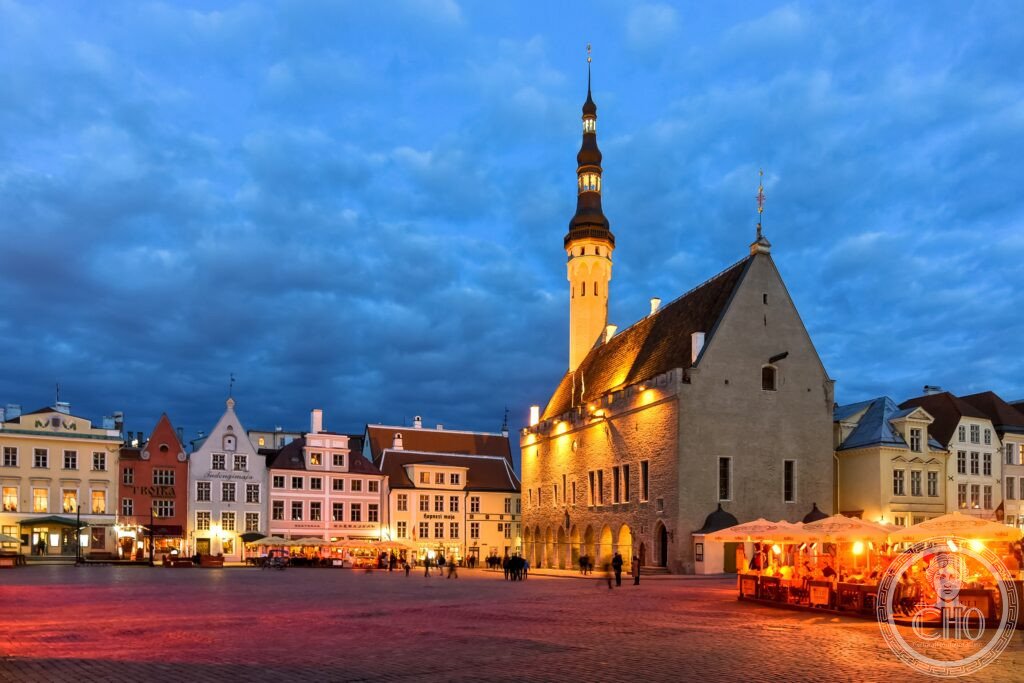
Northern Europe’s most complete medieval town survives here as two towns rather than one: Toompea, the limestone hill where bishops and Baltic German nobility governed, and the walled Lower Town below, where the merchants of the Hanseatic League made their money and kept the aristocracy out. Both are still standing, and the wall that separated them still runs between.
At a glance
Tallinn’s Old Town (Vanalinn) is the historic core of the Estonian capital and one of the best-preserved medieval trading towns anywhere in Europe. Its shape was set between the 13th and 16th centuries, when the town was a member of the Hanseatic League and the northern hinge of the trade that ran between Novgorod and the cities of the Baltic and North Sea. What makes it unusual is not any single monument but the completeness of the fabric: the street plan, the merchant houses with their loading beams still fixed above the doors, the guild halls, the churches and the defensive circuit are all in place, and the two-town division between rulers on the hill and traders below is still legible from any street corner. UNESCO inscribed the historic centre in 1997.
Key facts
- The walls: about 1.85 km of the medieval circuit survives, together with 26 defensive towers, two intermediate gates and parts of two front gates — long stretches at their original height, which reaches over 15 metres. It is the reason the town reads as a walled town and not as a set of monuments in a modern city.
- St Olaf’s Church: the spire stands at 123 metres today. It once reached 159 metres, and from its completion in the middle of the 16th century until lightning brought it down in 1625 it was very probably the tallest building in the world. It has been struck and burnt repeatedly since; the present spire is a later rebuilding.
- Toompea: the upper town on its limestone outcrop, seat of the castle and the cathedral, and the country’s administrative centre from the Danish conquest of 1219 to the present — the Estonian parliament still sits there.
- Town Hall: built 1402–1404 on Raekoja plats, the oldest surviving Gothic town hall in northern Europe; the weathervane on its 64-metre tower, Vana Toomas (Old Thomas), has been the city’s mascot since 1530.
- The guilds: the Great Guild house of 1410 and the House of the Blackheads, the brotherhood of unmarried merchants, are both still standing on Pikk street, the old mercantile spine of the Lower Town.
- Heritage: UNESCO World Heritage Site, Historic Centre (Old Town) of Tallinn, inscribed 1997 (reference 822).
- GPS: 59.4370° N, 24.7536° E
History
The Danes took the hill in 1219 and built a castle on it; the name Tallinn is generally derived from Taani linn(us), the Danish town or castle. The Teutonic Order held the territory briefly from 1238, and in 1346 the Danish crown sold its Estonian duchy to the Order outright. By then the town below the hill had joined the Hanseatic League — the date usually given is 1285 — and its German-speaking merchant class had become the real power in the Lower Town, governing through its guilds and keeping its own courts, while Toompea above remained the preserve of the nobility and the bishop. The two settlements had separate walls, separate jurisdictions and, for long stretches, a mutual dislike.
The Hanseatic centuries paid for almost everything a visitor now comes to see: the town hall, the guild houses, the merchant dwellings of Pikk street, the churches, and the walls that protected the whole. The Livonian War brought the arrangement to an end. In 1561 the town submitted to the Swedish crown, and the Swedish period lasted until the Great Northern War brought Estonia into the Russian Empire in 1710. Independence came in 1918, Soviet occupation in 1940, and independence again in 1991. The Old Town survived the Second World War with damage but without the wholesale destruction suffered by other Baltic ports, and the post-war decades left its fabric largely untouched — one reason the medieval plan is so intact today.
What you see
On Toompea: the castle, rebuilt over the centuries and now the seat of the Riigikogu, with Tall Hermann tower of the 1360s at its corner — the flag raised there each morning is the national flag, and the ritual matters here. Beside it stands the Alexander Nevsky Cathedral of 1900, Russian Orthodox, onion-domed, put up by the imperial authorities as a statement and still read locally as one. A short walk away is the Dome Church (Toomkirik), the oldest church in the city, its walls and ceiling hung with the carved coats of arms of the Baltic German families who worshipped and were buried there.
In the Lower Town: Raekoja plats, the market square, with the Gothic town hall on one side; Pikk street running from the harbour gate through the merchant quarter, with the Great Guild and the House of the Blackheads along it; St Olaf’s with its spire; and the wall walk itself, reached at the Nunna, Sauna and Kuldjala towers, from which the roofline of the town reads exactly as the plan intends. The Kiek in de Kök artillery tower and the bastion tunnels beneath it, both now museums, explain the defensive system from the inside.
Practical information
- Walking the Old Town: free, and the streets are the point; allow half a day for the essential circuit and a full day to include the museums. The lanes are cobbled and steep in places between the Lower Town and Toompea.
- Paid sites: the tower walk on the surviving wall, the Kiek in de Kök tower and its bastion tunnels, the town hall and its cellars, and the St Olaf’s tower platform all charge admission; check current prices before going, as they change seasonally.
- When to come: June to August for the long northern light, December for the Christmas market on Raekoja plats, which the city traces back to 1441. The town is busiest when cruise ships and the Helsinki ferries land together in the middle of the day.
Getting there
Tallinn Airport is 4 km from the centre, with a tram and a bus into town in about twenty minutes. The ferry from Helsinki crosses the Gulf of Finland in two to three and a half hours and is the better arrival: the walls and spires are visible from the deck as the ship comes in, and the Old Town is a fifteen-minute walk from the terminal. GPS: 59.4370, 24.7536.
Nearby
- Helsinki — 85 km north across the gulf, two to three and a half hours by ferry; a day trip that many people make in the other direction.
- Lahemaa National Park — 70 km east; forest, bog boardwalks and a group of Baltic German manor houses at Palmse, Sagadi and Vihula.
- Kadriorg — 2 km east of the Old Town; the Baroque palace Peter the Great built for Catherine, now an art museum, in a park that ends at the sea.
Sources
- UNESCO World Heritage Centre, Historic Centre (Old Town) of Tallinn, reference 822, inscribed 1997, and the accompanying ICOMOS evaluation
- Visit Tallinn, the city’s official visitor service — the town wall towers and St Olaf’s tower platform
- Tallinn City Museum (Tallinna Linnamuuseum), Kiek in de Kök Fortifications Museum
- Tallinn Town Hall (Tallinna Raekoda), official site of the building
Find it on the map
See this place and what’s around it →📷 Become a Cultural Heritage Online photographer
Share your photos of places: they stay published under your name as the author. The more they're seen, the more you get noticed — and soon a contest will reward the most appreciated photos.
Log in or sign up free to add a photo