
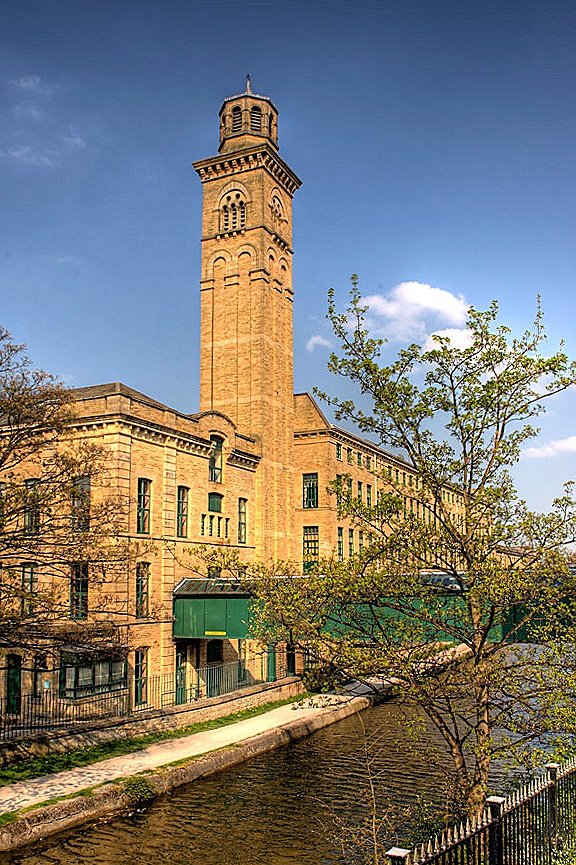
An extraordinarily intact Victorian model industrial village in West Yorkshire — built by textile magnate Sir Titus Salt as a complete planned community for his mill workers, and now a UNESCO World Heritage Site that houses the world’s largest permanent collection of David Hockney’s work.
At a glance
Inscribed as a UNESCO World Heritage Site in 2001, Saltaire is one of the finest surviving examples of a Victorian model industrial village. Between 1851 and 1876, the textile manufacturer Sir Titus Salt (1803–1876) built not only one of the largest mills in England but an entire town around it — 850 stone workers’ houses, a Congregationalist church, a school, a hospital, a park with bandstand, public baths and washhouses, almshouses, a Mechanics’ Institute, and shops. Notably absent: a pub, a pawnbroker, and a prison. The village demonstrated, on a large scale, that industrial capitalism could be humane. After decades of decline, Salts Mill was rescued in the 1980s and now houses the permanent Bradford collection of David Hockney artworks alongside restaurants and galleries.
Key facts
- UNESCO inscription: 2001 (criteria ii, iv)
- Location: Saltaire, Bradford, West Yorkshire, England (BD18 3LA)
- Built: 1851–1876 CE by Sir Titus Salt (1803–1876)
- Salts Mill: 1853 CE — six storeys, 168 m long; produced alpaca and mohair fabrics
- Workers’ housing: 850 stone-built houses with indoor privies — unprecedented for Victorian working-class housing
- Now: Salts Mill = David Hockney gallery + restaurants + shops; village is a living residential community
- Open: Salts Mill open daily; village free to explore year-round
History
Sir Titus Salt made his fortune identifying a fibre that Victorian England’s textile industry had overlooked: the fleece of the South American alpaca and llama, whose long, lustrous fibres produced a distinctive cloth — lighter and shinier than wool — that became fashionable for ladies’ dress fabric. By 1850 Salt was one of the wealthiest manufacturers in Bradford, operating five separate mills in the city. Bradford itself, however, was one of the most squalid industrial cities in England: polluted, overcrowded, its workers housed in back-to-back slums without sanitation.
Salt decided to leave Bradford entirely. In 1851 he purchased a greenfield site on the River Aire, three miles upstream from Bradford’s centre, at a location served by both the Midland Railway and the Leeds and Liverpool Canal. He commissioned the architects Lockwood and Mawson to design a complete community: first the mill (Salts Mill, opened 1853), then the housing, then the institutions.
The result, built over 25 years, was remarkable: 850 workers’ houses built in stone (not the cheap brick of Bradford’s slums), each with an indoor toilet — a sanitary provision virtually unknown in Victorian working-class housing. The village had a church seating 800, a school, a hospital, a park on the river with a bandstand, public baths and washhouses for those without bathing facilities at home, almshouses for retired workers, and a Mechanics’ Institute with a library and lecture hall where workers could improve their education.
What Saltaire deliberately did not have was also telling: Salt was a committed teetotaller, so there was no pub. He believed poverty was partly caused by debt, so there was no pawnbroker. He believed in education not punishment, so there was no prison.
After Salt’s death in 1876, the mill passed through several owners and by the 1980s had become derelict. Businessman Jonathan Silver purchased it in 1987, renovated it, and opened it as a cultural and commercial centre. In 1993 Silver persuaded his friend David Hockney — born in Bradford in 1937 — to exhibit a permanent collection at the mill. Hockney agreed, and the Bradford 1853 Gallery now holds over 300 of his works, including large-format paintings and the iPad drawings for which he became famous late in his career.
What you see
Salts Mill dominates the village — a vast Italianate palazzo in millstone grit, six storeys tall and 168 metres long, its chimney disguised as an Italian campanile. Inside, the 1853 Gallery occupies three floors, with Hockney’s paintings hung salon-style alongside the original mill windows. Restaurants, bookshops, and design shops occupy the remaining floors.
The workers’ housing is laid out on a strict grid of named streets — Salt’s four sons give their names to Titus Street, William Henry Street, George Street, and Edward Street — with houses graded by the seniority of their occupants: larger for overlookers, smaller for spinners, larger again for managers. All are in uniform millstone grit, giving the village its distinctive honey-and-grey palette.
The Congregationalist United Reformed Church (1859) has a grand Italianate portico; Titus Salt is buried in a mausoleum at the east end. The Saltaire Club and Institute (the Mechanics’ Institute, 1871) still operates as a community space. Roberts Park on the south bank of the Aire preserves the original Victorian bandstand. The entire village is a living community — people still live in Titus Salt’s workers’ houses.
Practical information
- Salts Mill: Victoria Road, Saltaire, BD18 3LA — David Hockney gallery, restaurants, shops; open daily (closed some bank holidays)
- Admission: Salts Mill and village free; no entry charge for the Hockney gallery
- Guided tours: Village walking tours available from Saltaire Village Society (saltairevillage.info)
- Allow: Half day for mill and village; full day with Roberts Park and lunch
- Accessibility: Mill at street level, gallery on upper floors with lift; village streets level
Getting there
Saltaire is 3 miles (5 km) northwest of Bradford centre and 9 miles from Leeds. By rail: Saltaire railway station (Airedale Line, frequent trains from Bradford Forster Square and Leeds) is directly adjacent to Salts Mill — the most convenient approach. By bus: Regular services from Bradford and Shipley. By car: A650 from Bradford; parking on Victoria Road and surrounding streets. On foot from Shipley: 20-minute walk along the Aire towpath.
Nearby
- Bradford city centre — National Science and Media Museum (free), Cartwright Hall art gallery, Bradford Cathedral; 5 km southeast
- Haworth — Brontë Parsonage Museum and the Brontë moors; 10 km southwest
- Harewood House — Robert Adam country house with Capability Brown landscape gardens; 15 km east
- Ilkley Moor — dramatic moorland, spa town, the Cow and Calf rocks; 10 km north
Sources
- UNESCO World Heritage List — Saltaire (whc.unesco.org)
- Saltaire Village Society — saltairevillage.info
- Jack Reynolds, The Great Paternalist: Titus Salt and the Growth of Nineteenth-Century Bradford (Temple Smith, 1983)
- Bradford 1853 Gallery / Salts Mill — saltsmill.org.uk
- Wikipedia — Saltaire
Find it on the map
See this place and what’s around it →📷 Become a Cultural Heritage Online photographer
Share your photos of places: they stay published under your name as the author. The more they're seen, the more you get noticed — and soon a contest will reward the most appreciated photos.
Log in or sign up free to add a photo