
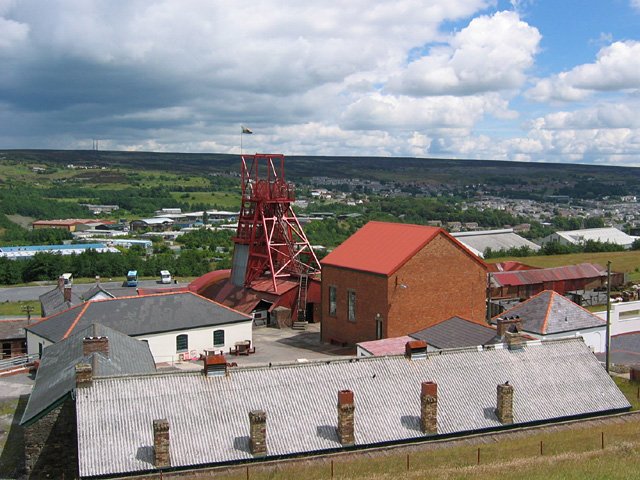
A remarkably intact 19th-century iron-and-coal industrial landscape in southeast Wales — the complete preserved infrastructure of Industrial Revolution iron-making, from blast furnaces and workers’ cottages to a working colliery where visitors still descend 90 metres underground.
At a glance
Inscribed as a UNESCO World Heritage Site in 2000, the Blaenavon Industrial Landscape in Torfaen county, southeast Wales, preserves the complete chain of an early 19th-century iron-and-coal economy. In 1789 the Blaenavon Ironworks was founded; by 1796 it was the second-largest ironworks in Wales, supplying iron for the railways, bridges, and engineering projects of the Industrial Revolution. The landscape contains the well-preserved ironworks itself, the Big Pit colliery and museum, workers’ housing, transport infrastructure, and the mountain landscape that supplied the raw materials. What makes Blaenavon exceptional is not a single monument but the survival of an entire integrated industrial ecosystem.
Key facts
- UNESCO inscription: 2000 (criteria iii, iv)
- Location: Blaenavon, Torfaen, southeast Wales; 10 km north of Pontypool
- Blaenavon Ironworks: founded 1789; three blast furnaces, water balance tower, workers’ cottages
- Big Pit: 1860–1980 CE; 90 m deep shaft; underground museum with guided tours
- Peak production: By 1796, second-largest ironworks in Wales; supplied iron for the railways of the Industrial Revolution
- Admission: Blaenavon Ironworks charged (CADW); Big Pit National Coal Museum free (National Museum Wales)
- Open: Ironworks April–October; Big Pit year-round (check nmw.ac.uk for hours)
History
In the late 18th century, the uplands of southeast Wales contained everything the Industrial Revolution needed in one place: iron ore and limestone in the hillsides, coal seams below, fast streams for water power, and access to the canal network for transport. In 1789 a partnership of English industrialists — Thomas Hill, Thomas Hopkins, and Benjamin Pratt — founded the Blaenavon Ironworks, constructing three stone blast furnaces against the hillside using the slope to charge the furnaces from above.
By 1796 Blaenavon was the second-largest ironworks in Wales and one of the most important in Britain. The ironworks supplied iron for railway tracks, bridges, and engineering projects across the country. In 1837 a young metallurgist named Sidney Gilchrist Thomas worked at Blaenavon and developed the basic process for dephosphorising iron (the Thomas–Gilchrist process, 1878) — an innovation that made it possible to use the phosphoric iron ores of continental Europe for steel-making, transforming the global steel industry.
Coal mining at Blaenavon was initially subsidiary to iron-making — coal fired the blast furnaces. As the ironworks declined in the late 19th century, coal mining expanded. Big Pit (named for its large shaft diameter) operated from 1860 to 1980, when it closed as part of the broader collapse of the South Wales coalfield. Rather than being demolished, Big Pit was preserved as a museum and is now one of the most authentic mining heritage sites in Britain, with tours led by former miners.
What you see
Blaenavon Ironworks (1789) is one of the best-preserved ironworks complexes in Europe. Three stone blast furnaces still stand against the hillside that was used to charge them with ore, limestone, and coke. The remarkable water balance tower — a counterbalance mechanism using the weight of water to raise heavy loads up the hillside — is one of only a handful surviving in Britain. Stack Square and Engine Row preserve rows of original workers’ cottages, giving a direct sense of how industrial workers lived in the early 19th century.
Big Pit National Coal Museum is the emotional centrepiece of any visit. Wearing a hard hat and cap lamp, visitors descend 90 metres in the original winding cage to walk through the actual underground workings, accompanied by guides who were themselves miners at Big Pit before it closed. Above ground, the winding engine house, fitting shop, pithead baths, and lamp room are all preserved and accessible.
The wider landscape preserves 19th-century tram roads and inclines on the Blorenge mountain — the engineered transport infrastructure that moved raw materials down to the ironworks and finished iron out to the canal system below.
Practical information
- Big Pit National Coal Museum: NP4 9XP — free entry; underground tours require a safety briefing; no cameras underground; children under 1 m in height cannot descend
- Blaenavon Ironworks: North Street, Blaenavon, NP4 9RN — CADW admission charged; open April–October
- Allow: Full day for both sites plus the World Heritage Centre in Blaenavon town
- Accessibility: Big Pit surface buildings accessible; underground tour requires physical agility (narrow passages, ladders)
- Combined visit: Blaenavon town centre has a World Heritage Centre visitor hub (free) with context for the whole landscape
Getting there
Blaenavon is 10 km north of Pontypool and 40 km north of Cardiff. By car: B4248 from Abergavenny or B4246 from Pontypool; Big Pit and the Ironworks both have car parks. By bus: Bus 23 from Pontypool bus station runs to Blaenavon (limited service; check Traveline Cymru). By rail: Nearest stations are Abergavenny (15 km) and Pontypool & New Inn (10 km); local bus or taxi from there.
Nearby
- Abergavenny — market town and gateway to the Brecon Beacons; 15 km west; excellent food scene
- Brecon Beacons National Park — dramatic upland landscape with waterfalls, caves, and walking; begins immediately north and west
- Pontypool — historic market town; Pontypool Park and Folly Tower; 10 km south
- Raglan Castle — impressive late medieval castle ruin; 20 km southeast
Sources
- UNESCO World Heritage List — Blaenavon Industrial Landscape (whc.unesco.org)
- National Museum Wales / Big Pit — museum.wales
- CADW — Blaenavon Ironworks (cadw.gov.wales)
- Jeremy Lowe, Blaenavon Iron and Steel Works (CADW Welsh Historic Monuments, 1998)
- Wikipedia — Blaenavon Industrial Landscape
Find it on the map
See this place and what’s around it →📷 Become a Cultural Heritage Online photographer
Share your photos of places: they stay published under your name as the author. The more they're seen, the more you get noticed — and soon a contest will reward the most appreciated photos.
Log in or sign up free to add a photo