
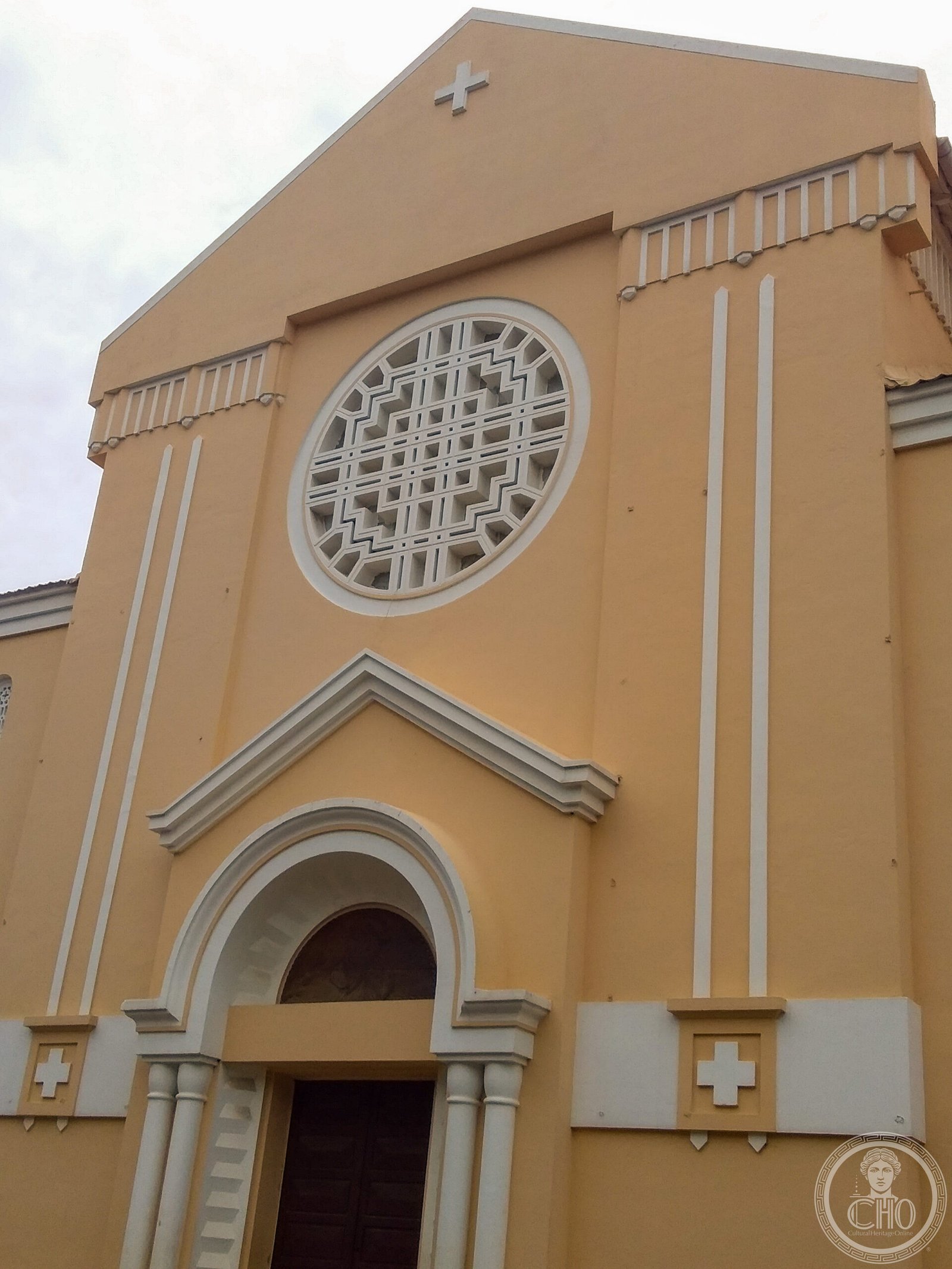
In Conakry, the capital of Guinea, the foundation stone of Sainte-Marie Cathedral was blessed in 1928 by Monsignor Raymond-René Lerouge, then head of the Catholic mission, with work continuing through the Thirties under the French colonial administration. The red-and-yellow building stands on the third boulevard of the Kaloum district, immediately next to the presidential palace. On its exact architectural style the sources disagree, some speaking of neo-Gothic elements and others of Orthodox influences, with neither version confirmed by a primary text; the most cautious description remains that of a colonial-era cathedral of local architectural note. The apostolic prefecture of French Guinea was erected on 18 October 1897, raised to an apostolic vicariate on 18 April 1920, renamed the apostolic vicariate of Conakry on 12 May 1949 and raised to a metropolitan archdiocese on 14 September 1955, later ceding territory in 2024 to the new diocese of Boké. After independence on 2 October 1958, the regime of President Ahmed Sékou Touré systematically persecuted the Catholic Church. In May 1967 Touré ordered the expulsion of all foreign missionaries by 1 June, over two hundred people removed almost overnight, after church property had already been confiscated by the state from 1961. Monsignor Robert Sarah was appointed archbishop of Conakry in 1979, at only 34, the youngest bishop in the world at the time, and publicly criticised the regime. After Touré’s death in 1984, his name was found on a list of people to be eliminated, discovered on the dictator’s desk. No specific episode, closure, confiscation or damage, concerning the cathedral building itself during those years is documented: the well-documented persecution concerns the church as an institution and its leaders, not a recorded event on the structure as such. Complaints of illegal expropriation of church property, according to the then archbishop Vincent Coulibaly, have continued in recent times, with episodes reported in 2020. After the military coup of 5 September 2021, the Guinean bishops’ conference condemned it and asked for guarantees for the safety of the deposed president Alpha Condé, while Cardinal Robert Sarah, by then in the Vatican but still archbishop emeritus of Conakry, wrote to the new military leadership urging a radical change in the running of the country; here too no specific episode linked to the cathedral building is recorded. Pope John Paul II visited Conakry in February 1992, as part of an apostolic journey that also took in Senegal and Gambia, though it is not confirmed with certainty whether he celebrated mass specifically inside this cathedral. The present archbishop is Monsignor François Sylla, in office since 28 February 2026, who succeeded Vincent Coulibaly.
About Sainte-Marie Cathedral
In Conakry, the capital of Guinea, the foundation stone of Sainte-Marie Cathedral was blessed in 1928 by Monsignor Raymond-René Lerouge, then head of the Catholic mission, with construction continuing through the 1930s under French colonial administration. The red-and-yellow building stands on the 3rd Boulevard in the Kaloum district, immediately adjacent to the presidential palace; sources disagree on its exact architectural style, some describing neo-Gothic elements and others Orthodox influences, with neither claim confirmed by a primary source — the safest description is a colonial-era cathedral of local architectural note.
Key facts
- 1928-1930s: the cathedral built under French colonial administration.
- 14 September 1955: elevated to the seat of the Metropolitan Archdiocese of Conakry.
- May 1967: President Sékou Touré expels over 200 foreign missionaries from Guinea.
- 1979: Robert Sarah becomes archbishop at 34, the world’s youngest bishop, and later finds his name on Touré’s posthumous death list.
- February 1992: Pope John Paul II visits Conakry.
- 28 February 2026: Archbishop François Sylla takes office.
History
Built in the final decades of French colonial rule, this cathedral stood as the seat of an archdiocese that endured some of postcolonial Africa’s harshest state repression of the Catholic Church under Ahmed Sékou Touré, whose government expelled over 200 missionaries in 1967 and, according to the death list found on his desk after his 1984 death, had marked Archbishop Robert Sarah for elimination. No documented incident targeted the cathedral building itself during this period — the persecution fell on the institution and its leaders, not the structure — and the cathedral has continued through Guinea’s more recent political upheavals, including the 2021 coup, without recorded direct incident.
What you see
A red-and-yellow colonial-era facade stands beside Conakry’s presidential palace, across from the Ministry of Higher Education, its exact architectural influences disputed among tourism sources rather than settled by any documented primary description.
Practical information
- Opening hours: generally open daily outside services; check current hours before visiting.
- Address: 3rd Boulevard, Kaloum, Conakry, Guinea.
Getting there
The cathedral stands on the 3rd Boulevard in Conakry’s Kaloum district, next to the presidential palace. GPS: 9°30′37″N, 13°42′56″W.
Nearby
- Presidential Palace of Guinea — immediately adjacent to the cathedral in the Kaloum district.
Sources
- Wikipedia (French and English) — “Cathédrale Sainte-Marie de Conakry” and “Archdiocese of Conakry”
- Aid to the Church in Need International — “Guinea-Conakry” country profile.
- Wikipedia — “Robert Sarah”
- Agenzia Fides — coverage of Church-property expropriation claims and the 2021 coup.
- Catholic-Hierarchy.org and GCatholic.org — Archdiocese of Conakry listings.
Find it on the map
See this place and what’s around it →📷 Become a Cultural Heritage Online photographer
Share your photos of places: they stay published under your name as the author. The more they're seen, the more you get noticed — and soon a contest will reward the most appreciated photos.
Log in or sign up free to add a photo