
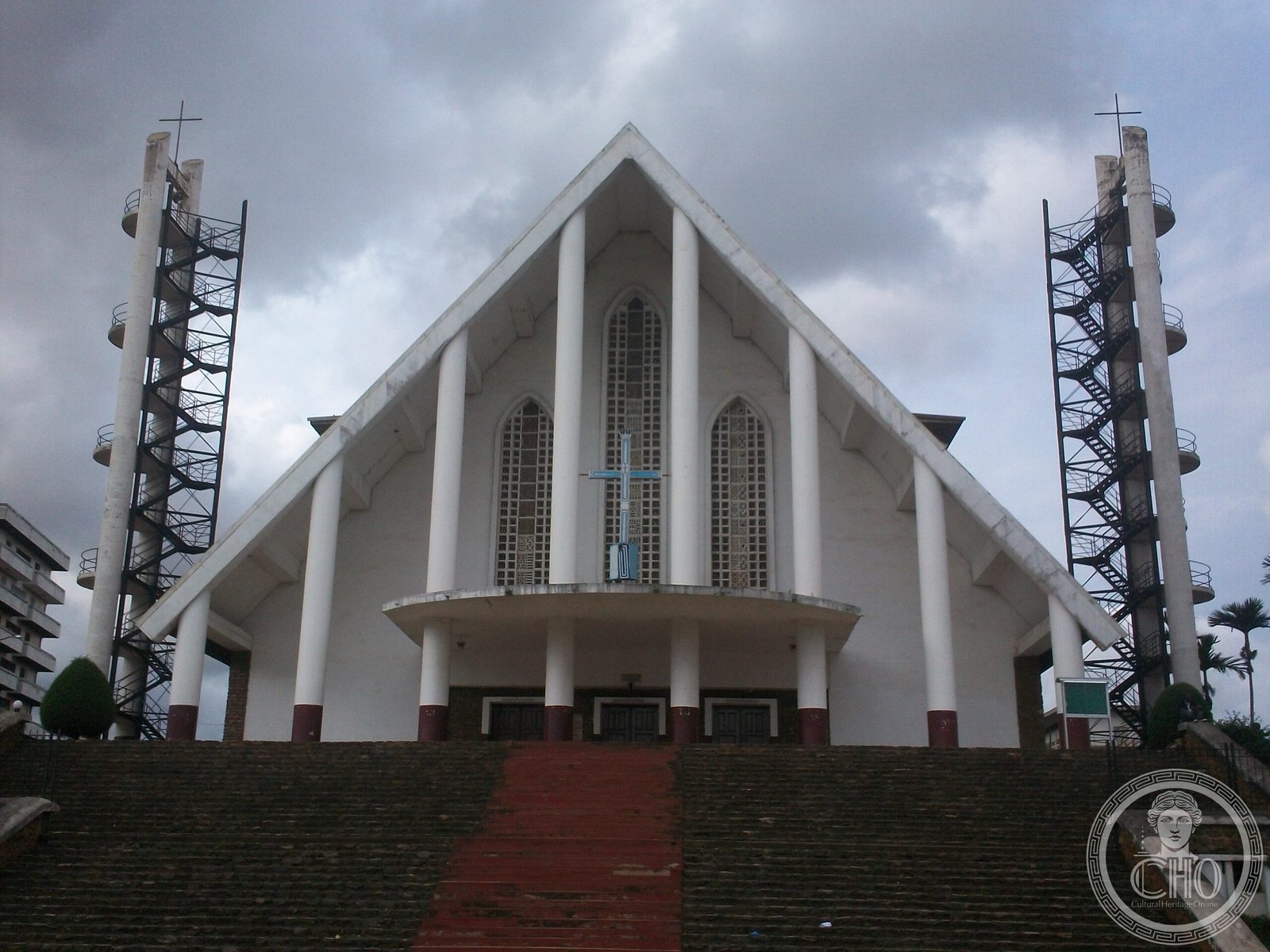
A Yaounde, capitale del Camerun, la cattedrale di Notre-Dame-des-Victoires nacque da un voto: monsignor Francois-Xavier Vogt, vicario apostolico, promise durante la Seconda guerra mondiale di costruire un santuario se il Camerun ne fosse uscito indenne, ma morì nel 1943, prima della fine del conflitto e ben prima che l’edificio prendesse forma. La prima pietra fu posata il 4 marzo 1952 da monsignor Rene Graffin, primo arcivescovo di Yaounde, e la cattedrale fu consacrata nel 1955, sebbene la data esatta non risulti documentata con precisione; non risulta documentato il nome di un architetto né uno stile architettonico specifico, e secondo alcune fonti, dopo oltre cinquant’anni dalla fondazione, la costruzione non risulterebbe ancora del tutto completata. La cattedrale va tenuta distinta dalla vicina Basilica di Maria Regina degli Apostoli, sulla collina di Mvolye, un edificio diverso: quest’ultima sorge sul sito della prima missione cattolica tedesca fondata nel 1901 da padre Heinrich Vieter, la cui chiesa originaria fu demolita nel 1990 e ricostruita come basilica minore, elevata a tale rango il 10 dicembre 2006 e consacrata dal cardinale Jean-Louis Tauran a nome di Benedetto XVI; non risulta però confermato da fonti primarie che lo stesso Benedetto XVI, in visita in Camerun nel marzo 2009, abbia effettivamente visitato questa basilica di persona, dato che i suoi atti ufficiali documentati si tennero allo stadio Amadou Ahidjo e nella chiesa del Christ-Roi a Tsinga, non a Mvolye né nella cattedrale. La prefettura apostolica del Camerun fu eretta il 18 marzo 1890, elevata a vicariato apostolico il 2 gennaio 1905, rinominata vicariato apostolico di Yaounde il 3 aprile 1931 ed elevata ad arcidiocesi metropolitana il 14 settembre 1955; l’attuale arcivescovo è monsignor Jean Mbarga, in carica dal 31 ottobre 2014. Nessun arcivescovo di Yaounde è mai stato creato cardinale: l’unico cardinale camerunese, Christian Tumi, fu invece arcivescovo di Douala dal 1991 al 2009, creato cardinale nel 1988 quando era ancora vescovo di Garoua, non di Yaounde. I primi missionari cattolici tedeschi, arrivati a Douala nel 1890 sotto padre Vieter, si estesero a Yaounde nei primi anni del Novecento ma fuggirono nel 1916 durante la campagna alleata della Prima guerra mondiale, sostituiti dai padri dello Spirito Santo francesi sotto il mandato francese; i pallottini tedeschi tornarono in un Camerun ormai indipendente solo nel 1964 — una vicenda però legata alla missione cattolica in generale, non specificamente a questa cattedrale, costruita più tardi, tra il 1952 e il 1955, sotto l’amministrazione francese. L’attuale arcivescovo Mbarga ha più volte preso posizione pubblicamente sulla crisi anglofona che dal 2016 colpisce le regioni di lingua inglese del Camerun, incluse cerimonie simboliche per la pace a Yaounde, sebbene la voce più direttamente coinvolta resti quella dell’arcivescovo di Bamenda, Andrew Nkea Fuanya, nella regione anglofona stessa; non risulta alcun evento specifico legato alla crisi tenutosi nella cattedrale. Papa Giovanni Paolo II visitò la cattedrale il 10 agosto 1985, incontrandovi la comunità ecclesiale, e vi tornò con ogni probabilità il 14 settembre 1995 per firmare l’esortazione post-sinodale “Ecclesia in Africa”, sebbene la fonte vaticana primaria non specifichi l’edificio esatto e il dettaglio provenga solo da fonti secondarie.
About Notre-Dame-des-Victoires Cathedral
In Yaoundé, the capital of Cameroon, Notre-Dame-des-Victoires Cathedral was born from a vow: Bishop François-Xavier Vogt, Apostolic Vicar, promised during the Second World War to build a sanctuary if Cameroon emerged unharmed, but died in 1943, before the war’s end and long before the building took shape. The foundation stone was laid on 4 March 1952 by Bishop René Graffin, the first Archbishop of Yaoundé, and the cathedral was consecrated in 1955, though the exact date is not precisely documented; no architect’s name or specific architectural style is documented, and per some sources, more than fifty years after its founding, construction has still not been entirely completed.
Key facts
- 4 March 1952 – 1955: the cathedral built and consecrated, though possibly still unfinished
- 14 September 1955: elevated to the seat of the Metropolitan Archdiocese of Yaoundé
- 10 August 1985: Pope John Paul II visits the cathedral
- No Archbishop of Yaoundé has ever been made a cardinal, unlike neighboring Douala
- Distinct from the nearby Basilica of Mary Queen of the Apostles; Pope Benedict XVI’s 2009 Cameroon visit did not confirmably include either building
- 31 October 2014: Archbishop Jean Mbarga takes office
History
Vowed during the Second World War by a bishop who died before construction even began, this cathedral took shape only from 1952, consecrated in 1955 as the new seat of Yaoundé’s archdiocese — yet some accounts suggest it remains technically unfinished more than seven decades later. It is frequently confused with the nearby Basilica of Mary Queen of the Apostles on Mvolyé hill, a separate building on the site of Cameroon’s first German Catholic mission; Pope John Paul II visited the cathedral itself in 1985 and likely returned in 1995 to sign a major papal document there, while no source confirms Pope Benedict XVI’s 2009 Cameroon visit included either building.
What you see
A white modernist facade with twin bell towers rises near Yaoundé’s central post office roundabout, its precise architect and style undocumented in available sources — a building whose long, unresolved construction history is itself part of its character.
Practical information
- Opening hours: generally open daily outside services; check current hours before visiting
- Address: Avenue Mgr. François Xavier Vogt, Centre Commercial district, near Rond-Point de la Poste Centrale, Yaoundé I, Cameroon
Getting there
The cathedral stands near Yaoundé’s central post office roundabout, at the start of Boulevard du 20 Mai. GPS: 3°51′48″N, 11°31′16″E.
Nearby
- Basilica of Mary Queen of the Apostles, Mvolyé — a separate Marian basilica about 2.5 km away, often confused with the cathedral
Sources
- Wikipedia (French and English) — “Cathédrale Notre-Dame-des-Victoires de Yaoundé” and “Our Lady of Victories Cathedral, Yaoundé”
- GCatholic.org — Cathédrale Notre-Dame des Victoires and Archdiocese of Yaoundé listings
- Wikipedia — “Pallottine mission to Kamerun” and “Mvolyé”
- Catholic-Hierarchy.org — Archdiocese of Yaoundé and Christian Tumi listings
Find it on the map
See this place and what’s around it →📷 Become a Cultural Heritage Online photographer
Share your photos of places: they stay published under your name as the author. The more they're seen, the more you get noticed — and soon a contest will reward the most appreciated photos.
Log in or sign up free to add a photo