
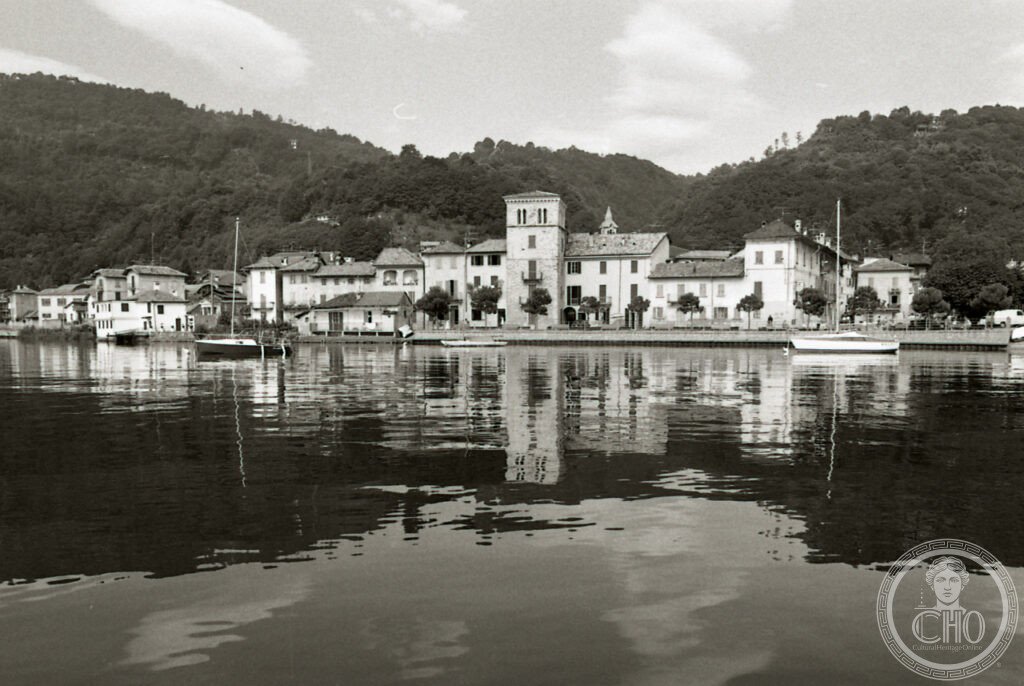
Twenty chapels climb through a small wood above Lake Orta, each one staging an episode from the life of St Francis of Assisi in painted terracotta and fresco. Built over two centuries, the sequence ends with a crowded, quietly theatrical scene of the saint’s death, with the lake and the island of San Giulio visible below.
At a glance
The Sacro Monte di Orta stands in a seven-hectare sacred wood on the promontory above Orta San Giulio, overlooking Lake Orta and the island of San Giulio. It is one of nine sites that together form the UNESCO World Heritage Site known as the Sacri Monti of Piedmont and Lombardy, inscribed in 2003, and it is the only one of the group dedicated entirely to the life of St Francis rather than to the Passion or to the Virgin.
Twenty chapels, built between 1591 and 1788, follow Francis’s story from his conversion to his death. Inside each one, life-size terracotta figures set the scene, painted in the round and framed by fresco, so that the visitor looks through a grille or window into a fixed tableau rather than an open room.
Key facts
- Location: Orta San Giulio, province of Novara, Piedmont
- Dedication: the life of St Francis of Assisi, the only Sacro Monte with an exclusively Franciscan programme
- Construction: twenty chapels built between 1591 and 1788
- Content: around 370 life-size terracotta figures and some 900 frescoes across the chapels
- Setting: a seven-hectare wood, the bosco sacro, above the western shore of Lake Orta
- Status: part of the serial UNESCO World Heritage Site Sacri Monti of Piedmont and Lombardy, inscribed 2003
History
The Sacri Monti tradition began at Varallo in 1486, when the Franciscan friar Bernardino Caimi, newly returned from Jerusalem, laid out chapels there as scaled replicas of the holy sites, offering pilgrims a substitute for a journey to Palestine that had become closed to them. The idea spread across Piedmont and Lombardy over the following two centuries.
At Orta, the Arciconfraternita di San Francesco chose a different subject. From 1591 the confraternity built a cycle dedicated not to the Holy Land but to the biography of Francis himself, from his conversion to his death, making it the only Sacro Monte built around a single saint’s life rather than a scriptural narrative. The project took shape in the same decades as the Counter-Reformation, and its emphasis on Franciscan poverty, humility and charity has been read as a deliberate answer to the Protestant stress on scripture alone.
The last chapel was completed in the late eighteenth century. In 2003 the Sacro Monte di Orta was inscribed on the UNESCO World Heritage List together with eight other Piedmontese and Lombard Sacri Monti, as a single serial site.
What you see
The twenty chapels are arranged along a wooded loop, each a small building with terracotta figures visible through a grille or window rather than a space to walk into. Giovanni d’Enrico, working across much of the seventeenth century, was responsible for the sculpture in a large share of the chapels, and the fresco painting inside them is the work of the regional school of Sacri Monti painters active around Lake Maggiore from the late sixteenth to the eighteenth century.
The early chapels show Francis’s conversion and the approval of his Rule by Pope Innocent III, the latter set inside a chapel with an eighteenth-century mosaic floor. Further round the loop, one chapel recreates the miracle of the spring, where Francis strikes a rock and water flows, and the chapel once had a working hydraulic element. The sequence closes with the Transito, the death of Francis at Porziuncola, the largest of the tableaux, with some thirty figures gathered around the dying saint, a fresco of larks on the ceiling recalling the legend that birds sang at the moment of his death, and a terracotta wolf at his feet recalling the tamed wolf of Gubbio.
Through gaps in the trees, the wood opens onto views of Lake Orta and the island of San Giulio below.
Practical information
- Access: a signed path leads up from Piazza Motta in Orta San Giulio to the Sacro Monte; there is also road access for cars to a car park near the site
- Visiting: the chapels are viewed from outside through windows or grilles set into each building; the recommended route follows the numbered chapels in order
- Combining the visit: many visitors pair the Sacro Monte with a boat crossing to the island of San Giulio and its basilica
- Current details: for opening times, any admission arrangements and transport timetables, check the official channels for the Sacro Monte di Orta and for Trenitalia before travelling
Getting there
Orta San Giulio is reached by train from Milan and Turin, changing at Novara for the Orta-Miasino station, from which the village centre lies a short distance away. From the village square, Piazza Motta, a marked footpath climbs to the Sacro Monte.
Nearby
- Orta San Giulio — the lakeside village at the foot of the Sacro Monte, reached on foot from the chapels
- Isola di San Giulio — a short boat crossing from Piazza Motta, home to the Basilica di San Giulio
- Basilica di San Giulio — founded in the fifth century, with an eleventh-century Romanesque nave, a sixteenth-century facade and a twelfth-century carved pulpit
- Lake Orta — the lake itself, visible from several points along the Sacro Monte’s wooded path
Sources
- UNESCO
- Arciconfraternita di San Francesco di Orta San Giulio
- Legenda Maior di San Bonaventura
- Fioretti di San Francesco
Find it on the map
See this place and what’s around it →📷 Become a Cultural Heritage Online photographer
Share your photos of places: they stay published under your name as the author. The more they're seen, the more you get noticed — and soon a contest will reward the most appreciated photos.
Log in or sign up free to add a photo