
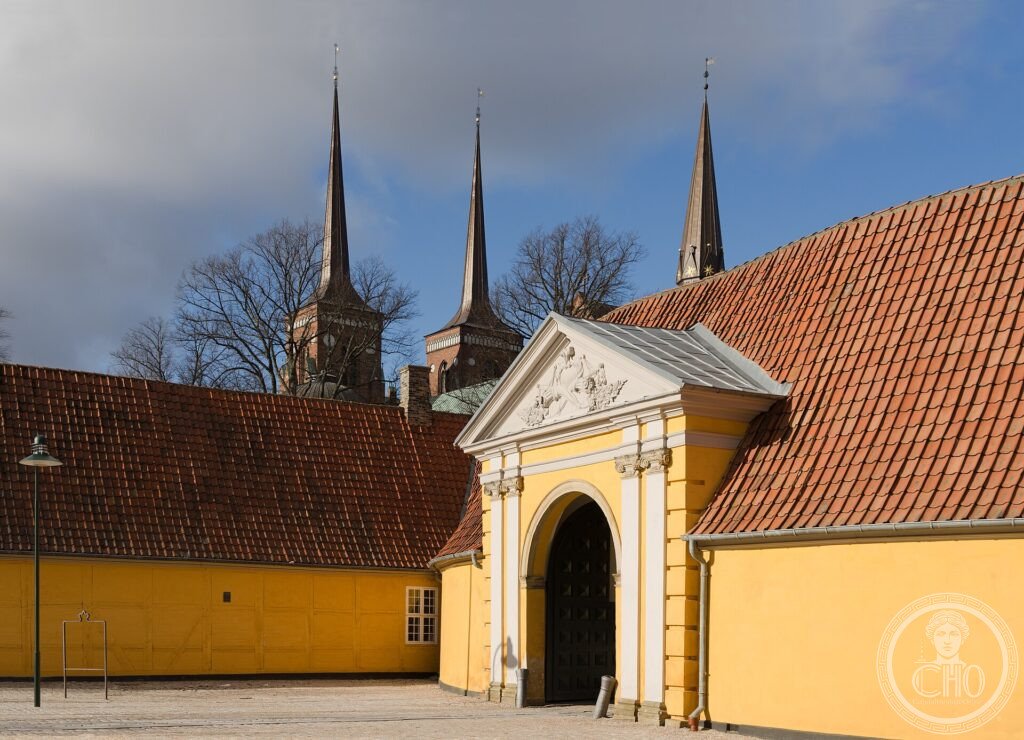
Begun in the twelfth century by Bishop Absalon, Roskilde was the first great brick cathedral in Scandinavia and spread its style across the North. For six hundred years it has been the mausoleum of the kings and queens of Denmark: a history of the monarchy written in the chapels added over the centuries.
At a glance
Roskilde Cathedral, west of Copenhagen, was the first great Brick Gothic cathedral in Scandinavia, begun in the 12th century by Bishop Absalon. Built and rebuilt in brick, it spread the new Gothic style across northern Europe. Since the 15th century it has been the burial church of the Danish monarchs, and the chapels added around it over the centuries form a unique record of European royal architecture and of changing styles from Gothic to modern. It was inscribed by UNESCO in 1995.
Key facts
- UNESCO: World Heritage since 1995 (Roskilde Cathedral)
- Begun: in the 1170s by Bishop Absalon, in brick
- First of its kind: the earliest Brick Gothic cathedral in Scandinavia
- Royal mausoleum: burial place of Danish kings and queens since the 15th century
- Many chapels: added over the centuries in successive styles
- Near Copenhagen: in the old royal town of Roskilde
History
Roskilde was an early royal and church centre of Denmark. In the 1170s the powerful Bishop Absalon, founder of Copenhagen, began rebuilding its cathedral in brick in the new Gothic manner imported from northern France and Flanders, a daring choice that made Roskilde the first Brick Gothic cathedral in the north and a model for others around the Baltic.
From the 15th century the Danish monarchs chose it as their burial church, and successive royal chapels were built onto the cathedral, each in the style of its age, so that the building grew into a gallery of architecture across six centuries. It remains the royal mausoleum of Denmark.
What you see
The cathedral rises in red brick with twin spires above the town and fjord. Inside, the lofty Gothic nave leads to the high altar with its great gilded altarpiece, while around the choir and aisles open the royal burial chapels — from late-Gothic to Renaissance, Baroque and modern — filled with the elaborate tombs and sarcophagi of Danish kings and queens.
The clock with its moving figures and the carved choir stalls add to the richness.
Practical information
- Cathedral: open to visitors; a small admission applies
- Time needed: 1–1.5 hours
- Note: still an active church; visiting may be limited during services
- Nearby: the Viking Ship Museum on the fjord
Getting there
Roskilde is about 30 km west of Copenhagen, the Danish capital, with frequent trains (about 25 minutes). The cathedral is a short walk from the station. GPS: 55.6422° N, 12.0803° E.
Nearby
- Viking Ship Museum — reconstructed Viking ships on the fjord
- Copenhagen — the capital, about 30 km east
- Roskilde Fjord — the inlet and its sailing waters
Sources
- UNESCO World Heritage Centre — “Roskilde Cathedral” (ref. 695)
- Roskilde Domkirke — official cathedral site
- Encyclopaedia Britannica — Roskilde
Find it on the map
See this place and what’s around it →📷 Become a Cultural Heritage Online photographer
Share your photos of places: they stay published under your name as the author. The more they're seen, the more you get noticed — and soon a contest will reward the most appreciated photos.
Log in or sign up free to add a photoIs this page about you?
This page is read by travellers and heritage enthusiasts who find it on Google. Tell us how you are connected to this place and we will take it from there.