
At a glance
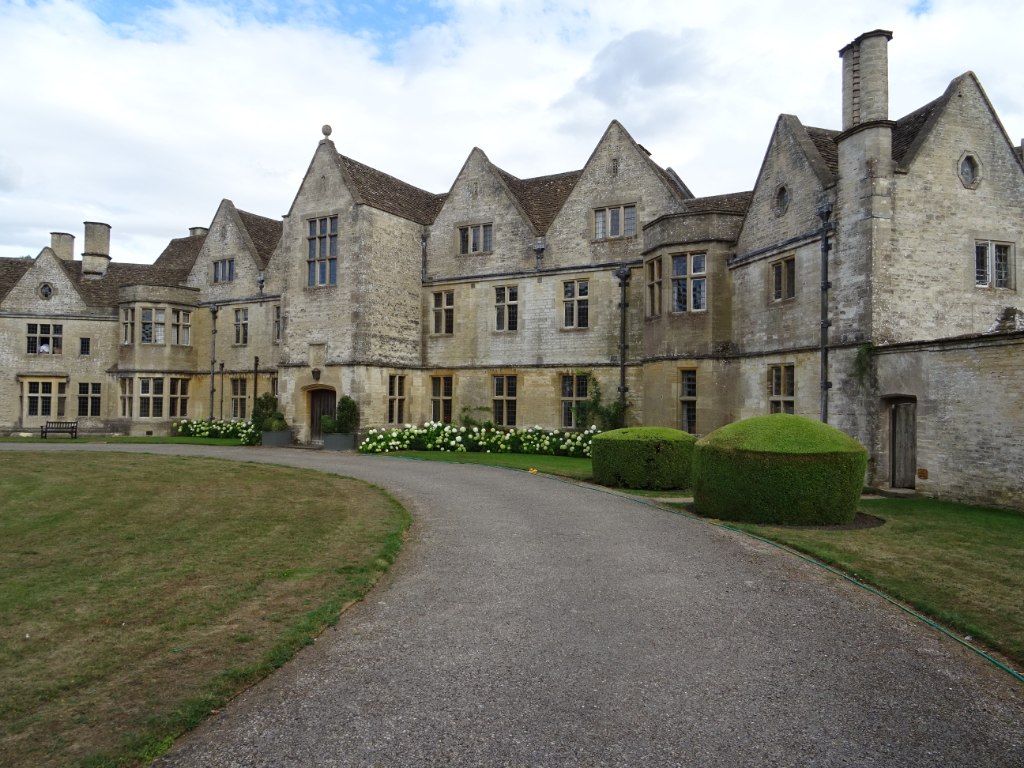
Rodmarton Manor is widely regarded as the largest building erected in the Arts and Crafts tradition in England. Conceived and built between 1909 and 1929 under the direction of architect Ernest Barnsley, it stands in the Cotswold village of Rodmarton as a living monument to the ideal that architecture, craft, and community are inseparable. Almost every object inside — furniture, metalwork, embroidery, rugs — was made by hand by estate craftsmen or local artisans, most of them working under the same roof they were helping to build.
Key facts
- Architects
- Ernest Barnsley (principal, 1909–1925); Sidney Barnsley (completion, 1926–1929)
- Built
- 1909–1929
- Address
- Rodmarton, Cirencester, Gloucestershire GL7 6PF, England
- Coordinates
- 51.6781° N, 2.0837° W
- Designation
- Grade I listed building (Historic England)
- Current use
- Private family home; open to visitors in summer
History
In 1909 Claud Biddulph, a banker and landowner, commissioned Ernest Barnsley to design a new country house on his Gloucestershire estate. Barnsley — who, together with his brother Sidney and their friend Ernest Gimson, had settled in the Cotswolds in the 1890s to practise craft-based architecture inspired by William Morris — seized the commission as an opportunity to realise Arts and Crafts principles at an unprecedented scale.
Rather than bringing in outside contractors, Barnsley drew exclusively on the skills of estate workers and local craftsmen. Masons, carpenters, blacksmiths, and weavers were trained on site; many later passed their skills to the next generation. Stone was quarried locally from the Cotswold limestone belt. Timber was felled from the estate’s own woodlands. This deep commitment to local material and labour gave the project a character that no catalogue of fittings or off-site factory could have replicated.
Construction proceeded slowly, wing by wing, over two decades. Ernest Barnsley died in 1925 before the work was finished; his brother Sidney took over and completed the house by 1929. During the Second World War the manor was requisitioned and parts of the building were used for military purposes, leaving some interiors in need of repair. The Biddulph family subsequently undertook careful restoration, respecting the original craft ethic throughout. The house remains in family ownership today.
What you see
From the approach the manor presents a long, low Cotswold-stone facade, its proportions unhurried and deeply rooted in the landscape. Steeply pitched stone-slate roofs, mullioned windows, and restrained surface ornament — all hallmarks of the Cotswold School — create a building that seems to have grown from the ground rather than been imposed upon it.
Inside, the principal rooms reveal the full range of craft skills deployed over the building’s lifetime. Furniture — dressers, settles, chairs, tables — was designed by Ernest Barnsley and made by estate joiners, with joinery details that prioritise honesty of construction over decorative concealment. Metalwork fittings on doors and fireplaces were forged in the estate smithy. Embroidered textiles and hand-woven rugs, many produced by the Biddulph family and their circle, hang and lie in rooms that were designed around them.
The gardens, designed in a series of outdoor rooms linked by yew hedges and dry-stone walls, are an equally important part of the Arts and Crafts conception. They include a leisure garden, a kitchen garden, a wildflower meadow, and a series of topiary walks — all maintained using traditional hand methods that mirror the philosophy of the house.
The Arts and Crafts tradition
The Arts and Crafts movement emerged in Britain in the second half of the nineteenth century as a reaction against the dehumanising effects of industrial mass production. Theorists such as John Ruskin and William Morris argued that meaningful work — work done by hand, with skill, and with knowledge of materials — was both morally superior and aesthetically richer than machine manufacture. Their ideas found architectural expression in buildings where designers and makers were one and the same.
The Cotswold School — a loose association of craftsmen centred on the villages around Chipping Campden and Cirencester — gave these ideas a regional identity. Ernest Gimson, the Barnsley brothers, and their associates brought furniture-making, metalworking, and vernacular masonry together under a single roof, producing work whose formal qualities derived directly from understanding materials and process.
Rodmarton is unusual — possibly unique — in the degree to which it sustained these ideals at architectural scale. Where most Arts and Crafts houses were designed by adherents of the movement but built and furnished using conventional trades, Rodmarton’s entire material culture was produced within a community of craftsmen directly answerable to the architect and patron. It is for this reason that the house is regarded not merely as a significant Arts and Crafts building but as the fullest physical realisation of what the movement believed architecture could be.
Visiting
Rodmarton Manor opens for guided house tours on selected dates in summer, typically from late May through August. Visitor numbers per tour are kept small to protect the interiors. The gardens open more frequently — on many weekend and weekday dates throughout the growing season — and are accessible independently of the house tours.
Group bookings for house and garden visits can be arranged in advance by contacting the estate directly. Photography inside the house is subject to the owners’ current policy; check before visiting. The manor participates in the Historic Houses network and admission may be included in membership schemes.
Booking in advance is recommended for house tours, which regularly sell out. Refreshments are not available on site; the nearby village of Rodmarton has no facilities, so visitors should plan accordingly.
Getting there
Rodmarton village lies approximately 10 kilometres west-south-west of Cirencester, in the southern Cotswolds. The easiest approach is by car: from Cirencester take the A433 westward toward Tetbury, then follow signs to Rodmarton. Parking is available at the manor on visiting days.
The nearest railway station is Kemble (on the Great Western Main Line between Swindon and Stroud), approximately 7 kilometres to the north-east. There is no regular bus service connecting Kemble to Rodmarton; visitors arriving by train will need to arrange a taxi or hire a bicycle. Taxis from Kemble can be pre-booked through local operators in Cirencester or Tetbury.
Sources
- Historic England, List Entry 1082424 — Rodmarton Manor, Grade I listed building.
- Anscombe, Isabelle. Arts and Crafts in Britain and America. Rizzoli, 1978.
- Davey, Peter. Arts and Crafts Architecture. Phaidon, 1995.
- Rodmarton Manor official website: rodmarton-manor.co.uk
- Wikimedia Commons: File:Rodmarton Manor (geograph 6014172).jpg, CC BY-SA 3.0
.jpg)
Find it on the map
See this place and what’s around it →📷 Become a Cultural Heritage Online photographer
Share your photos of places: they stay published under your name as the author. The more they're seen, the more you get noticed — and soon a contest will reward the most appreciated photos.
Log in or sign up free to add a photo