
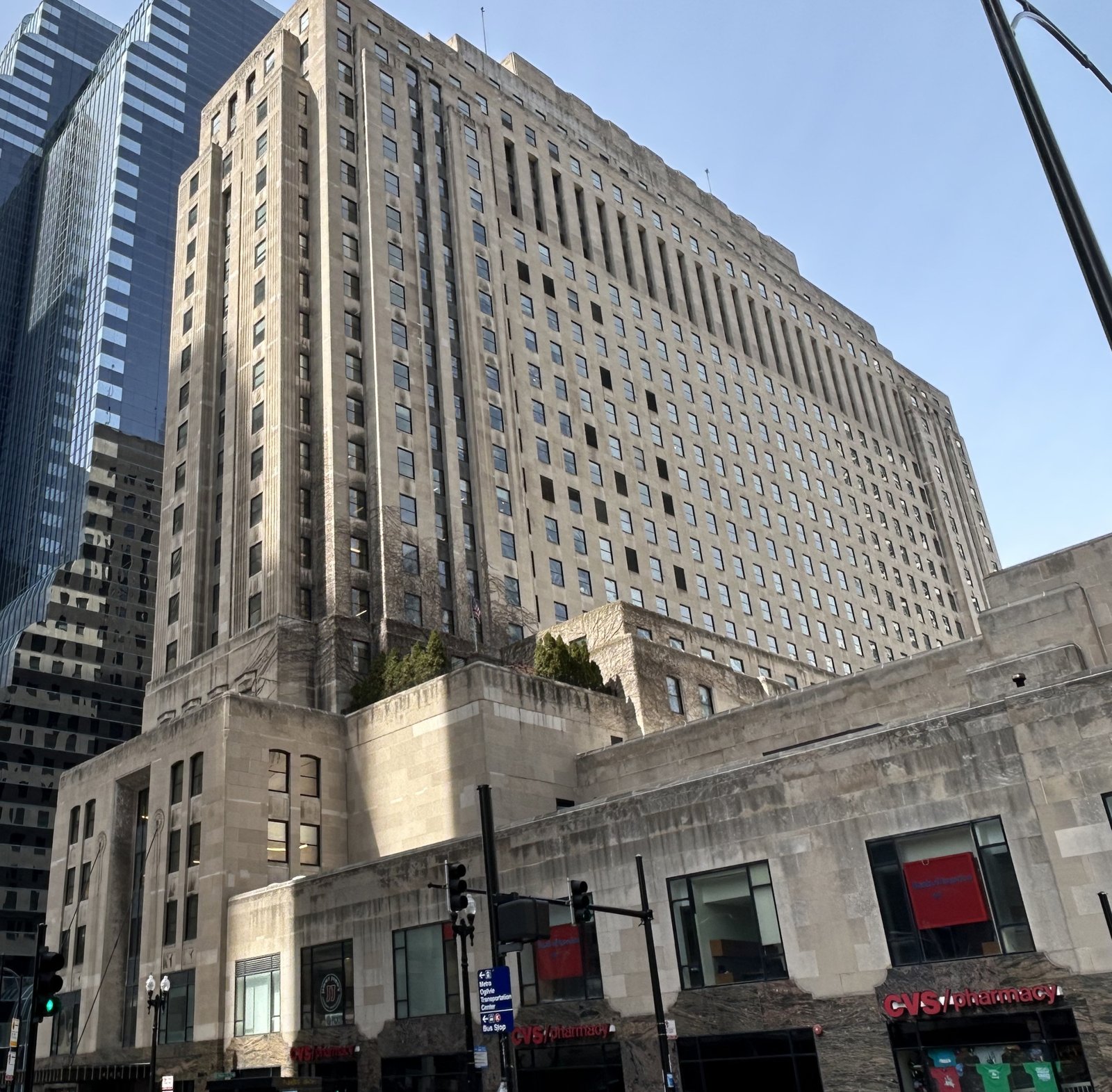
Completed in June 1929 as the Chicago Daily News Building, Riverside Plaza on the south bank of the Chicago River was designed by Holabird & Root as an Art Deco statement against the Gothic Tribune Tower — the first American skyscraper built over air rights above railroad tracks, and the first to incorporate an open-air plaza into its design.
At a glance
Riverside Plaza stands at 2 North Riverside Plaza in Chicago, Illinois, on the south bank of the Chicago River opposite the site of the Chicago Civic Opera House. Designed by Holabird & Root and completed in 1929 at a cost of $8 million, the 26-story Art Deco tower was built by Chicago Daily News publisher Walter A. Strong on air rights acquired over the railroad tracks running along the river’s west bank — an engineering first in the United States. The “Tribune”’s architecture critic later called it “one of Chicago’s finest examples of Art Deco architecture and a path-breaking work of engineering and urban design.” At 302 feet, it remains one of Chicago’s most significant early-modernist riverfront landmarks.
Key facts
- Completed: June 1929
- Original name: Chicago Daily News Building
- Style: Art Deco
- Architect: Holabird & Root (formerly Holabird & Roche)
- Developer: Chicago Daily News (Walter A. Strong)
- Stories: 26
- Height: 302 ft (92 m) at roof
- Cost: $8 million (1929)
- Distinction: First US skyscraper developed over railroad air rights; first US skyscraper with open-air plaza
- Address: 2 North Riverside Plaza, Chicago, Illinois
- GPS: 41.88255, −87.63922
History
The Chicago Daily News Building was commissioned in the mid-1920s when Walter A. Strong acquired the paper from the estate of Victor F. Lawson and determined to build a modern newspaper facility worthy of one of Chicago’s dominant dailies. Lawson had left a riverfront parcel that Strong found too small; instead, he negotiated for the air rights over the railroad tracks running along the Chicago River’s west bank — a process requiring a year and a half of meetings to reach agreement among the railroad and adjacent property owners. It was the first time in the United States that a major building had been constructed over operational railroad infrastructure using purchased air rights, establishing a model that would later transform urban real estate development across the country.
Strong commissioned Holabird & Root — the firm in the middle of its transition from Holabird & Roche — to design the 26-story tower. The resulting building was widely read as an architectural declaration of war against the Chicago Tribune’s 1925 Neo-Gothic Tribune Tower: where the Tribune’s building looked backward to medieval precedent, the Daily News building declared its modernity through a bold Art Deco façade with bas-reliefs of journalism’s patron saints — Benjamin Franklin, Joseph Pulitzer, Horace Greeley, and James Gordon Bennett among them. Inside, artist John W. Norton painted a celebrated mural divided into three sections depicting the stages of newspaper production: Gathering the News, Printing the News, and Transporting the News. The mural was removed in 1993 and placed in storage, where it has remained. The Daily News itself ceased publication in 1978; the building was subsequently renamed Riverside Plaza and now serves as a standard Chicago Loop office tower.
What you see
The Riverside Plaza facade is one of Chicago’s definitive examples of late-1920s commercial Art Deco at the skyscraper scale. The massing follows the setback formula established by New York’s 1916 zoning law: a broad base stepping back as the tower rises through its upper floors toward a flat-topped crown. The Art Deco ornament is concentrated at the base — where the bas-reliefs of journalism figures give the building an unusual iconographic program — and at the cornice levels, where geometric carved details give way to the smooth limestone surfaces of the upper stories.
The building’s relationship to the Chicago River is its most significant urban design feature. The open plaza at street level — a ramp concourse now serving Ogilvie Transportation Center — was the first such public exterior space incorporated into an American skyscraper design, anticipating by decades the plaza-tower typology that would reshape midcentury American cities. From the river walk, the building presents one of the cleanest Art Deco profiles in the Chicago Loop, its stone cladding reading as pale limestone against the darker masonry of the adjacent Union Station complex.
Practical information
- Active commercial office building; the street-level concourse and Chicago Riverwalk at its base are freely accessible.
- The exterior bas-reliefs and Art Deco ornament at the building’s base are best examined on foot from the riverfront.
- Located in the West Loop, one block west of the Chicago River, with direct access from Ogilvie Transportation Center (Metra commuter rail).
Getting there
Riverside Plaza is at 2 North Riverside Plaza in Chicago’s West Loop, one block west of the Chicago River. O’Hare International Airport (ORD) is approximately 17 miles northwest; Midway Airport (MDW) approximately 10 miles southwest. The building is directly adjacent to Ogilvie Transportation Center (Metra commuter rail) and walkable from CTA rapid transit stations on the Green, Pink, and Orange Lines at Clinton Street. By car, Interstate 90/94 (the Kennedy Expressway) runs a short distance to the north, with the Ohio Street exit providing the most direct approach.
Nearby
- Chicago Civic Opera House (1929) — the 45-story Art Deco tower directly across the river, built by Samuel Insull on the parcel that Walter Strong sold him; the Lyric Opera of Chicago performs there today
- Union Station (1925) — Daniel Burnham’s Beaux-Arts train station immediately to the south, its Great Hall one of the finest interior spaces in Chicago
- Tribune Tower (1925) — the Neo-Gothic rival that the Daily News Building was consciously designed to counter, approximately 1 mile northeast on North Michigan Avenue
Sources
- Wikipedia: “Riverside Plaza (Chicago)”
- Kamin, Blair. “A Hard Zell,” Chicago Tribune, October 19, 2000 (Art Deco architectural assessment)
- Strong, Walter A. “Air rights and the Chicago Daily News,” National Association of Building Owners and Managers, 1929
- Wikimedia Commons: 2_North_Riverside_Plaza_4701_(1).jpg, CC BY-SA 4.0, SecretName101
Find it on the map
See this place and what’s around it →Record researched and written by Luigi De Marchi for Cultural Heritage Online, 2026.
📷 Become a Cultural Heritage Online photographer
Share your photos of places: they stay published under your name as the author. The more they're seen, the more you get noticed — and soon a contest will reward the most appreciated photos.
Log in or sign up free to add a photoIs this page about you?
This page is read by travellers and heritage enthusiasts who find it on Google. Tell us how you are connected to this place and we will take it from there.