
Rio de Janeiro

Rio de Janeiro Sugarloaf mountain Corcovado Christ Redeemer Brazil UNESCO World Heritage landscape
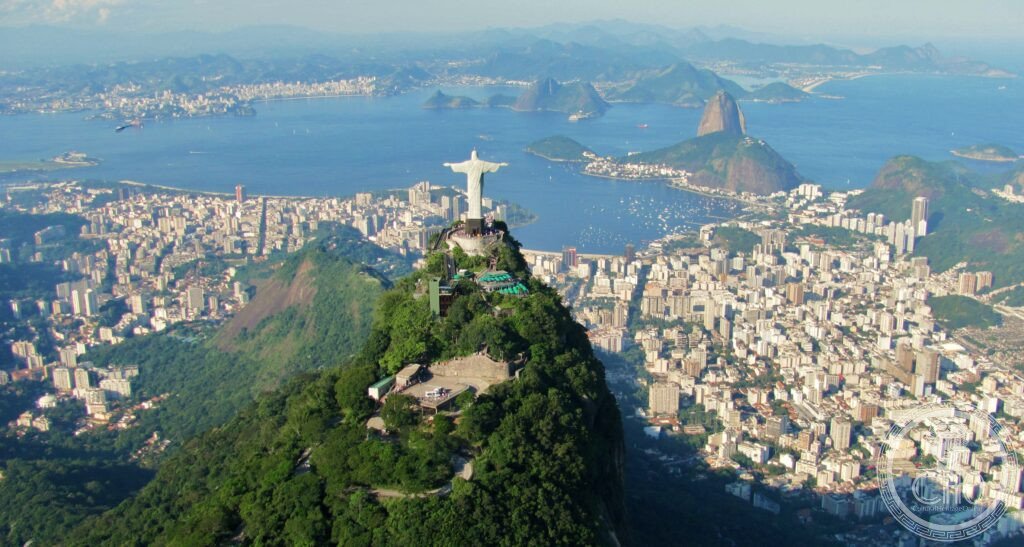
Rio de Janeiro (the view from the Sugarloaf gondola platform across the Guanabara Bay, the South Atlantic and the city spread between the mountains: the profile (the most geologically dramatic urban landscape in any major city on Earth: the vertical granite monoliths (Sugarloaf — Pão de Açúcar: 396 m — and Corcovado: 704 m — rising directly from the edge of the sea and the city’s beach districts; the Guanabara Bay (the largest bay in Brazil by water volume: 412 km² of deep-water Atlantic embayment flanked by rainforest-covered hills — the most scenically overpowered natural harbour in the world); Christ the Redeemer (Cristo Redentor; on the summit of Corcovado; the most globally recognised statue silhouette in South America: the 38-m reinforced concrete figure (1931) with arms spanning 28 m — the most widely reproduced single Christian statue in the 20th century; visible from 40 km — the most visible man-made landmark in Rio de Janeiro)); the forest (the Tijuca Forest — the largest urban rainforest in the world: 3,953 hectares of Atlantic Forest recovered by re-planting from 1861 onward — the most extensive urban reforestation project in the history of any major city in South America; the only urban forest in the world with a flowing river (the Rio Carioca) and a 35-m waterfall (Cascatinha de Taunay) inside it), Rio de Janeiro, Rio de Janeiro State, Brazil — UNESCO World Heritage Site (Rio de Janeiro: Carioca Landscapes between the Mountain and the Sea) 2012. Photo via Wikimedia Commons.
Rio de Janeiro State, Brazil · Christ the Redeemer (38m; arms 28m; 1931); Sugarloaf Mountain (396m; granite monadnock; cable car 1912 = first cable car in Brazil); Corcovado (704m); Guanabara Bay (412km²; largest bay in Brazil by volume); Tijuca Forest (3,953ha; largest urban rainforest in world; reforested 1861 onward); Copacabana + Ipanema beaches; Carnaval (largest street festival in world); founded 1565 by Portuguese; former capital of Brazil (1763-1960) and of the Portuguese colonial empire (1808-1821); Bossa Nova birthplace · UNESCO World Heritage (Carioca Landscapes) 2012

Rio de Janeiro

The most scenically extravagant city on Earth and the place where the Atlantic Ocean, the Atlantic Forest, the Portuguese colonial baroque, and the 20th-century Art Deco converge beneath a Christ figure that has, since 1931, been visible from any ship approaching the coast of Brazil.

At a glance

Rio de Janeiro (UNESCO WHS 2012 as “Rio de Janeiro: Carioca Landscapes between the Mountain and the Sea” — the most panoramically inscribed UNESCO WHS in South America (the inscription covers not a single monument but an entire urban landscape ensemble: the mountains, the forests, the beaches, and the bays); the most unusual UNESCO inscription in the Americas: a living city of 6.7 million people inscribed for its geographic beauty — the only major South American capital city inscribed primarily for its natural and scenic landscape rather than for its monuments or historic centre; the landscape (the most geologically dramatic urban setting in the world: the vertical granite inselbergs (Sugarloaf; Corcovado; the Two Brothers peaks (Dois Irmãos); the Pedra da Gávea (the world’s largest coastal monolith (844 m; freestanding granite with a near-vertical sea face; described in UNESCO nomination as the “most spectacular natural urban setting” in any city in the Americas); the Atlantic Forest (a remnant of the world’s most biodiverse rainforest; the Tijuca Forest (the largest urban tropical forest in the world (3,953 ha) was systematically restored between 1861 and 1874 by Dom Pedro II’s foresters — the most consequential single urban reforestation project in Brazilian history)).

Key facts

  • Christ the Redeemer and Corcovado: the most recognisable statue in South America — Cristo Redentor (the Christ the Redeemer statue: 38 m tall; base 8 m; arms span 28 m; weight 635 tonnes; built from reinforced soapstone-tile-faced concrete; opened on 12 October 1931 by President Getúlio Vargas — the most politically attended single monument opening in Brazilian history; designed by Brazilian engineer Heitor da Silva Costa and modelled by French sculptor Paul Landowski (the most frequently misattributed public sculpture in South America: the statue is widely credited to Landowski alone, but da Silva Costa designed the pose and the engineering — the most consequential design collaboration in Brazilian heritage construction); the view from the Corcovado summit (704 m; the finest 360° panorama in any major city in the world: Guanabara Bay to the east, the Atlantic to the south, the Tijuca Forest below, the city’s Zona Norte to the north — the most geographically informative single viewpoint in any city in the Americas); the cog railway (the Trem do Corcovado: 3.8 km rack railway built in 1884 (the oldest rack railway in Brazil — the most reliably historic single tourist transport experience in Rio de Janeiro); the most atmospherically scenic approach to a monument in Brazil: the train passes through dense Atlantic Forest for 20 minutes before emerging at the summit))
  • Sugarloaf Mountain (Pão de Açúcar): the most immediately recognisable mountain silhouette in South America — Pão de Açúcar (the Sugarloaf: 396 m; a bare granite monadnock rising directly from the entrance of Guanabara Bay; the name (the most frequently explained single geographic name in Rio: the shape resembles a loaf of refined sugar, the most important Portuguese colonial export from Brazil; OR the name comes from the indigenous Tupi phrase “Pau-nh-açuquã” (high, pointed, isolated hill) — the most actively debated etymology in Rio topography); the cable car (the first cable car in Brazil (1912 — the most historically pioneering single tourist infrastructure installation in Rio de Janeiro); the two-stage cable car (Praia Vermelha → Morro da Urca (230 m) → Sugarloaf summit (396 m))); the sunset from Sugarloaf (the most widely recommended single evening event in Rio by travel publications (The Guardian, Lonely Planet, Condé Nast Traveler, Le Monde: all four cite the Sugarloaf sunset as the single best experience in Rio — the most consistently recommended single heritage moment in South American tourism)))
  • Carnaval — the largest street festival in the world: the most attended single cultural event in Brazil — Carnaval (the Rio de Janeiro Carnival: the largest street festival in the world (approximately 7 million people per day at its peak — the most attended single daily street event in the world; occurring over the 4 days before Ash Wednesday); the Sambódromo (the official parade venue: the 700-m concrete parade avenue designed by Oscar Niemeyer (1984) — the most precisely designed single piece of spectator infrastructure in any city in Latin America; 100,000 spectator seats; the Rio Carnival parade venue that Niemeyer designed in 90 days — the most rapidly designed significant piece of public architecture in Brazilian history); the samba schools (the most complex single performance organisation in the world: each escola de samba (neighbourhood-based samba school) presents a 60–90 minute allegorical pageant; the school uses 3,000–5,000 performers; the 12 highest-ranked schools in the Grupo Especial compete — the most intensive single cultural competition in Brazil))
  • Heritage: UNESCO World Heritage Site, Rio de Janeiro: Carioca Landscapes between the Mountain and the Sea, inscribed 2012
  • GPS: -22.9068° N, -43.1729° E

History

Portuguese colonial history (Rio de Janeiro was founded on 1 March 1565 by Estácio de Sá (the most precisely dated founding of any major South American city — the most precisely documented colonial founding act in Brazilian history: the founding battle against the French and Tamoio Indians at the foot of Pão de Açúcar on 1 March is the most militarily decisive single date in Rio’s colonial history; the name (January river — named after Guanabara Bay, which the first Portuguese explorers mistook for the mouth of a great river in January 1502 — the most consequentially mistaken single geographical identification in Brazilian topographical history)); the colonial capital (1763: Rio became the capital of the viceroyalty of Brazil — the most politically important single administrative transfer in Portuguese colonial South America; 1808: João VI of Portugal moved the entire Portuguese royal court to Rio after Napoleon’s invasion of Portugal — the most extraordinary single colonial capital event in the Americas: for 13 years (1808–1821) Rio de Janeiro was the capital of the Portuguese Empire (the only time a major European empire was ruled from its colonial territory — the most unusual single chapter in colonial administrative history)); 1960: capital transferred to Brasília (UNESCO WHS 1987)); UNESCO WHS 2012.

What you see

The essential Rio sequence (the Corcovado and Christ the Redeemer (described in Key Facts; best in the morning before clouds form — arrive at 8am for the clearest view; the queue management system (online booking required in peak season; the most organised single tourist access in Rio heritage sites)); the Sugarloaf cable car (described in Key Facts; the sunset visit; the 6–7pm gondola for the sunset across the bay); the Tijuca Forest (the world’s largest urban rainforest; the Cascatinha de Taunay waterfall (the most accessible 35-m waterfall inside any urban park in the world; 20 min walk from the park entrance); the Vista Chinesa (the Chinese Pavilion viewpoint: the finest panorama over the Lagoa Rodrigo de Freitas and the Leblon/Ipanema beaches from the forest — the most atmospheric single urban viewpoint in the Tijuca Forest)); the beaches (Copacabana: 4 km of urban beach — the most densely peopled public beach in the world on a summer weekend; Ipanema: the more residential alternative; the Ipanema sunset from the Pedra do Arpoador rock promontory — the most locally popular single sunset spot in Rio and the quietest of the major panoramic viewpoints).

Practical information

  • Getting there: Galeão International Airport (GIG; the main international airport; 40 km north; 1h by BRT Transcarioca bus to Jardim Oceânico station; the most cost-effective single airport transfer in Rio at R$4 (approximately $0.75 USD); OR taxi (R$90–120; 45 min in off-peak hours); the real-time traffic situation (the most frequently misleading ETA in any South American city’s airport transfer: the 40 km can take 1h 30min in peak hours or 35 min at 6am — the most unpredictably variable single journey in Rio); Santos Dumont Airport (SDU; city-centre; 6 km from Copacabana; used for domestic flights only; the most convenient single airport for domestic connections to São Paulo (the most frequently flown Brazilian domestic route))); by bus from São Paulo (5h 30min; the most comfortable long-distance bus service in Brazil: the G7 and 1001 lines run double-decker sleeper buses (the most comfortable long-distance terrestrial connection between Brazil’s two largest cities))
  • Iguaçu Falls (UNESCO WHS 1984 and 1986, Argentina + Brazil): the most powerful waterfall system in the world — Iguaçu Falls (1,600 km south-west; 2h flight from Rio; the 2,700-m wide waterfall on the border between Argentina and Brazil; the largest waterfall system in the world by width and total water volume (70,000 m³/s in the flood season — the most water moved over a continuous waterfall in the world; the Garganta del Diablo (Devil’s Throat): a U-shaped 700-m wide, 82-m high cataract — the most viscerally overwhelming single waterfall in the world (Eleanor Roosevelt, upon seeing the falls: “Poor Niagara” — the most diplomatically devastating single comparison in the history of waterfall tourism)); the two sides (the Argentine side (UNESCO WHS 1984): better for walking beneath the falls; the Brazilian side (UNESCO WHS 1986): better for the panoramic overview; the most comprehensive coverage of the falls requires one day on each side))
  • Salvador da Bahia (UNESCO WHS 1985): the spiritual capital of Afro-Brazilian culture — Salvador (1,800 km north; 2h flight from Rio; the first capital of Brazil (1549–1763) and the largest city in the Bahia state; the Pelourinho historic centre (UNESCO WHS 1985): the largest and finest collection of Portuguese colonial architecture in the Americas (the most concentrated single colonial baroque townscape in any city in the Americas); the Candomblé (the Afro-Brazilian religion combining Yoruba, Fon, and Bantu traditions brought by enslaved West Africans (the most important single African religious tradition to survive in Brazil; Brazil received the largest number of enslaved Africans in the Americas (approximately 4 million — the most single largest enslaved African population in the Americas); Bahia was the port of entry for the majority — the most consequential single Brazilian state for the Atlantic Slave Trade); the blocos afro (the Afro-Brazilian carnival groups of Salvador: the most politically significant Carnaval tradition in Brazil; Ilê Aiyê (founded 1974 — the first all-Black bloco afro in Brazil, the most politically consequential single Carnaval founding in Brazilian cultural history))

Getting there

Galeão Airport (GIG) 40 km north (1h BRT bus R$4 / taxi 45min). Santos Dumont (SDU) for domestic. Online booking required for Corcovado/Christ Redeemer. Best morning visit: Corcovado 8am. Best evening: Sugarloaf sunset 6-7pm. GPS: -22.9068, -43.1729.

Nearby

  • Iguaçu Falls (UNESCO WHS 1984/1986) — 1,600 km south-west (2h flight); the most powerful waterfall system in the world — described in Practical section; the essential Brazil nature circuit: Rio de Janeiro (3 nights: Corcovado + Sugarloaf + Tijuca + Ipanema sunset) + Iguaçu (2 nights: Argentine side day 1 + Brazilian side day 2) + optional return via São Paulo
  • Petrópolis (Museu Imperial) and the Serra dos Órgãos — 65 km north (1h 30min by bus via the Serra Fluminense); the 19th-century summer capital of the Brazilian Empire and the finest mountain landscape accessible from Rio — Petrópolis (the Museu Imperial: the former summer palace of Dom Pedro II (the most historically significant single building in Petrópolis: the Crystal Palace (1884; an iron-frame greenhouse built in France and assembled in Brazil — the most directly imported single piece of European prefabricated architecture in 19th-century Brazil); the mountain scenery (the Serra dos Órgãos National Park: the Dedo de Deus (Finger of God) rock spire (1,692 m) — the most recognisable single rock spire in the Atlantic Forest; the most challenging single-day scramble accessible by bus from Rio))
  • Paraty Historic Town (UNESCO WHS 2019) — 260 km south-west (4h by bus); the finest preserved 18th-century colonial port town in Brazil and the original Gold Road terminal — Paraty (the most intact single colonial Portuguese grid town in Brazil: the Historic Centre was closed to motor vehicles in 1966 (the most forward-thinking single urban conservation decision in Brazilian heritage history; the cobblestone streets flood deliberately at high tide — the most unusual single drainage engineering decision in any colonial Brazilian town: the street level was set slightly below the tideline so the sea washes the streets twice a day; the Cachaça (the Paraty region is the most important single cachaça-producing region in Brazil: the artisan cachaça distilleries in the surrounding hills produce Brazil’s finest craft spirit; the most essential single food-tourism product of the Paraty visit)

Sources

  • Wikipedia, Rio de Janeiro; Christ the Redeemer; Sugarloaf Mountain; Tijuca Forest; Rio Carnival, accessed June 2026
  • UNESCO, Rio de Janeiro: Carioca Landscapes between the Mountain and the Sea, WHS reference 1100, inscribed 2012
  • Ruy Castro, Rio de Janeiro: Carnival under Fire, Bloomsbury, 2004

Hero image: Rio de Janeiro, Wikimedia Commons. Editorial text © Cultural Heritage Online, 2026.

📷 Diventa un fotografo di Cultural Heritage Online

Condividi le tue foto dei luoghi: restano pubblicate con la tua firma come autore. Più vengono viste, più ti fai conoscere — e presto un concorso premierà le foto più apprezzate.

Accedi o registrati gratis per aggiungere una foto
📋 Copy & share on social
Scroll to Top