

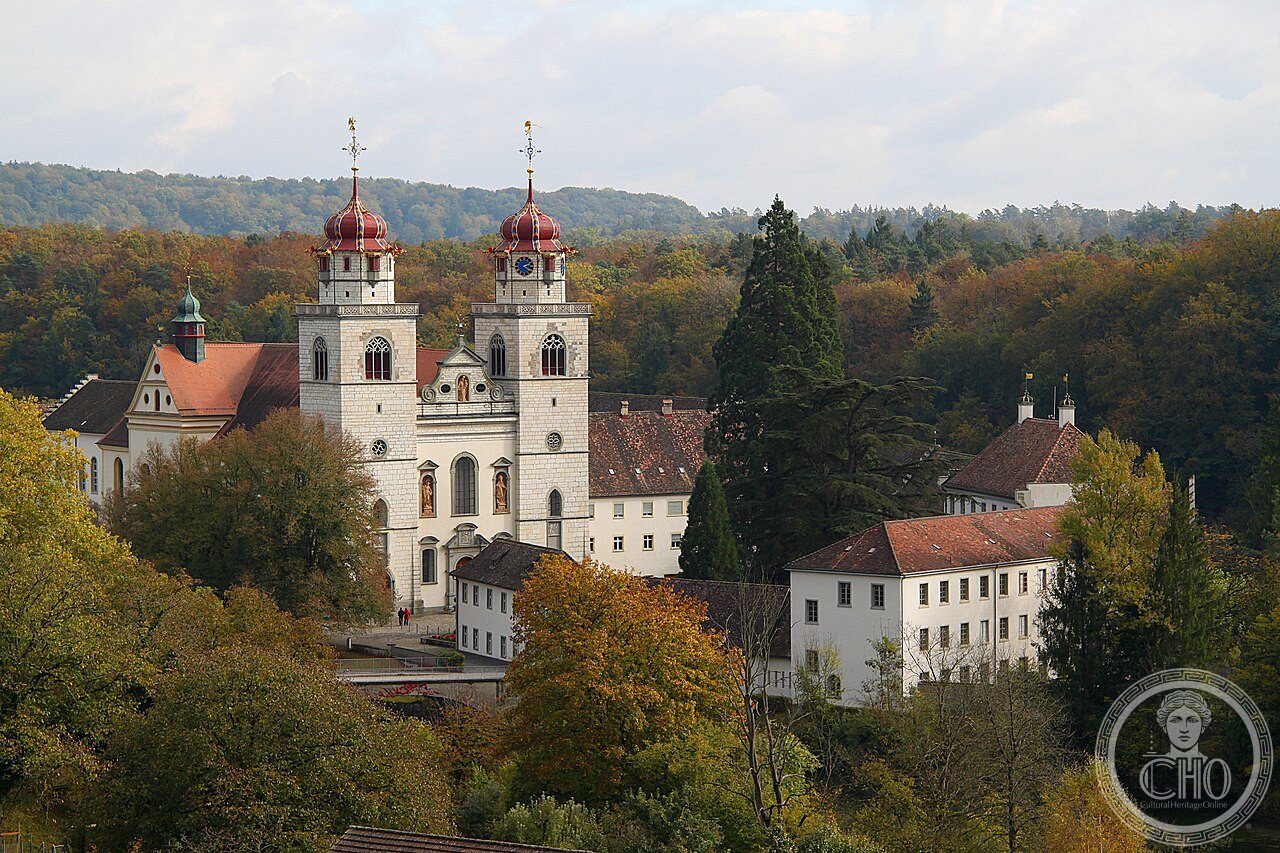
Having escaped Viking slavers, the Irish monk Findan (Fintan) spent twenty-two years as a hermit at Rheinau, between 851 and 878, on an island in the Rhine where the Benedictine monastery founded around 778 already stood. In the eighteenth century Abbot Gerold II Zurlauben transformed the complex, with work finished in 1744, into one of the most sumptuous examples of Swiss Baroque.
About Rheinau Abbey
Rheinau Abbey (Kloster Rheinau), a Benedictine monastery on an island in the Rhine in the canton of Zurich, was founded around 778 and suppressed in 1862. Among its most notable early residents was the Irish monk Saint Findan (Fintan), who, after escaping Viking slave traders, lived at the abbey as a hermit for twenty-two years, from 851 to 878. A Romanesque basilica was dedicated at the abbey in 1114, and the still-extant abbey archive was begun in 1120; the scriptorium flourished through the 12th century. In the 18th century, under Abbot Gerold II Zurlauben, Rheinau — like the comparably significant St. Gallen — experienced a late institutional resurgence: Zurlauben had the entire monastic complex magnificently rebuilt in Baroque style, construction continuing until 1744, giving the abbey much of its present appearance. The result, formerly the collegiate church of St. Maria, is considered one of the most sumptuous showpieces of high Baroque architecture in Switzerland. The abbey was temporarily suspended during the turmoil of the French Revolution and the French invasion of Switzerland in 1798, restored in 1803, before the cantonal council of Zurich finally decreed its dissolution in 1862.
Key facts
- Foundation: c. 778, Benedictine monastery on a Rhine island in the canton of Zurich
- Saint Findan (Fintan): Irish monk who escaped Viking slave traders and lived as a hermit at Rheinau for 22 years, 851-878
- Romanesque basilica: dedicated 1114; abbey archive begun 1120; scriptorium flourished in the 12th century
- Baroque rebuilding: under Abbot Gerold II Zurlauben, completed 1744; one of Switzerland’s most sumptuous high Baroque buildings
- 1798 suspension: during the French Revolutionary invasion of Switzerland; restored 1803
- Dissolution: 1862, by decree of the Zurich cantonal council
History
Saint Findan’s specific biography — an Irish monk who survived Viking enslavement before eventually settling into a 22-year hermitage at Rheinau — situates the abbey within the broader, often violent context of 9th-century Viking raiding across the British Isles and the wider movement of displaced individuals fleeing that violence into Continental European monastic institutions, giving Rheinau a documented connection to one of early medieval Europe’s most disruptive and far-reaching patterns of forced migration and enslavement. His subsequent decades-long hermitage at the island abbey, culminating in his veneration as a saint, reflects a common medieval pattern in which individuals with traumatic personal histories found lasting spiritual purpose and eventual sanctity through committed monastic withdrawal.
Abbot Gerold II Zurlauben’s 18th-century Baroque reconstruction, explicitly compared to St. Gallen’s own contemporary resurgence, situates Rheinau within the broader wave of ambitious Baroque-era rebuilding that transformed numerous aging medieval Swiss and South German monasteries during this period, each institution using contemporary architectural fashion to assert renewed institutional confidence and prosperity. The abbey’s eventual 1862 dissolution by cantonal decree, following its earlier survival of the 1798 French Revolutionary disruption, situates Rheinau within the broader 19th-century pattern of Swiss cantonal governments — often driven by liberal, anticlerical political currents — dissolving Catholic monastic institutions whose landholdings and privileges increasingly conflicted with emerging secular civic administration.
What you see
The Baroque abbey church, product of Abbot Zurlauben’s 18th-century rebuilding campaign completed in 1744, is widely regarded as one of Switzerland’s most sumptuous high Baroque interiors, rewarding a slow, detailed visit. The abbey’s setting on its own Rhine island gives the complex a distinctive, physically separated character, popularly known today as the “Musikinsel” (Music Island) for its use as a cultural and educational institution. The surviving 1120 archive connects the site to its documented medieval institutional history.
Practical information
- Opening hours: generally open daily, check current hours before visiting; free admission to the church
- Address: Klosterplatz, 8462 Rheinau, Switzerland
Getting there
Rheinau has direct rail connections from Zurich (approximately 1 hour, with a change) and Schaffhausen (approximately 30 minutes). By car, Rheinau sits in the canton of Zurich near the German border. GPS: 47.6421° N, 8.6073° E.
Nearby
- Rhine Falls (Rheinfall) — Europe’s largest waterfall, a short distance away near Schaffhausen
- Schaffhausen old town — a well-preserved historic centre, approximately 30 minutes away
- Reichenau Island — a separate, UNESCO-listed monastic island on Lake Constance, not to be confused with Rheinau
Sources
- Wikipedia — “Rheinau Abbey” (en.wikipedia.org)
- Switzerland Tourism — “Rheinau abbey island” (myswitzerland.com)
- Omnium Sanctorum Hiberniae — “Saint Fintan of Rheinau” (omniumsanctorumhiberniae.com)
Find it on the map
See this place and what’s around it →📷 Become a Cultural Heritage Online photographer
Share your photos of places: they stay published under your name as the author. The more they're seen, the more you get noticed — and soon a contest will reward the most appreciated photos.
Log in or sign up free to add a photo