

According to the Passio Placidi, a twelfth-century hagiographic text, Victor, head of the region of Chur, had the local landowner Placidus killed to stop the church’s lands from expanding. Bishop Tello, to make amends for the murder, left vast estates to the abbey. In 800 Charlemagne visited the rebuilt monastery in person, on his way back from Rome.
About Disentis Abbey
Disentis Abbey, a Benedictine monastery in the Canton of Grisons in eastern Switzerland’s upper Surselva valley, traces its origins to the Frankish monk Sigisbert, who — travelling alongside wandering Celtic monks up the Rhine and inspired by the monastic ideals of Columbanus and Luxeuil — established a hermitage in the then-uninhabited area known as Desertina, setting up his cell under the protection of Saint Martin. The abbey’s traditional foundation date of 614, attributed jointly to Sigisbert and the local magnate and landowner Placidus who supported him, is now understood through archaeological evidence to more likely fall between 700 and 720. According to the 12th-century hagiographic text known as the “Passio Placidi,” Victor, the regional leader of Chur, had Placidus murdered specifically to prevent further church land acquisition; Bishop Tello subsequently bequeathed extensive properties to the abbey, allegedly as compensation for this killing. The abbey’s strategic position on the Lukmanier Pass route drew imperial attention: Charlemagne personally visited the rebuilt abbey in 800, on his return journey from Rome. The complex underwent major Baroque refurbishment between 1683 and 1704, with the monastery church of St. Martin built in 1712. In 1799, Napoleon’s soldiers burned and plundered the abbey, destroying manuscripts and a printing press and costing the community half its estates; Abbot Anselm Huonder subsequently rebuilt the institution.
Key facts
- Foundation: traditionally 614, more likely early 8th century (700-720), by the Frankish monk Sigisbert with support from local magnate Placidus
- Placidus’s murder: according to the “Passio Placidi” (12th century), ordered by Victor of Chur to block church land acquisition; Bishop Tello’s subsequent bequest enriched the abbey
- Charlemagne’s visit: 800, on his return from Rome, reflecting the abbey’s strategic Lukmanier Pass position
- Baroque rebuilding: 1683-1704; monastery church of St. Martin built 1712
- 1799 destruction: burned and plundered by Napoleon’s troops; manuscripts and printing press destroyed, half the estates lost
- Rebuilding: under Abbot Anselm Huonder following the Napoleonic destruction
- Setting: near the source of the Rhine, in the upper Surselva valley, Grisons
History
The “Passio Placidi” narrative, whatever its precise historical accuracy as a 12th-century hagiographic composition rather than a contemporary account, situates Disentis’s early institutional wealth within a documented medieval pattern of monasteries receiving substantial episcopal land grants explicitly framed as moral or spiritual compensation for violence connected to the institution’s founding circle — Bishop Tello’s bequest, whatever its precise motivations, gave Disentis the territorial and economic foundation for its subsequent centuries of regional significance across the upper Rhine valley. Charlemagne’s personal 800 visit, occurring during his return journey from the Roman coronation that made him Holy Roman Emperor, gives Disentis a direct documented connection to one of the most consequential political events in early medieval European history, the abbey’s strategic position on the Lukmanier Pass explaining the emperor’s specific interest in this otherwise remote Alpine monastery.
The 1799 Napoleonic destruction, part of the broader French Revolutionary and Napoleonic Wars’ disruption of Swiss and Alpine monastic institutions, cost Disentis not only physical structures but irreplaceable manuscripts and its printing press — a specific loss of documented intellectual and cultural heritage typical of the broader wave of monastic destruction and secularisation that swept much of Catholic Europe during this period. Abbot Anselm Huonder’s subsequent rebuilding effort, restoring the abbey despite losing half its estates, reflects the resilience many Alpine monastic communities demonstrated in recovering from Napoleonic-era devastation, even when full restoration of lost economic resources proved impossible.
What you see
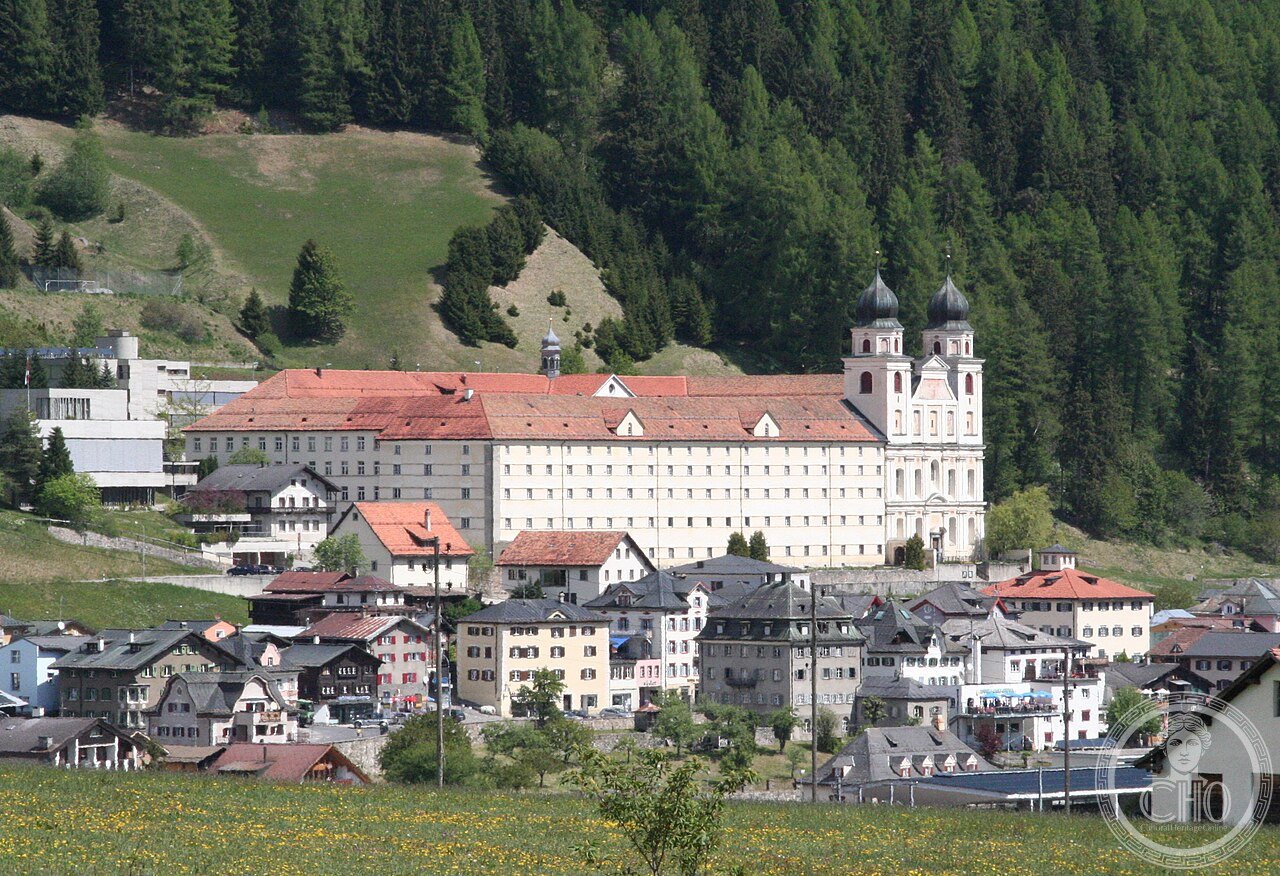
The Baroque monastery church of St. Martin, built in 1712 as part of the 1683-1704 rebuilding campaign, is the abbey’s principal architectural showpiece. The abbey’s setting near the source of the Rhine, in the dramatic upper Surselva valley of the Grisons, gives the complex a striking Alpine backdrop. The abbey’s continuing role as an active Benedictine monastery and school connects its long institutional history directly into the present.
Practical information
- Opening hours: generally open daily, check current hours before visiting; free admission to the church
- Address: Via Sogn Sigisbert, 7180 Disentis/Mustér, Switzerland
Getting there
Disentis/Mustér has direct rail connections from Chur (approximately 1.5 hours) via the Glacier Express route. By car, Disentis sits on the Lukmanier Pass road in the Grisons. GPS: 46.7067° N, 8.8552° E.
Nearby
- Rhine source (Tomasee) — the small mountain lake near Mount Badus, source of the Vorderrhein
- Lukmanier Pass — the historic Alpine pass route, connecting to Ticino
- Chur — approximately 1.5 hours away; Switzerland’s oldest town
Sources
- Wikipedia — “Disentis Abbey” (en.wikipedia.org)
- Switzerland Tourism — “Disentis Monastery – Benedictine Abbey” (myswitzerland.com)
- Andermatt-Sedrun-Disentis — “Discover Disentis Monastery” (andermatt-sedrun-disentis.ch)
Find it on the map
See this place and what’s around it →📷 Become a Cultural Heritage Online photographer
Share your photos of places: they stay published under your name as the author. The more they're seen, the more you get noticed — and soon a contest will reward the most appreciated photos.
Log in or sign up free to add a photo