

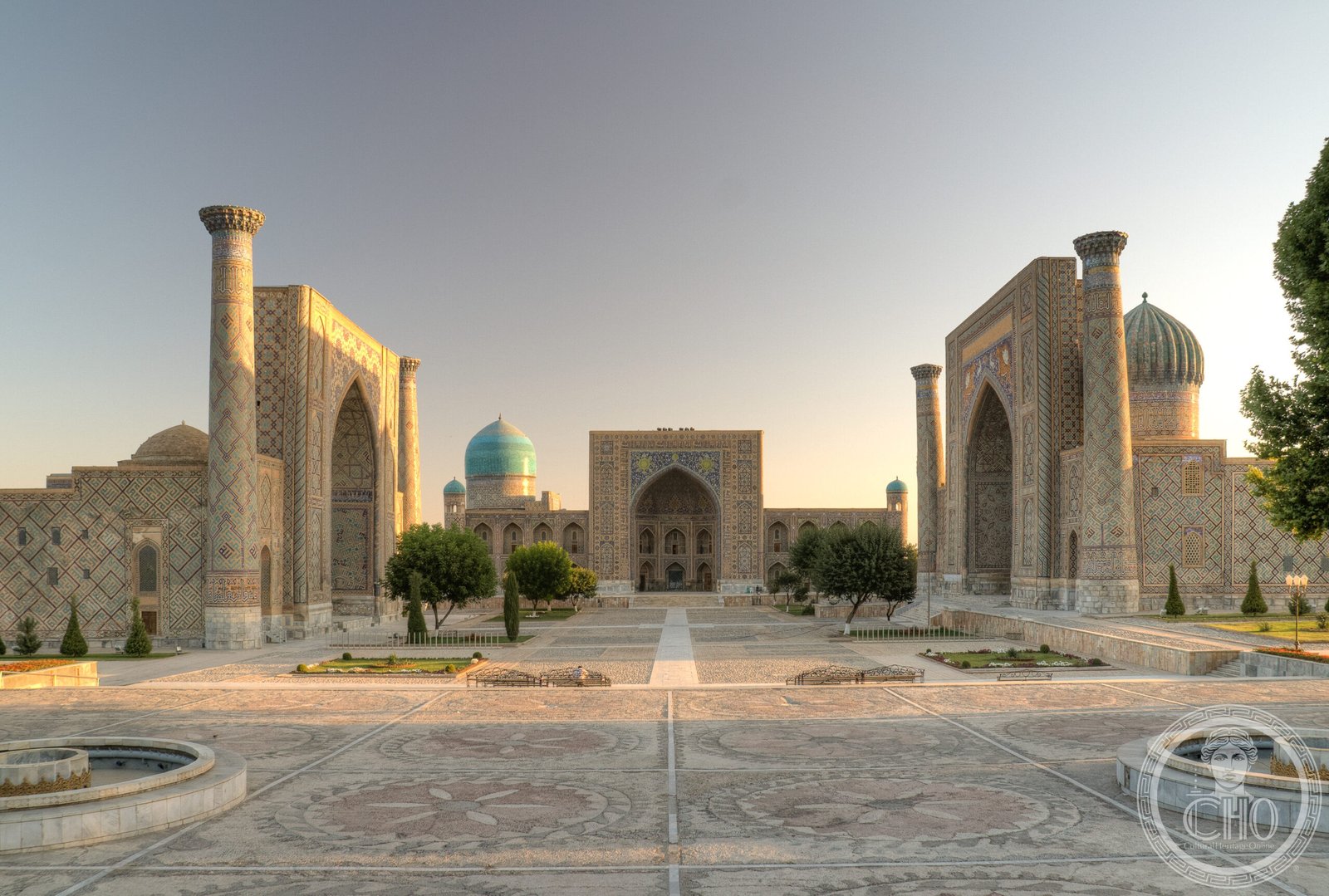
A ceremonial square in Samarkand anchored by three monumental madrasas, the Registan stands as a masterwork of Timurid Islamic architecture and a testament to the city’s role as a cultural crossroads.
At a glance
The Registan—whose name means “place of sand” in Persian—comprises three Islamic schools built across two centuries. The Ulugh Beg Madrasa represents the earlier Timurid period, while the Sherdar and Tilakari madrasas were constructed later under the Janid dynasty. All three buildings face the same plaza, creating an integrated architectural ensemble of exceptional scale and decoration.
History
The square’s early history is rooted in the Sarbadar uprising of 1365. Several decades after the Mongol conquest of Samarkand, a Friday mosque was built on this site, transforming the Registan into a center of civic and religious life. Over time it became a stage for power and ceremony: announcements were broadcast from enormous copper pipes called dzharchis, and public executions were held here. The three madrasas rose sequentially, the Ulugh Beg Madrasa anchoring the square during the Timurid Renaissance before the later structures were added.
What you see
Each madrasa is distinguished by soaring entrance portals, intricate tilework, and interior courtyards designed for teaching Islamic law and theology. The buildings employ muqarnas—the honeycomb vaulting characteristic of Islamic architecture—throughout their decorative schemes. Geometric patterns in turquoise, cobalt, and cream tile the façades, while calligraphy and arabesque designs enrich the interiors.
Cultural significance
The Registan embodied Samarkand’s identity as the hub of the Timurid Renaissance, when the city rivaled Baghdad and Cairo as a center of Islamic learning, art, and architecture. The square served as both a functional marketplace and ceremonial ground where the city’s political, religious, and intellectual life converged. The three madrasas remain among the finest examples of late-medieval Islamic architecture.
Key facts
- Location: Samarkand, Uzbekistan (39.65°N, 66.98°E)
- Three madrasas: Ulugh Beg (Timurid period), Sherdar (Janid), and Tilakari (Janid)
- Historic use: public square for proclamations, ceremonies, and executions
- Architectural feature: muqarnas vaulting and tilework in geometric and calligraphic patterns
Practical information & getting there
The Registan is located in central Samarkand. Detailed visiting hours and admission fees are best confirmed with local tourism authorities or your accommodation.
Sources & resources
Find it on the map
See this place and what’s around it →📷 Become a Cultural Heritage Online photographer
Share your photos of places: they stay published under your name as the author. The more they're seen, the more you get noticed — and soon a contest will reward the most appreciated photos.
Log in or sign up free to add a photoIs this page about you?
This page is read by travellers and heritage enthusiasts who find it on Google. Tell us how you are connected to this place and we will take it from there.