
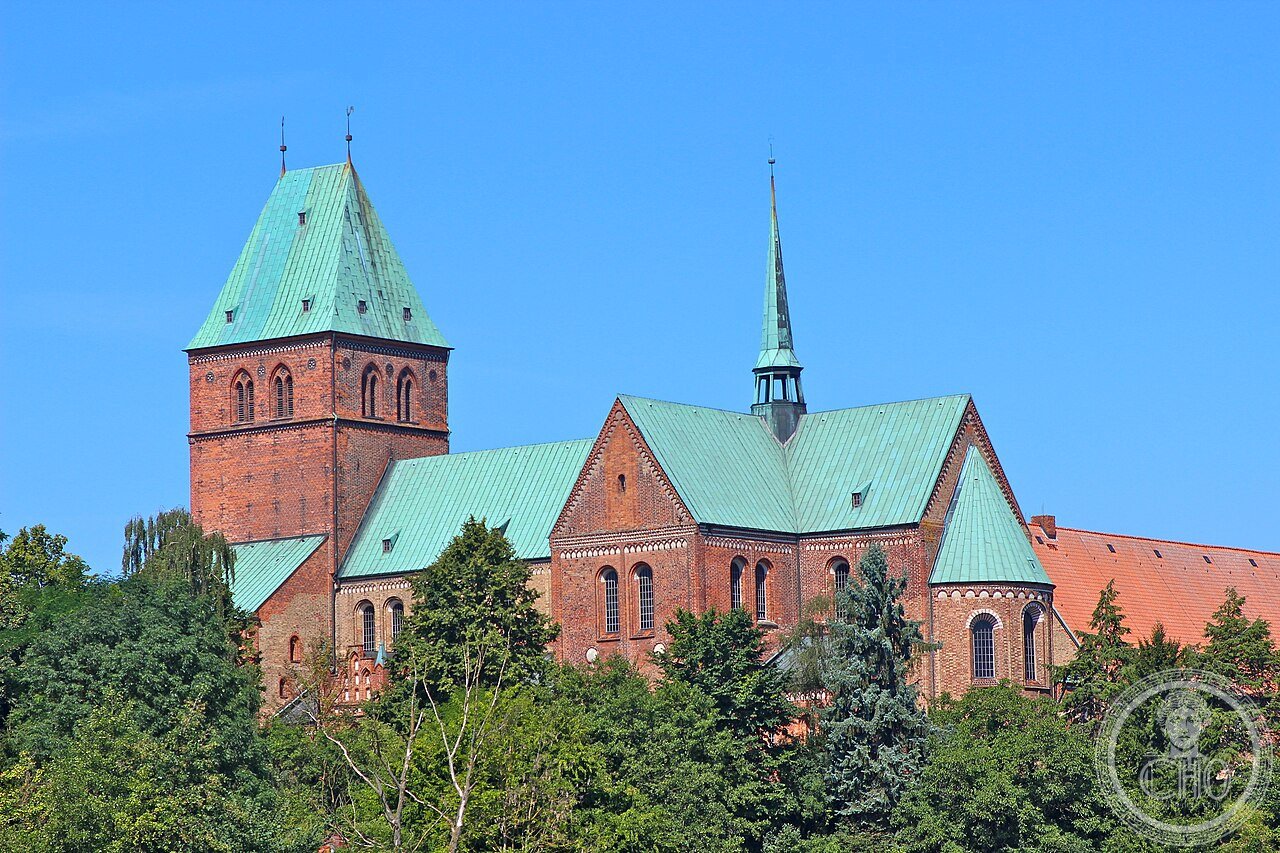
In 1154 Henry the Lion, Duke of Saxony, refounded together with Archbishop Hartwich I the episcopal see of Ratzeburg. The cathedral works, begun around 1165 and finished in 1220, produced one of the oldest brick churches in northern Germany — and it still defines the skyline of its island town encircled by four lakes.
About Ratzeburg Cathedral
Ratzeburg Cathedral stands at the heart of Ratzeburg, an island town in the Herzogtum Lauenburg district of Schleswig-Holstein, its historic centre surrounded by four lakes: the Großer Ratzeburger See, Großer Küchensee, Kleiner Küchensee, and Domsee. Henry the Lion, Duke of Saxony, became ruler of the town in 1143, and in 1154 he and Hartwich I, Archbishop of Hamburg, refounded the episcopal seat of Ratzeburg, installing Evermodus as its first bishop. Construction of the cathedral itself, initiated by Henry the Lion around 1165, was completed in 1220, and the resulting late Romanesque building — a three-nave basilica built in cross form with a square choir bay and semicircular apse, constructed in the characteristic north German “red-brick” style — remains one of the oldest brick churches in northern Germany and continues to define the island town’s silhouette today.
Key facts
- Episcopal refoundation: 1154, by Henry the Lion, Duke of Saxony, and Hartwich I, Archbishop of Hamburg; Evermodus installed as first bishop
- Construction: initiated c. 1165 by Henry the Lion, completed 1220; late Romanesque, red-brick basilica with three naves in cross form
- Significance: one of the oldest brick churches in northern Germany
- Setting: on Ratzeburg’s island old town, surrounded by four lakes
- Artistic treasures: medieval choir stalls, an early Gothic triumphal cross (c. 1260), a Passion relief on the winged altar (1420), and a carved Renaissance pulpit (1576)
- Historic organ: one of the earliest organs in northern Germany dated to the cathedral, from 1230
- Saint Ansverus: canonised in the 12th century, his relics entombed in the cathedral
History
Henry the Lion’s involvement in refounding Ratzeburg’s episcopal seat in 1154 and personally initiating the cathedral’s construction around 1165 places the building directly within his broader, historically significant programme of eastward German territorial and ecclesiastical expansion into formerly Slavic-inhabited lands along the Baltic and its associated river and lake systems — a programme for which Henry the Lion remains one of the most consequential figures in 12th-century German history, also responsible for founding or refounding numerous other towns and bishoprics across the region during the same broad period. The choice of brick as the primary building material, rather than the stone more typical of Romanesque church construction further south and west in Germany, reflects the specific geological reality of the North German Plain, where suitable building stone was scarce but good clay for brickmaking was locally abundant — a practical constraint that produced the distinctive “Backsteinromanik” (brick Romanesque) and later “Backsteingotik” (brick Gothic) architectural traditions across the entire North German and Baltic region, of which Ratzeburg’s cathedral stands as one of the earliest and most historically significant surviving examples.
The cathedral’s continuing decorative accumulation across subsequent centuries — the early Gothic triumphal cross around 1260, the 1420 Passion relief winged altar, and the 1576 Renaissance pulpit — reflects centuries of sustained artistic patronage layered onto the original late Romanesque architectural shell, giving the building a decorative history spanning from the 13th through the 16th centuries even as its core structure remained substantially unchanged from Henry the Lion’s original building campaign. The presence of Saint Ansverus’s relics, entombed at the cathedral following his 12th-century canonisation, adds a further specific devotional dimension to the building’s medieval history, connecting it to broader patterns of regional saints’ cults across northern German ecclesiastical institutions of the period.
What you see
The cathedral’s red-brick Romanesque exterior, among the oldest surviving examples of this North German building tradition, gives visitors direct access to an architectural style whose material logic — locally abundant clay rather than scarce building stone — shaped church construction across the entire Baltic-facing region for centuries afterward. Inside, the accumulated decorative history spanning the 13th to 16th centuries — the early Gothic triumphal cross, the 1420 Passion relief altar, and the 1576 Renaissance pulpit — rewards a slow circuit of the nave and choir. The cathedral’s setting on Ratzeburg’s lake-surrounded island town offers additional scenic value, with the building’s silhouette visible across the surrounding water from multiple vantage points.
Practical information
- Opening hours: generally open daily, check current hours before visiting; free admission
- Address: Domhof 35, 23909 Ratzeburg
Getting there
Ratzeburg has direct rail connections from Lübeck (approximately 30 minutes) and Hamburg (approximately 1 hour, typically with a change). By car, Ratzeburg sits just off the A20/A24 motorway network. The cathedral stands on the island old town at the heart of Ratzeburg. GPS: 53.7039° N, 10.7750° E.
Nearby
- Ratzeburg lakes — surrounding the island town; a popular boating and outdoor recreation area
- Lübeck — approximately 30 minutes by train; a UNESCO World Heritage Hanseatic old town with its own major brick Gothic churches
- Naturpark Lauenburgische Seen — the surrounding lake district nature park
Sources
- Herzogtum Lauenburg — official visitor information, “Ratzeburger Dom” (herzogtum-lauenburg.de/en)
- Wikipedia — “Ratzeburg” and “Ratzeburg Cathedral” (en.wikipedia.org)
- SpottingHistory — heritage documentation (spottinghistory.com)
Find it on the map
See this place and what’s around it →📷 Become a Cultural Heritage Online photographer
Share your photos of places: they stay published under your name as the author. The more they're seen, the more you get noticed — and soon a contest will reward the most appreciated photos.
Log in or sign up free to add a photo