
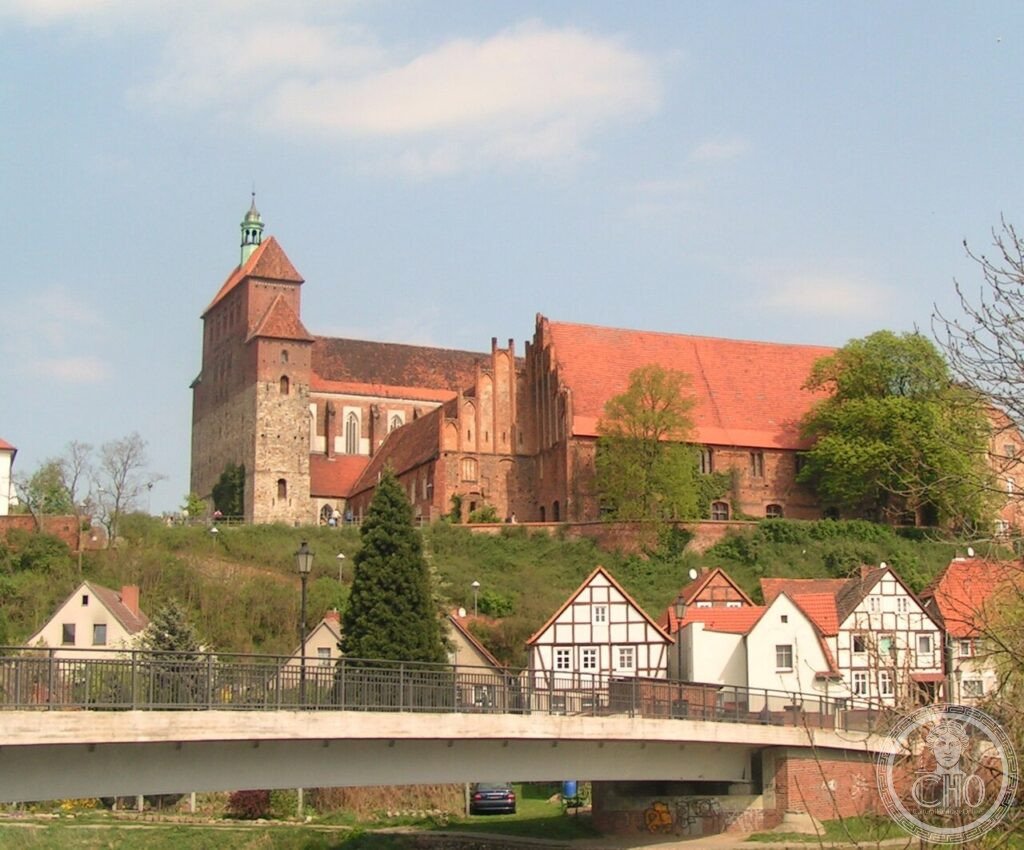
Already mentioned in 948 as a diocesan seat, Havelberg waited two centuries before the Premonstratensian monks built, between 1150 and 1170, the Romanesque basilica that still commands the river Havel from a steep promontory. A fire in 1279 forced a rebuilding in Gothic style; since the Reformation the cathedral has been Protestant, and the abbey was dissolved in 1819.
About Havelberg Cathedral
Havelberg was first documented in 948 as a diocesan town, but construction of the Dom St. Marien cathedral and its associated Premonstratensian monastery did not begin until the 12th century, when Premonstratensian canons built the church between 1150 and 1170 as a Romanesque basilica, consecrated in the latter year. The building suffered severe fire damage in 1279, prompting a substantial reconstruction in the Gothic style layered onto the surviving Romanesque core — the combination that gives the cathedral its present Romanesque-Gothic character. Since the Protestant Reformation, the cathedral has served a Lutheran congregation, and the associated abbey was formally dissolved in 1819. The building’s most striking physical characteristic is its setting: perched on a steep hill above the town island and the Havel river, the cathedral towers over the surrounding region from a promontory just north of Havelberg’s old town centre, reached today by a bridge over the connecting canal and a staircase linking the town centre to the hilltop.
Key facts
- Diocesan origins: first documented 948 as a diocesan town, well before the present cathedral’s construction
- Construction: 1150-1170, by Premonstratensian canons, as a Romanesque basilica; consecrated 1170
- 1279 fire: severe damage prompted reconstruction in Gothic style, layered onto the surviving Romanesque structure
- Confessional status: Protestant (Evangelical/Lutheran) since the Reformation; the associated Premonstratensian abbey was dissolved in 1819
- Setting: a steep hilltop promontory above the town island and the Havel river, connected to the old town by a bridge and staircase
History
Havelberg’s early documentation as a diocesan town in 948 places its ecclesiastical origins within the Ottonian-era push to establish Christian episcopal authority across Slavic-inhabited territories east of the Elbe, a missionary and administrative effort that faced significant setbacks — including periods of outright loss of Christian control in the region — before the Premonstratensian canons’ 12th-century arrival finally established the lasting monastic and cathedral community whose building survives today. The roughly two-century gap between Havelberg’s initial 948 documentation and the cathedral’s actual 1150-1170 construction reflects this turbulent intervening period, during which the nominal diocese existed without necessarily possessing a stable, continuously functioning cathedral establishment on the ground.
The 1279 fire and subsequent Gothic-style reconstruction exemplify a pattern common to numerous German Romanesque churches of the period, in which serious fire damage — a constant hazard for large medieval buildings incorporating substantial timber elements alongside stone — provided the practical occasion for architectural modernisation, allowing congregations and patrons to update a building’s style to contemporary Gothic taste under the guise of necessary structural repair rather than pure aesthetic replacement. The cathedral’s transition to Protestant use following the Reformation, and the abbey’s eventual 1819 dissolution, situate Havelberg within the broader pattern of former Catholic monastic institutions across Protestant German territories being secularised in stages from the 16th through the early 19th centuries, with the cathedral building itself continuing in active religious use throughout this long institutional transition even as its monastic community around it was formally wound down.
What you see
The cathedral’s hilltop setting is its single most memorable visual characteristic, offering commanding views over the Havel river and surrounding countryside that few comparable German cathedrals can match, given how unusually elevated and physically separated from the town centre the building stands. Inside, the combination of surviving Romanesque structural elements with the Gothic reconstruction undertaken after the 1279 fire gives the building a legible two-phase architectural history. The cloisters, part of the former Premonstratensian monastic complex, extend the site’s historical interest beyond the cathedral church itself, and the adjoining Prignitz Museum offers further regional historical context for visitors.
Practical information
- Opening hours: Tuesday-Saturday 10:00-17:00, Sunday 12:00-17:00; free admission to the church and cloisters
- Prignitz Museum: separate paid admission, approximately €4
- Address: Domplatz, 39539 Havelberg
Getting there
Havelberg is reachable by regional train (via Glöwen or Wittenberge) and by bus from Stendal or Rathenow. By car, Havelberg sits on the B107/B188 road network. From the town centre, a bridge and staircase lead up to the cathedral hill. GPS: 52.8268° N, 12.0788° E.
Nearby
- Havelberg old town — on the town island below the cathedral hill; a well-preserved small historic centre
- Havelberger Pferdemarkt — an annual horse market and folk festival, one of the oldest and largest of its kind in Germany
- Brandenburg an der Havel — further along the Havel river; home to its own significant cathedral, Brandenburg Cathedral
Sources
- Straße der Romanik — “St. Mary’s cathedral, Havelberg” (strassederromanik.de/en)
- Transromanica — “Ev. St. Mary’s cathedral and former Premonstratensian Monastery, Havelberg” (transromanica.com)
- Kulturstiftung Sachsen-Anhalt — “Havelberg Cathedral” (kulturstiftung-st.de/en)
- Wikipedia — “Havelberg Cathedral” (en.wikipedia.org)
Find it on the map
See this place and what’s around it →📷 Become a Cultural Heritage Online photographer
Share your photos of places: they stay published under your name as the author. The more they're seen, the more you get noticed — and soon a contest will reward the most appreciated photos.
Log in or sign up free to add a photoIs this page about you?
This page is read by travellers and heritage enthusiasts who find it on Google. Tell us how you are connected to this place and we will take it from there.