

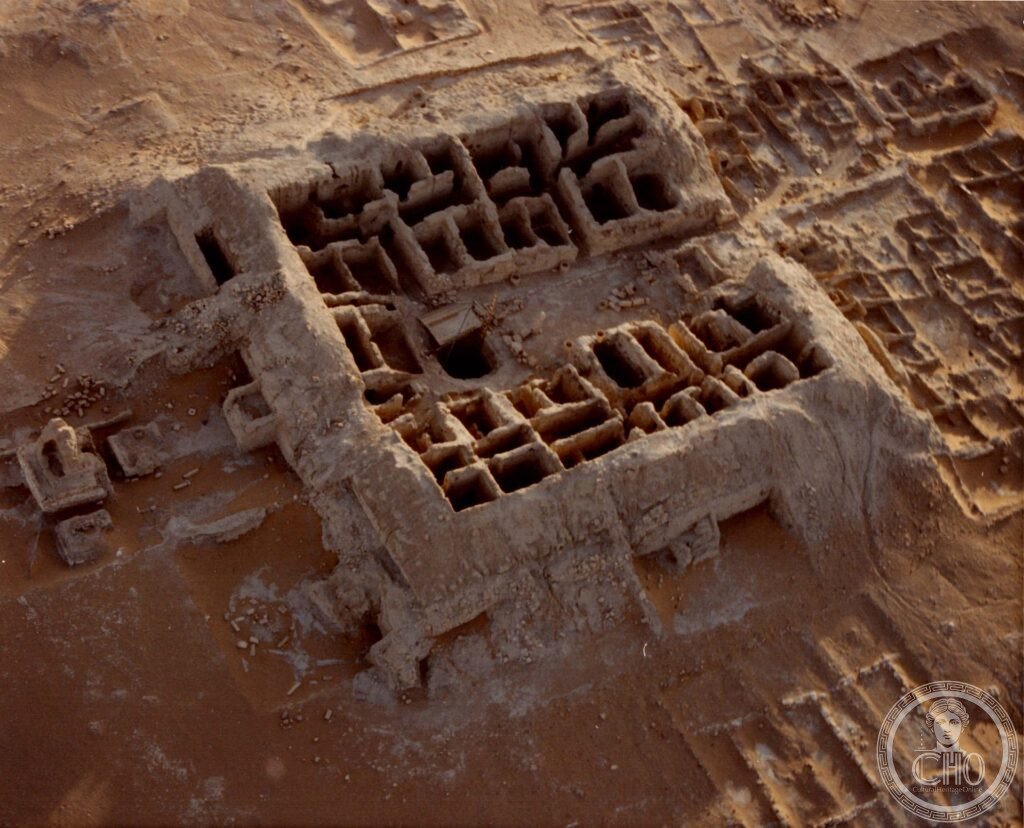
At the edge of the great Rub’ al-Khali desert, the sands have kept the remains of Qaryat al-Faw for centuries: a caravan city that was the capital of a pre-Islamic Arab kingdom and a crossroads of the incense routes. Temples, markets, tombs and inscriptions tell of a refined Arabian civilisation that flourished a thousand years and more before Islam.
At a glance
Qaryat al-Faw, in south-central Saudi Arabia at the edge of the Rub’ al-Khali (Empty Quarter), is the remarkably preserved site of a pre-Islamic caravan city. Flourishing in the first millennium BC and the early centuries AD, it was a capital of the kingdom of Kindah and a major crossroads on the trade routes carrying incense and goods across Arabia. Excavations have revealed a planned city of houses, markets, temples, tombs, wells and wall paintings, with inscriptions in early Arabian scripts. This window onto pre-Islamic Arabian civilisation was inscribed by UNESCO in 2024.
Key facts
- UNESCO: World Heritage since 2024 (Cultural Landscape of Al-Faw Archaeological Area)
- Caravan city: a hub on the ancient Arabian trade routes
- Kingdom of Kindah: a capital of the pre-Islamic Arab kingdom
- Incense routes: at a crossroads of the incense trade
- Planned city: houses, markets, temples, tombs and wells
- Early inscriptions: texts in early Arabian scripts
History
Long before Islam, southern and central Arabia were crossed by caravan routes carrying frankincense, myrrh and other goods, and at a pass (faw) on the edge of the Empty Quarter grew the city of Qaryat al-Faw. Watered by wells and oases, it became a capital of the Arab kingdom of Kindah and a prosperous trading and religious centre, with a temple, a market, fine houses, painted tombs and a sophisticated culture that blended Arabian with wider influences.
Abandoned and buried by the desert, the city was rediscovered and excavated by Saudi archaeologists from the 1970s, revealing one of the most important pre-Islamic sites in Arabia and shedding light on the peoples, languages and beliefs of the peninsula before Islam. It was inscribed by UNESCO in 2024.
What you see
The site, set against the dunes of the Empty Quarter, reveals the excavated foundations of the ancient city: the residential quarter, the market, the temple, the wells and irrigation works, and, in the surrounding desert, rock inscriptions and the burial grounds with their tombs. Finds from the city are displayed in Saudi museums.
The buried desert city, capital of a forgotten Arabian kingdom, is the fascination of Qaryat al-Faw.
Practical information
- Site: a remote desert archaeological area; access is developing
- Time needed: a few hours
- Note: very remote, on the edge of the Empty Quarter
- Setting: in south-central Saudi Arabia
Getting there
Qaryat al-Faw is in south-central Saudi Arabia, near the edge of the Rub’ al-Khali, south of Riyadh on the route toward Wadi al-Dawasir. Access is by desert road. GPS: 19.76° N, 45.15° E.
Nearby
- Wadi al-Dawasir — the nearest large settlement
- Rub’ al-Khali — the great Empty Quarter desert
- Riyadh — the Saudi capital, far to the north
Sources
- UNESCO World Heritage Centre — “Cultural Landscape of Al-Faw Archaeological Area” (ref. 1712)
- Saudi Heritage Commission — official body
- Encyclopaedia Britannica — Arabia, history of; Kindah
Find it on the map
See this place and what’s around it →📷 Become a Cultural Heritage Online photographer
Share your photos of places: they stay published under your name as the author. The more they're seen, the more you get noticed — and soon a contest will reward the most appreciated photos.
Log in or sign up free to add a photo