

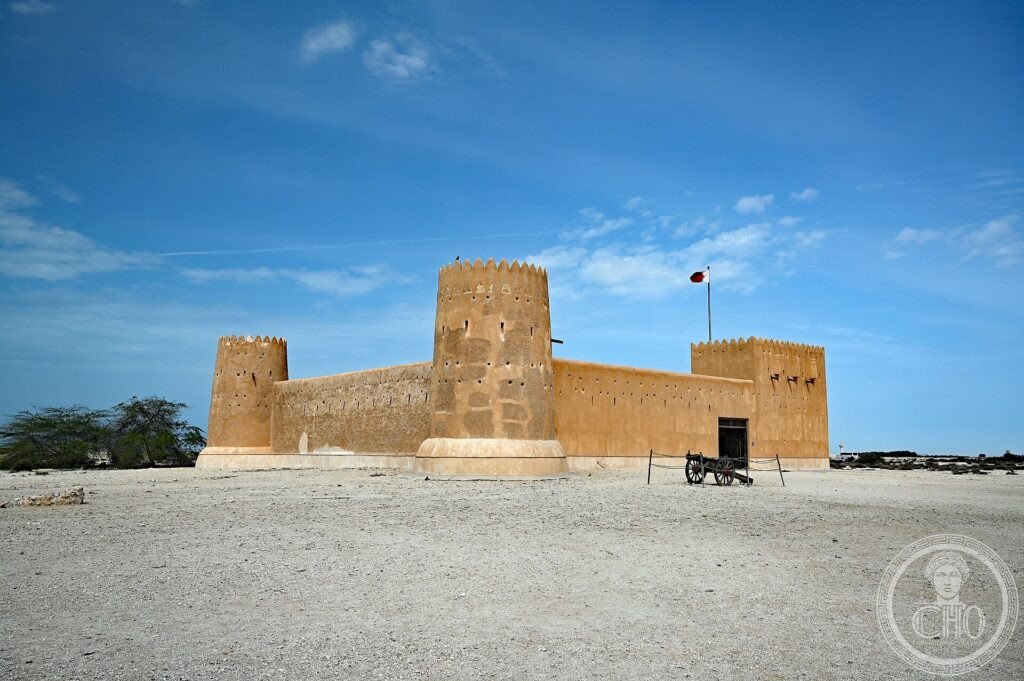
On the north-western coast of Qatar, the sands have buried and preserved the remains of Al Zubarah: one of the largest and best-preserved pearling and merchant towns of the Gulf. Founded in the eighteenth century, it grew rich on the pearl trade before being abandoned, leaving a rare portrait of life in the Gulf before oil.
At a glance
Al Zubarah, on the north-western coast of Qatar, is one of the largest and best-preserved examples of an 18th–19th-century pearling and trading town in the Gulf. Founded by merchants in the mid-18th century, it grew rich on the pearl trade and long-distance commerce, with a walled town, palaces, mosques, houses, markets and harbour, before declining and being abandoned, after which the sand preserved its remains. With its later fort still standing, it offers a rare picture of Gulf life before oil. It was inscribed by UNESCO in 2013.
Key facts
- UNESCO: World Heritage since 2013 (Al Zubarah Archaeological Site)
- Pearling town: a major centre of the Gulf pearl trade
- Founded: in the mid-18th century by merchants
- Preserved by sand: abandoned, then buried and protected
- Walled town: palaces, mosques, houses, markets and harbour
- The fort: a 20th-century fort marks the site
History
In the 18th century, merchants — many of them from Kuwait and the wider Gulf — founded Al Zubarah on the Qatari coast, and it grew rapidly into a thriving port, its wealth built on diving for the pearls that were the Gulf’s great export, and on trade across the Indian Ocean. The town was walled and densely built, with the homes of merchants, mosques, souks and a harbour protected by a sea wall.
Conflict and shifting trade led to its decline and eventual abandonment in the 19th and early 20th centuries, and the desert reclaimed it, preserving the street plan and buildings beneath the sand. Excavated in recent times and marked by an early 20th-century fort, Al Zubarah was inscribed by UNESCO in 2013 as an exceptionally complete pearling and trading town of the Gulf.
What you see
The restored Al Zubarah Fort, with its ochre walls and round corner towers, houses a visitor centre and overlooks the vast archaeological site beyond, where excavation and survey have revealed the walls, houses, courtyards, mosques and markets of the buried town and its harbour. The desert and sea around it complete the setting.
The fort against the desert, and the buried town it guards, evoke the lost world of the Gulf pearling era.
Practical information
- Site: the fort and visitor centre, and the excavated town
- Best time: the cooler months (November–March)
- Time needed: a few hours
- Setting: on the north-west coast of Qatar
Getting there
Al Zubarah is on the north-western coast of Qatar, about 100 km north-west of Doha, reached by road. GPS: 25.98° N, 51.03° E.
Nearby
- Doha — the Qatari capital, to the south-east
- Al Khor — a coastal town to the east
- The northern coast — the desert shore of the peninsula
Sources
- UNESCO World Heritage Centre — “Al Zubarah Archaeological Site” (ref. 1402)
- Qatar Museums — official body
- Encyclopaedia Britannica — Qatar
Find it on the map
See this place and what’s around it →📷 Become a Cultural Heritage Online photographer
Share your photos of places: they stay published under your name as the author. The more they're seen, the more you get noticed — and soon a contest will reward the most appreciated photos.
Log in or sign up free to add a photo