
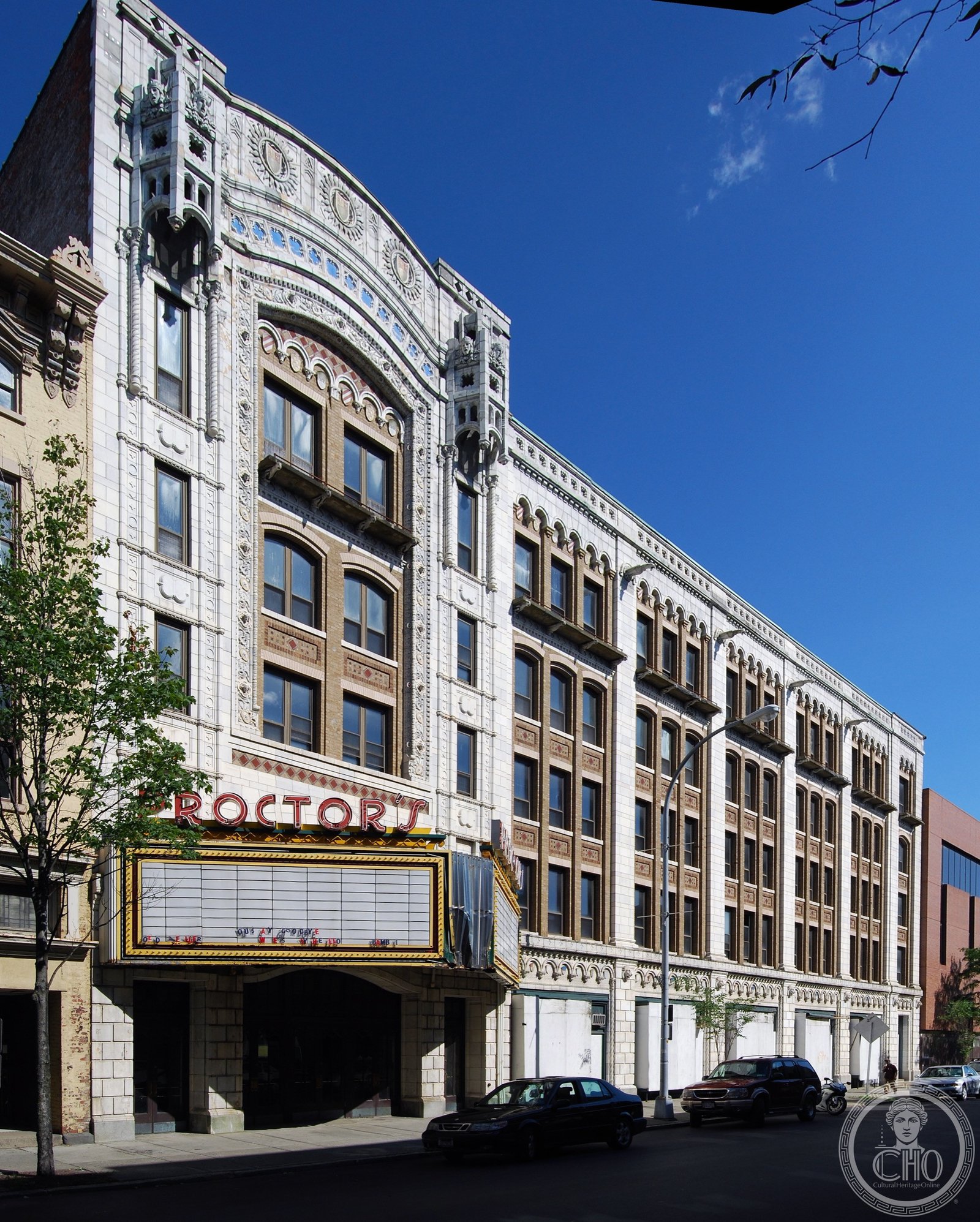
Opened in 1914 as the flagship of Frederick Freeman Proctor’s vaudeville circuit in upstate New York, Proctor’s Theatre on State Street is Troy’s oldest surviving theater, a restored Beaux-Arts landmark that now anchors the Capital District’s performing arts scene alongside its Schenectady counterpart.
At a glance
Proctor’s Theatre at 432 State Street in Troy, New York opened in 1914 as the Troy venue of the F.F. Proctor vaudeville circuit — the empire built by Frederick Freeman Proctor, one of the dominant figures in American vaudeville from the 1880s through the 1920s. The Beaux-Arts facade and ornate auditorium were designed to attract a broad cross-section of Troy society to the polished vaudeville entertainment Proctor’s circuit was known for. After closure and a period of dormancy, the building has been restored and serves the Troy community as a performing arts venue, anchoring the city’s ongoing downtown revitalization alongside arts institutions on River Street and the Hudson Mohawk Industrial Gateway.
Key facts
- Address: 432 State Street, Troy, NY 12180
- Opened: 1914
- Style: Beaux-Arts
- Founded by: Frederick Freeman Proctor (1851–1929), vaudeville impresario
- Circuit: F.F. Proctor chain (later merged with RKO)
- Current use: live performances, community events, Film Forum screenings
History
Frederick Freeman Proctor began his entertainment career as a circus performer and became one of the architects of American vaudeville’s golden age. His circuit eventually included dozens of theaters across New York and New England, with particular strength in the Capital District and upstate cities. Proctor operated on a philosophy of “polished vaudeville” — clean, family-appropriate entertainment at affordable prices — that distinguished his venues from the rougher variety halls that competed for working-class audiences in the late nineteenth century.
The Troy theater opened in 1914 as one of the Proctor circuit’s flagship upstate venues, designed in the Beaux-Arts manner then standard for major-market vaudeville houses. Troy in 1914 was still a significant industrial city — the center of American collar manufacturing and a major iron and steel producer — with a population and commercial life capable of supporting a theater of the Proctor’s scale. As vaudeville declined in the 1920s, the theater transitioned to film; the Proctor circuit eventually merged with RKO, the film and theater conglomerate.
Troy’s subsequent deindustrialization and population loss reduced the theater’s commercial viability through the mid-twentieth century. The building’s subsequent history includes periods of closure and preservation advocacy typical of historic vaudeville-era theaters in declining industrial cities. Restoration efforts have returned the building to active performing arts use, and the theater is now part of the broader Proctor’s organization that also operates the Schenectady Proctor’s Theatre (itself a major regional performing arts center).
What you see
Proctor’s Theatre’s State Street facade presents a multi-story Beaux-Arts composition with classical pilasters, arched window openings at the upper levels, and decorative terracotta ornament in the frieze. The building’s scale — taller than the surrounding commercial buildings — asserts the theater’s civic importance in Troy’s downtown. The vertical composition, with its emphasis on classical detail carried up through multiple stories, is characteristic of the Beaux-Arts theater architecture of the 1910s.
The auditorium interior has been restored with attention to the ornamental plasterwork of the original design. The deep horseshoe plan provides good sight lines from the balcony to the proscenium stage, a configuration that served both vaudeville acts and the film programs that succeeded them.
Practical information
- Programming: check the Troy calendar for Proctor’s events and Film Forum screenings
- Parking: public parking on State Street and in garages near Monument Square; the theater is walkable from Troy’s downtown and from the Troy ferry landing
- Time needed: 15 minutes for exterior; 2–3 hours for a performance
Getting there
Troy is on the eastern bank of the Hudson River immediately north of Albany, accessible via I-787 and the Collar City Bridge. Albany-Rensselaer Amtrak station (ALB) is approximately 5 miles south via the Collar City Bridge; CDTA bus service connects Albany and Troy via the Routes 22/222 corridor. Albany International Airport (ALB) is approximately 10 miles southwest.
Nearby
- Monument Square — the civic heart of Troy at the intersection of Third Street and Broadway, anchored by the Soldiers’ and Sailors’ Monument; 5 minutes on foot from the theater
- Hudson Mohawk Industrial Gateway — the Burden Iron Works Museum and its preserved industrial complex at 1 East Industrial Parkway commemorates Troy’s role as a nineteenth-century iron production center
- Rensselaer Polytechnic Institute — one of the oldest technological universities in the United States, founded 1824 on the heights above downtown Troy; campus on Eighth Street with views over the Hudson Valley
Sources
- Proctor’s Theatre, Troy (proctors.org)
- Waite, Diana. Architectural Elements of Troy and Rensselaer County. Troy: Troy Architectural Program, 1987.
Find it on the map
See this place and what’s around it →Record researched and written by Luigi De Marchi for Cultural Heritage Online, 2026.
📷 Become a Cultural Heritage Online photographer
Share your photos of places: they stay published under your name as the author. The more they're seen, the more you get noticed — and soon a contest will reward the most appreciated photos.
Log in or sign up free to add a photoIs this page about you?
This page is read by travellers and heritage enthusiasts who find it on Google. Tell us how you are connected to this place and we will take it from there.