
In the semi-arid valleys of Oaxaca, prehistoric caves yielded the earliest evidence of plant domestication in the Americas while Zapotec civilisation built some of Mesoamerica’s most extraordinary stone-mosaic architecture — earning UNESCO recognition in 2010 for the exceptional convergence of human origins archaeology and living pre-Hispanic heritage.
At a glance
The UNESCO World Heritage Site encompasses two main components in the Central Valley of Oaxaca: the hilltop archaeological site of Yagul and the extraordinary Zapotec religious centre of Mitla, along with a scatter of prehistoric caves in the surrounding semi-arid landscape. Together they document 12,000 years of human activity in this valley, from the earliest plant domestication to the height of Zapotec civilisation. Guilá Naquitz cave, near Yagul, provided archaeologists with the earliest confirmed evidence of domesticated squash (c. 10,000 BP) and early maize domestication anywhere in the Americas.
Key facts
- UNESCO inscription: 2010 (List No. 1352).
- Period: c. 10,000 BP (cave evidence) through 1500 CE (Zapotec).
- Location: Central Valley of Oaxaca state, Mexico.
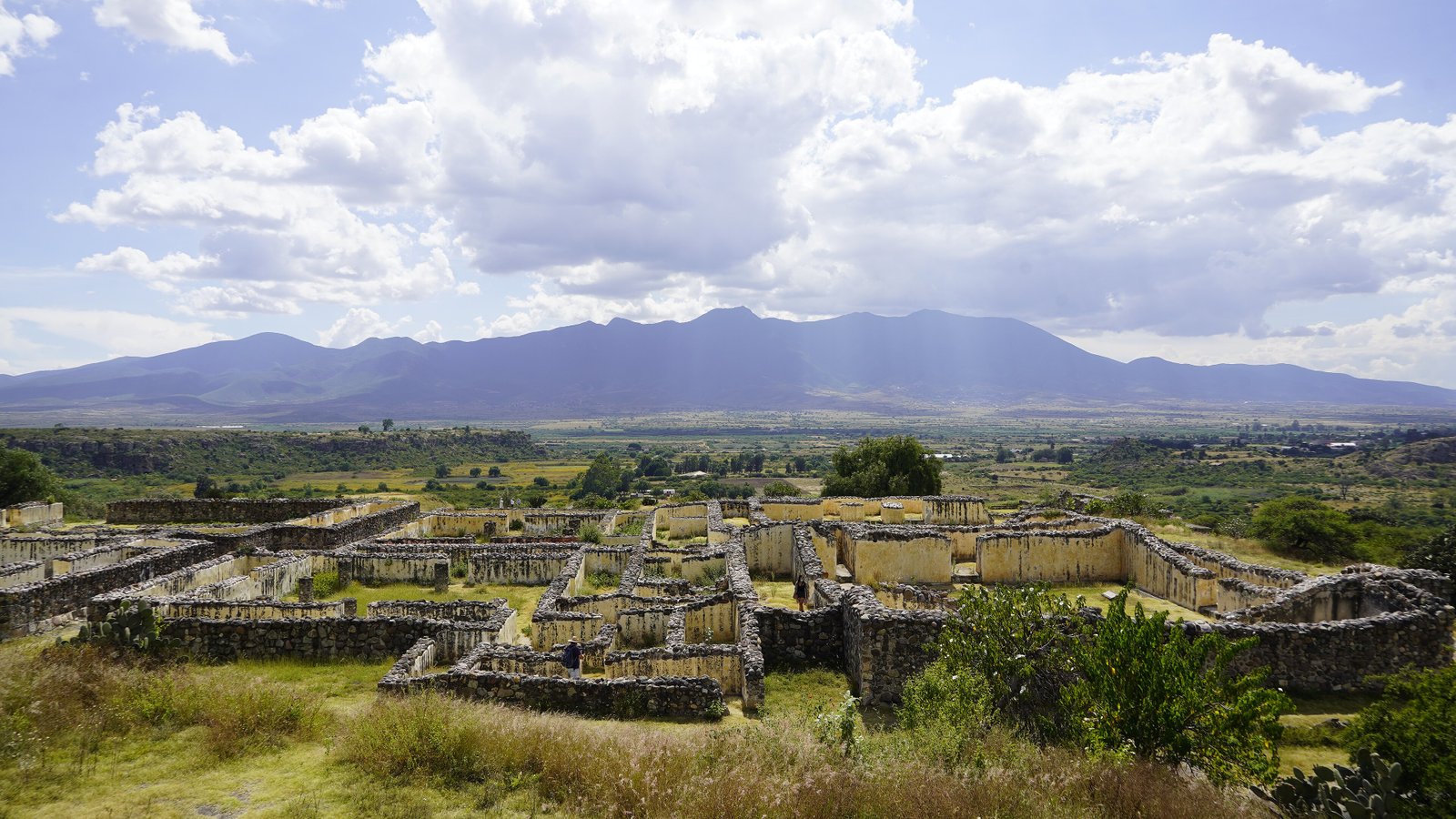
- Key site 1 — Yagul: Hilltop Zapotec ceremonial centre and fortress (c. 500–1200 CE); large ball court; panoramic valley views.
- Key site 2 — Mitla: Most important Zapotec religious centre after Monte Albán; unique geometric stone mosaic architecture (no mortar).
- Caves: Guilá Naquitz cave — earliest squash domestication evidence (~10,000 BP); early maize domestication.
- Significance: Dual — domestication of New World crops and outstanding Zapotec monumental architecture.
History
The Central Valley of Oaxaca has been inhabited since the Pleistocene. The Guilá Naquitz cave (approximately 5 km north-east of Yagul) was excavated in the 1960s by archaeologist Kent Flannery and yielded carbonised plant remains demonstrating that squash (Cucurbita pepo) was being cultivated here approximately 10,000 years ago — the earliest confirmed domestication evidence in the Americas. Traces of early maize cob modification from the same cave, dated to approximately 6,250 BP, pushed back the timeline for corn domestication significantly. By 500 BCE the Zapotec civilisation had established Monte Albán as its capital (visible from the valley rim). Yagul developed as a secondary ceremonial and defensive centre between 500 and 1200 CE. Mitla — whose Nahuatl name Mictlan means “place of the dead” — functioned as the principal religious site of the Zapotec after Monte Albán’s decline, remaining active until the Spanish Conquest.
What you see
At Yagul the visitor ascends to a hilltop complex of plazas, palace structures, and a large ball court — one of the best-preserved in Oaxaca — with dramatic views across the valley floor to the surrounding sierras. The so-called “labyrinth” beneath the main plaza is a network of underground rooms used for ritual purposes. At Mitla the signature wonder is the stone mosaic decoration covering the exterior and interior walls of the Grupo de las Columnas: thousands of individually cut stone tesserae assembled in interlocking geometric patterns — stepped frets, zigzags, diamond grids — with absolute precision and entirely without mortar. No two panels repeat exactly. The effect is simultaneously monumental and obsessively fine-grained, unlike anything else in Mesoamerica. The Spanish built a church directly atop one of Mitla’s pyramids, which remains as a visible colonial overlay on the Zapotec core.
Outstanding Universal Value
UNESCO recognised the site’s dual significance. The prehistoric caves document one of the most important transitions in human history — the shift from nomadic foraging to sedentary agriculture through the domestication of key New World crops (squash, maize, chilli) that would eventually feed billions. The Zapotec ceremonial sites of Yagul and Mitla represent a peak of pre-Hispanic architectural achievement: Mitla’s stone mosaic technique is unique in world architecture. Together they provide an unbroken cultural sequence from hunter-gatherer camps through agricultural villages to complex urban-ceremonial society, all within one valley.
Practical information
- Base: Oaxaca city (35–45 km west) — excellent accommodation, cuisine, and connections.
- Yagul: 36 km east of Oaxaca city via Highway 190; open daily 8:00–17:00; entrance fee applies.
- Mitla: 46 km east of Oaxaca city via Highway 190; the archaeological zone is open daily; the adjacent San Pablo Villa de Mitla town has restaurants and craft shops.
- Guided access: INAH-authorised guides available at both sites; Spanish-language guided tours more common; English guides bookable from Oaxaca.
- Combined itinerary: Yagul and Mitla are 10 km apart on the same highway — easily combined in a full-day trip from Oaxaca, optionally with a stop at the Tule tree (El Árbol del Tule) en route.
Getting there
Oaxaca International Airport (OAX) receives direct flights from Mexico City and selected US cities. From Oaxaca city, Highway 190 east (the Pan-American highway) passes both sites: Yagul is signed at km 36, Mitla at km 46. Shared taxis (colectivos) from the second-class bus terminal in Oaxaca run frequently to Mitla village; for Yagul a private vehicle or tour transfer is practical as the site turnoff is on the highway. Dozens of licensed tour operators in Oaxaca offer half- and full-day itineraries combining both sites.
Nearby
Monte Albán (10 km west of Oaxaca city) is the great Zapotec capital, also UNESCO-inscribed (within the Oaxaca Valley and Monte Albán listing). El Árbol del Tule in Santa María del Tule (9 km east of Oaxaca) is the world’s largest tree by trunk circumference — a 2,000-year-old Montezuma cypress. The Hierve el Agua petrified waterfalls (60 km east) offer a striking geological landscape. Oaxaca city itself is a UNESCO World Heritage centre of colonial and indigenous culture.
Sources
- UNESCO World Heritage: Prehistoric Caves of Yagul and Mitla in the Central Valley of Oaxaca (List No. 1352).
- Wikipedia: Prehistoric Caves of Yagul and Mitla.
- Wikipedia: Mitla.
- Wikipedia: Yagul.
- Flannery, K. (ed.), 1986. Guilá Naquitz: Archaic Foraging and Early Agriculture in Oaxaca, Mexico. Academic Press.
Find it on the map
See this place and what’s around it →📷 Become a Cultural Heritage Online photographer
Share your photos of places: they stay published under your name as the author. The more they're seen, the more you get noticed — and soon a contest will reward the most appreciated photos.
Log in or sign up free to add a photo