
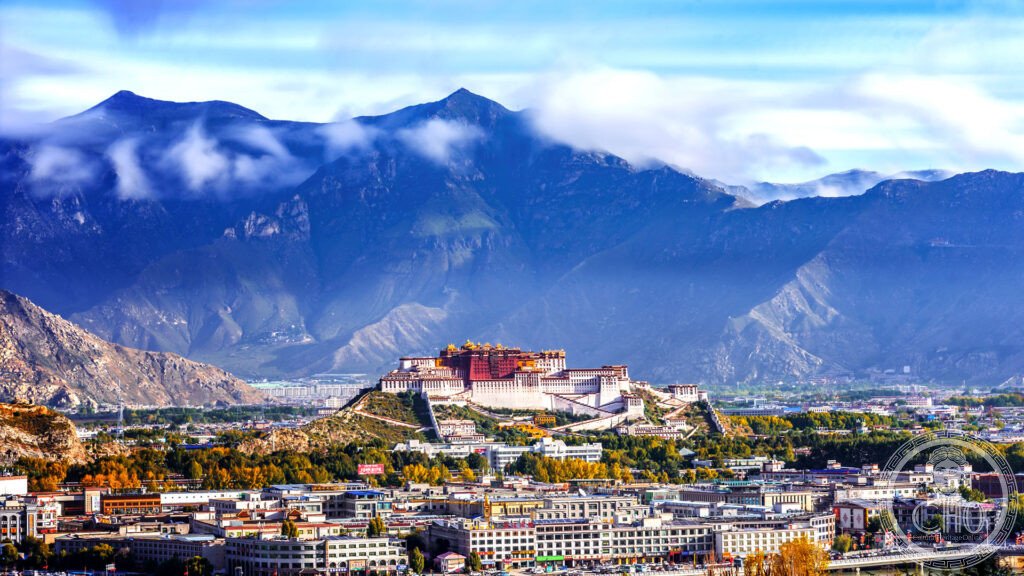
The highest palace in the world and the most sacred complex in Tibetan Buddhism — the Potala Palace, rising 117 metres above the Lhasa plain on the Red Mountain (Marpo Ri), was the winter residence of the Dalai Lamas for over 300 years and is the most important surviving monument of Tibetan civilization.
At a glance
The Potala Palace (UNESCO WHS 1994; the Historic Ensemble of the Potala Palace, Lhasa, includes the Potala Palace itself, the Jokhang Temple (the holiest shrine in Tibet), and the Norbulingka Palace (the summer residence of the Dalai Lamas); the combined WHS was extended in 2000 and 2001 to include all three sites); the palace (the Potala as a building: 13 storeys; 117 m above the Red Mountain (Marpo Ri; 3,764 m above sea level); approximately 400 m east-west facade; total floor area approximately 117,000 m²; approximately 1,000 rooms; 10,000 religious shrines; 200,000 Buddha statues — the most sacred single collection of Tibetan Buddhist religious objects in the world in a single building; the palace as a symbol (the Potala is the most recognisable symbol of Tibetan civilization and identity; the image of the white-and-red palace rising above the Lhasa plain is the most frequently reproduced image of Tibet in any media; it appears on the Tibetan flag, on all Tibetan government-in-exile documents, and in every discussion of Tibetan independence — the most politically charged heritage site in Asia); the altitude (the Potala stands at 3,756 m — the highest palace in the world; the visitor must climb 300 stairs from the base to the entrance of the Red Palace; the most physically demanding palace visit for altitude-naive visitors; the NPS recommendation for Lhasa visitors: 2 full days of rest and acclimatisation before attempting the Potala stairs).
Key facts
- The Dalai Lamas and the palace: 300 years of theocratic rule from the Potala — the Dalai Lama institution (the Dalai Lama is the spiritual leader of Tibetan Buddhism and, from 1642 to 1959, the temporal ruler of Tibet; “Dalai Lama” means “Ocean of Wisdom” in Mongolian-Tibetan; the title was first given to the 3rd Dalai Lama by Altan Khan in 1578 — the most consequential act of Mongolian religious patronage in Tibetan history; the reincarnation tradition (each Dalai Lama is considered the reincarnation of the previous one; the search for a new Dalai Lama following the death of the previous one (the identification of the reincarnation by oracles, signs, and tests of recognition; the most elaborate succession process in any religious tradition); the 5th Dalai Lama (Ngawang Lobsang Gyatso, the “Great Fifth”; 1617–1682; the most important Dalai Lama in history; he united Tibet politically and spiritually for the first time in the 17th century; he commissioned the Potala Palace in 1645 — the most ambitious single construction project in Tibetan history; his regent Sangye Gyatso concealed his death for 15 years to maintain political stability — the most audacious political deception in Tibetan history); the 14th Dalai Lama (Tenzin Gyatso; born 1935; the current and longest-serving Dalai Lama; fled into exile in Dharamsala, India on 17 March 1959 during the Tibetan Uprising — the most consequential single night flight in Tibetan history; has not returned to the Potala; the most significant heritage site in the world that is inaccessible to its primary living symbol))
- The Red Palace interior: the most sacred spaces in Tibetan Buddhism — the Potrang Marpo (the Red Palace; the 7 upper storeys of the palace; the most important interior in any heritage site in Asia for Tibetan Buddhism): the mausolea of the Dalai Lamas (the 8 chörtens (stupas) in the Red Palace containing the embalmed bodies of the 5th through 13th Dalai Lamas (all except the 6th, who died in exile; the 14th is in exile): the largest chörten (the mausoleum of the 5th Dalai Lama — the most ornate religious structure in the Potala; 14.85 m high; covered in 3,721 kg of gold inlaid with turquoise, coral, and diamond); the smallest is 4 m high; the chapels (35 individual chapels dedicated to various Buddhist deities and historical figures; the most important: the Chapel of Arya Lokeshvara (the most sacred room in the Potala; it contains a statue of Lokeshvara (the bodhisattva of compassion; Tibetan: Chenrezig) believed to have been present since the time of the 7th-century original Potala; the most ancient sacred object in the palace; the statue that the Dalai Lama would pray before on the most important occasions)); the victory chörten (the Dungkar Lhakhang; the memorial to the Tibetan military victory at Khalatse against Ladakh in 1684 — the most obscure but most historically significant military commemoration in the palace)
- Jokhang Temple and the Barkhor Circuit: the holiest place in Tibet and the most sacred pilgrimage circuit — the Jokhang Temple (the most important single religious building in Tibet; built by King Songtsen Gampo (7th century CE) to house the Jowo Rinpoche — the most sacred Buddha image in Tibet: a gilded statue of Shakyamuni Buddha at age 12, brought to Tibet as part of the dowry of the Chinese princess Wencheng when she married Songtsen Gampo; the golden roof (the most recognisable element of the Jokhang exterior; the golden dharma wheel with two deer flanking it — the most universally recognised symbol of Tibetan Buddhism); the prostrating pilgrims (the most moving single sight in Lhasa: the pilgrims performing full-body prostrations on the flagstones outside the Jokhang entrance; the prostration (laying full length on the ground with arms extended; rising; repeating; some pilgrims prostrate the entire Barkhor circuit — 800 m; the most physically demanding act of religious devotion in Tibetan Buddhism; completed 100,000 or more times as a specific spiritual practice)); the Barkhor Circuit (the traditional circumambulation route around the Jokhang Temple; 800 m; the most important single pilgrimage circuit in Tibet; packed with pilgrims and merchants at all hours; the market (the finest traditional craft market in Lhasa: thangka paintings, prayer flags, prayer wheels, yak butter, tsampa (roasted barley flour) — the most authentic Tibetan market atmosphere accessible without a permit)
- Heritage: UNESCO World Heritage Site, Historic Ensemble of the Potala Palace, Lhasa, inscribed 1994 (extended 2000, 2001)
- GPS: 29.6576° N, 91.1172° E
History
The original Potala (the first palace on Marpo Ri was built by King Songtsen Gampo (569–649 CE; the first great king of the Tibetan Empire; the most important political figure in Tibetan history; he unified the Tibetan tribes, created the Tibetan script based on Indic scripts (the single most important cultural act in Tibetan history), introduced Buddhism to Tibet, and built the original palace on Marpo Ri); the original palace was largely destroyed in later conflicts and only 2 of the original rooms survive in the modern Potala); the 17th-century Potala (the 5th Dalai Lama commissioned the White Palace (Potrang Karpo) in 1645 CE; construction under his regent Desi Sonam Chöpel; the White Palace completed 1648 CE; the Red Palace commissioned by the regent Sangye Gyatso in 1690 CE (after the 5th Dalai Lama’s death, concealed from 1682–1697); completed 1694 CE; the most important architectural commission in Tibetan history; the British Younghusband Expedition (1904; the first time any foreign military force entered Lhasa; Colonel Francis Younghusband was the first British officer to enter the Potala; the most diplomatically momentous British military achievement in Central Asian history)); the 20th century (the 13th Dalai Lama (1876–1933; the most politically active Dalai Lama of the modern era; twice fled Lhasa (from the British in 1904 and the Chinese in 1910; the most extensively travelled Dalai Lama before the 14th)); the Chinese occupation of Tibet (1950–1951; the People’s Liberation Army entered Tibet; the Seventeen Point Agreement (the most controversial treaty in Tibetan history)); the 1959 Uprising (the Tibetan Uprising of 1959; the most important political event in modern Tibetan history; the 14th Dalai Lama fled on 17 March 1959 in disguise across the Himalayas to India; the Potala has been a museum since 1959); UNESCO WHS 1994.
What you see
The Potala visit (ticket quota: the most restricted single-day visitor quota of any UNESCO palace in Asia — only 2,300 visitors per day; tickets must be booked in advance (the most efficiently sold-out attraction in Lhasa; during peak season (July–September) tickets sell out days in advance); the visit structure (all visitors enter at the base of the eastern approach staircase; climb 300 stairs (approximately 30 minutes at altitude); the White Palace (the external viewing area and the East Main Hall (the Sishi Phuntsok: the most important hall in the White Palace; the throne where the Dalai Lamas held audiences; the most politically significant single room in the history of Tibet); the Red Palace (the 35 chapels and 8 chörtens; the most sacred interior in Tibet; the visit is guided or self-guided; the lighting is intentionally dim and atmospheric in the chapels); the roof terrace (the finest single panorama of Lhasa; the Lhasa plain; the Kyichu River; the Sera Monastery in the hills north-east; the Norbulingka Palace gardens below)); the Jokhang Temple (a separate visit; open daily; the pilgrims; the golden roof; the Barkhor Circuit; described in the Key Facts section); the Norbulingka (the summer palace; 2 km west of the Potala; the gardens (the finest gardens in Lhasa; open to picnickers in summer; the most un-solemn heritage site in the Lhasa WHS ensemble); the Norbulingka was the site of the pivotal events of 17 March 1959 when crowds gathered to prevent the Dalai Lama’s rumoured abduction by the Chinese — the most important crowd event in Tibetan modern history).
Practical information
- Getting there: Tibet Travel Permit (the most important bureaucratic requirement in all of Asia travel: all foreign nationals require a Tibet Travel Permit (TTP) in addition to a Chinese visa to enter the Tibet Autonomous Region; the TTP is only issued through a licensed Tibetan travel agency (it cannot be obtained independently); the agency books the permit and accompanies all foreign visitors throughout Tibet (the most paternalistic visa regime for a UNESCO WHS in the world)); Lhasa Gonggar Airport (LXA; 60 km south of Lhasa; 1h shuttle to city; direct flights from Chengdu (2h; the most frequent connection; daily); Beijing (3h 45min); Shanghai (4h 30min); Guangzhou (3h 30min)); the Qinghai-Tibet Railway (the highest railway in the world; the Lhasa railway station is at 3,642 m; the Tanggula Pass (the highest point on the railway at 5,072 m — the highest point of any railway in the world); 47h from Beijing; 21h from Chengdu; the most spectacular overland approach to any heritage site in Asia; the pressurised carriages supply supplemental oxygen during the highest sections); altitude precautions (the most important practical advice: spend at least 2 full days in Lhasa before attempting the Potala stairs; the altitude is 3,650 m (the most challenging altitude of any UNESCO WHS city in the world apart from Cusco); symptoms of acute mountain sickness (AMS): headache, nausea, fatigue (rest; do NOT ascend further; descend if symptoms worsen); ibuprofen (the most effective non-prescription treatment for altitude headache; acetazolamide (Diamox) requires a prescription; start 2 days before arrival)
- The Himalayan circuit: the mountains framing the Tibetan plateau — Everest Base Camp (250 km south-west of Lhasa (4–5h drive to Shigatse; then 5h to Base Camp); the North Base Camp of Mount Everest (8,848.86 m; the highest mountain on Earth; the North Base Camp (Rongbuk; 5,150 m) is the highest vehicle-accessible point in the world on the north side; the Rongbuk Monastery (3,990 m; the highest functioning Buddhist monastery in the world; the most wind-battered architectural achievement in Buddhist monastic history; the Everest view from Rongbuk on a clear morning (the most dramatic mountain sight in the world: Everest rising 2.8 km above the monastery; the plume of wind-blown snow on the summit; the most aspirational view in mountaineering history)); the road from Lhasa (the Friendship Highway; 920 km to Kathmandu (Nepal border at Zhangmu/Kodari); the most scenic overland route in Asia for overland travellers))
- Kathmandu and the Kathmandu Valley (UNESCO WHS 1979): the finest concentration of medieval Hindu and Buddhist monuments in a single city — Kathmandu (the most important gateway city for Tibet from the south; 130 km south of the border via the Friendship Highway; the Kathmandu Valley WHS (the 7 monument zones: Pashupatinath Temple (the most important Hindu temple in Nepal; the cremation ghats on the Bagmati River (the most ritually significant river confluence in Nepal; the open-air cremations visible from across the river — the most confronting sacred site for Western visitors in Asia); Swayambhunath (the “Monkey Temple”; the white stupa on the hill above Kathmandu; the painted eyes of the Buddha watching over the valley — the most frequently used image in any Nepal tourism material; the monkeys (Rhesus macaques; the most persistent and the most photogenic wildlife in any UNESCO heritage urban site in Asia)); Boudhanath (the largest stupa in South Asia; 36 m high; the circumambulation (kora) route around the base; the community of Tibetan Buddhist monasteries and merchants surrounding the stupa — the most important Tibetan Buddhist community outside of Tibet))
Getting there
Tibet Travel Permit required (via licensed Tibetan travel agency; most restrictive visa requirement of any UNESCO WHS). Lhasa Airport (LXA) 60 km (direct from Chengdu 2h). Qinghai-Tibet Railway: highest railway in world (Tanggula Pass 5,072m). Acclimatise 2+ days before visiting Potala (altitude 3,756m). GPS: 29.6576, 91.1172.
Nearby
- Namtso Lake — 230 km north of Lhasa (4h drive); the most sacred lake in Tibet and the second-largest saltwater lake in China — Namtso (altitude 4,718 m — one of the highest lakes in the world; the turquoise water (glacially fed; the most intense natural blue of any large body of water in Asia); the Nyenchen Tanglha Mountain (7,162 m; the most sacred mountain in the Lhasa region; the snow-capped peak reflected in the lake surface — the finest single high-altitude landscape view in Tibet); the Tashi Dor Peninsula (the peninsula that extends into the lake; the Buddhist hermit caves (monks and nuns have retreated to caves on the peninsulas for meditation for over a thousand years — the most continuous high-altitude retreat practice in any religious tradition); the most visually dramatic UNESCO-adjacent natural heritage site in Tibet)
- Sera and Drepung Monasteries — 5–8 km from the Potala (20 min by road); the two surviving great Gelug monasteries of Lhasa — Sera Monastery (the most important surviving intact large monastery in the Lhasa area; the monk debate (the afternoon monk debates in the Sera courtyard; 3pm–5pm daily; the most extraordinary spectacle in any Tibetan Buddhist monastery: monks debating Buddhist philosophy with dramatic slapping, pointing, and shouting gestures; the performance of logic as physical art — the most energetic academic dispute in any religious setting in Asia; the style (the questioner stands while the respondent sits; the questioner claps once before asking; the clap both emphasises the point and is said to dispel evil spirits — the most multi-functional academic gesture in any religious tradition)); Drepung Monastery (the largest Buddhist monastery in the world before 1959 — 10,000 monks; the granary of Tibetan Buddhism; the finest collection of thangka festival paintings (the Shoton Festival; the unveiling of a giant thangka on the Drepung hillside; the most impressive single religious textile display in Tibet))
- Gyantse and Shigatse — 270 km south-west of Lhasa (4h drive); the two most important historic cities in Tibet after Lhasa — Gyantse (the Gyantse Dzong (the fortress; the site of the decisive Tibetan resistance to the 1904 British Younghusband Expedition; the most historically significant military site in Tibet); the Pelkhor Chöde Monastery (the Kumbum Chörten — the finest multi-storey stupa in Tibet; 9 storeys; 77 chapels; the most complete 15th-century Tibetan Buddhist iconographic programme on any structure in Tibet)); Shigatse (the seat of the Panchen Lama; the Tashilhunpo Monastery (the most important Gelug monastery outside Lhasa; founded 1447 CE by the first Dalai Lama; the Panchen Lama’s seat; the giant Maitreya Buddha (26.2 m high; the largest seated gilded bronze statue in the world; the most recent addition to the monastery (completed 1914); the most impressive single sculpture in any Tibetan monastery))
Sources
- Wikipedia, Potala Palace; Dalai Lama; Jokhang Temple, accessed June 2026
- UNESCO, Historic Ensemble of the Potala Palace, Lhasa, WHS reference 707, inscribed 1994 (ext. 2000, 2001)
- Hugh Richardson, Tibet and its History, Shambhala, 1984
Find it on the map
See this place and what’s around it →📷 Become a Cultural Heritage Online photographer
Share your photos of places: they stay published under your name as the author. The more they're seen, the more you get noticed — and soon a contest will reward the most appreciated photos.
Log in or sign up free to add a photoIs this page about you?
This page is read by travellers and heritage enthusiasts who find it on Google. Tell us how you are connected to this place and we will take it from there.