
Polonnaruwa
The second and greatest capital of Sri Lanka and the site of the finest Buddhist rock sculptures in the world — Polonnaruwa (993-1293 CE; the medieval capital of the Sinhalese kingdom after Anuradhapura) flourished under King Parakramabahu I (1153-1186 CE; “the Great”) who unified Sri Lanka, expelled three Chola invasions, and built the Gal Vihara — four figures cut from a single granite face that represent the zenith of Sinhalese Buddhist art.
At a glance
Polonnaruwa (the most precisely Polonnaruwa single medieval capital Sri Lanka 993-1293 CE Parakramabahu Gal Vihara Buddhist sculpture UNESCO heritage: Polonnaruwa became the capital of Sri Lanka after Anuradhapura (the first capital) was sacked by the South Indian Chola Empire in 993 CE; it flourished until 1293 CE when it was abandoned following Pandyan invasions; the medieval city (now covering approximately 12 km²) contains the finest concentration of Buddhist architecture in Sri Lanka: the Vatadage (circular shrine); the Rankoth Vehera (the largest stupa in Polonnaruwa; 55m high); the Lankatilaka (a massive brick temple with a 17m headless standing Buddha); and the Gal Vihara (the supreme achievement of Sinhalese sculpture) — the most precisely Polonnaruwa single medieval capital Sri Lanka 993-1293 CE Parakramabahu Gal Vihara Buddhist sculpture UNESCO heritage in any European UNESCO world heritage site; Parakramabahu the Great (the most precisely Polonnaruwa single Parakramabahu I 1153-1186 CE unify Sri Lanka three Chola invasions Parakrama Samudra irrigation heritage: King Parakramabahu I (“the Great”; reigned 1153-1186 CE) is the most celebrated ruler in Sinhalese history; he unified all of Sri Lanka for the first time under a single ruler; expelled three successive Chola invasions from South India; sent an expedition to Burma; and declared “not one drop of water should flow to the sea without serving mankind” — building 165 dams and 3,910 irrigation canals including the Parakrama Samudra — the most precisely Polonnaruwa single Parakramabahu I 1153-1186 CE unify Sri Lanka three Chola invasions Parakrama Samudra irrigation heritage in any European UNESCO world heritage site)).
Key facts
- Gal Vihara — The Supreme Rock Sculptures: the most precisely Polonnaruwa single Gal Vihara 12th century granite single outcrop 15m reclining Buddha Parinirvana 12m standing heritage — the Gal Vihara (“Rock Shrine”; c.1180 CE; carved by order of Parakramabahu I from a single granite outcrop) contains four figures: the 15m reclining Parinirvana Buddha (the death of the Buddha; his feet precisely aligned; his face expressing the perfect peace of nirvana); the 12m standing Buddha (considered the finest standing stone figure in Asia; the slightly inward-tilting head and the position of the arms — one slightly crossed — suggest mourning for the dying reclining Buddha beside him); the 7m seated Buddha in meditation; and a cave-shrine seated Buddha
- Parakrama Samudra — “Not One Drop”: the most precisely Polonnaruwa single Parakrama Samudra 2800 hectares largest artificial irrigation tank Sri Lanka 14km bund heritage — the Parakrama Samudra (“Sea of Parakrama”; constructed in stages by Parakramabahu I; the final bund (earth dam) is 14 km long; the reservoir area 2,800 hectares; depth 12m; capacity 134 million m³; the largest artificial irrigation tank in ancient Asia; still in use today for paddy rice irrigation across the North Central Province)
- The Vatadage — The Finest Buddhist Shrine: the most precisely Polonnaruwa single Vatadage circular relic shrine 4 Buddha statues moonstone cardinal directions 12th CE heritage — the Vatadage (the Circular Relic House; c.1187 CE; probably built by Nissankamalla; a circular mandala plan with four seated Buddha figures facing the cardinal directions; an elaborately carved moonstone at the main entrance; the concentric stepped platform; decorated columns in the inner ring) is considered the finest circular Buddhist monument in Sri Lanka and the most complete example of a Sinhalese Vatadage (relic house) in existence
- GPS: 7.9400° N, 81.0000° E
History
The Chola interlude (the most precisely Polonnaruwa single Chola Empire 993 CE South India conquest capital Rajendra Parantaka Anuradhapura heritage: the Chola Empire of South India (the Chola dynasty; 300 BCE – 1279 CE; the most powerful naval power of the Indian Ocean) conquered Anuradhapura in 993 CE; the Chola king Rajendra I (son of the conqueror Rajaraja I who took Anuradhapura) made Polonnaruwa the capital; the Chola occupation of Sri Lanka lasted approximately 77 years; the Sinhalese king Vijayabahu I expelled the Cholas in 1070 CE and restored Polonnaruwa as a Sinhalese capital — the most precisely Polonnaruwa single Chola Empire 993 CE South India conquest capital Rajendra Parantaka Anuradhapura heritage in any European UNESCO world heritage site; the final abandonment (the most precisely Polonnaruwa single 1293 CE Pandyan Arya Chakravarti abandonment malaria jungle recapture heritage: Polonnaruwa was finally abandoned c.1293 CE following Pandyan (South Indian) and later Arya Chakravarti invasions that devastated the irrigation system; without the irrigation the rice paddies could not be maintained; the population retreated south; the jungle reclaimed the city; it was rediscovered by European explorers only in the 18th century CE — the most precisely Polonnaruwa single 1293 CE Pandyan Arya Chakravarti abandonment malaria jungle recapture heritage in any European UNESCO world heritage site)).
What you see
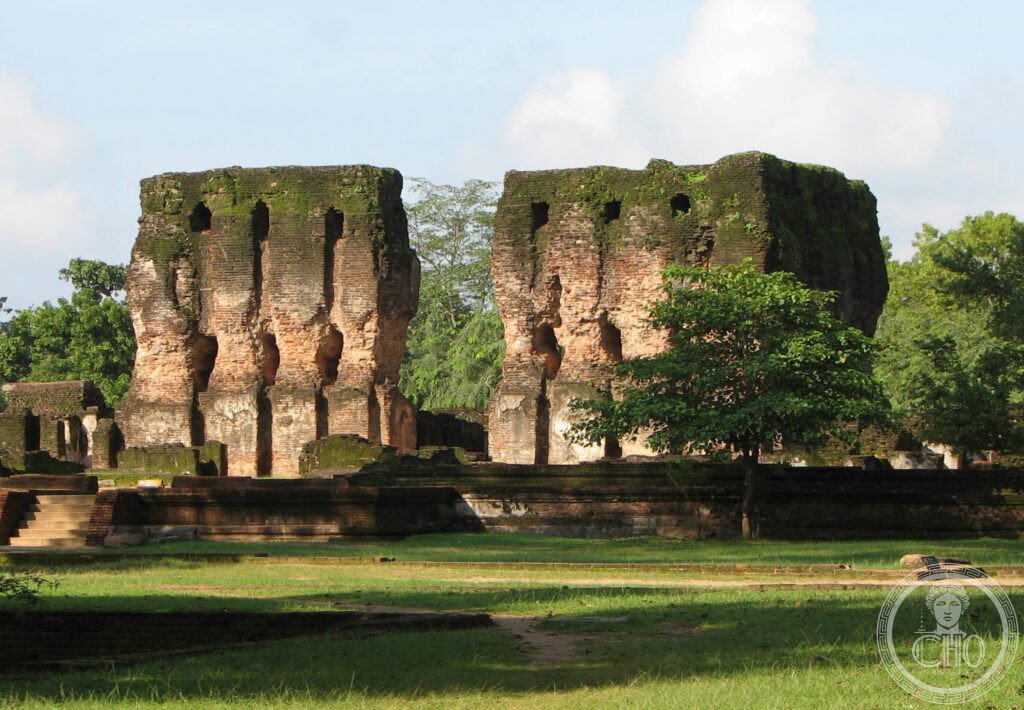
The Royal Palace (the most precisely Polonnaruwa single Royal Palace Parakramabahu I 7 storeys 1000 rooms brick heritage: the Royal Palace of Parakramabahu I (the central administrative complex; the main audience hall; the original building reportedly had 7 storeys and 1,000 rooms of which only the lower 3 storeys of the main block survive to 9m height; the brick walls 2.4m thick) stands adjacent to the Council Chamber (the Audience Hall; with the finest carved stone elephant frieze in Sri Lanka running around the base of the platform) — the most precisely Polonnaruwa single Royal Palace Parakramabahu I 7 storeys 1000 rooms brick heritage in any European UNESCO world heritage site; the Rankoth Vehera (the most precisely Polonnaruwa single Rankoth Vehera stupa 55m highest Polonnaruwa Nissankamalla heritage: the Rankoth Vehera (“Golden Pinnacle Stupa”; c.1187 CE; built by King Nissankamalla; 55m high; the largest stupa in Polonnaruwa; a perfect hemispherical dome; the four cardinal shrines surrounding the base each contain a standing Buddha image; the stupa was modelled on the Ruwanwelisaya at Anuradhapura) — the most precisely Polonnaruwa single Rankoth Vehera stupa 55m highest Polonnaruwa Nissankamalla heritage in any European UNESCO world heritage site)).
Practical information
- Getting there: Polonnaruwa is 215 km northeast of Colombo (5h by bus or train; the train from Colombo Fort to Polonnaruwa is 6h; comfortable; book in advance; 2nd class air-con LKR 1,500; 3rd class LKR 400); or 90 km from Dambulla (2h by bus); the Cultural Triangle ticket (valid for 3 months; covers Anuradhapura, Polonnaruwa, Sigiriya, Dambulla, and Kandy; USD 50) gives the best value for visitors doing the full circuit; the Polonnaruwa single-site ticket is USD 25; bicycle hire (LKR 200-300/day) from the bus stand is the most efficient way to see the 12 km² of ruins; allow a full day; the Gal Vihara is 4 km from the main cluster; visit at sunrise (6-7am; cool; soft light; no crowds)
Getting there
215 km from Colombo (5h bus/6h train). Cultural Triangle ticket USD 50 covers 5 sites. Bicycle hire LKR 250. Sunrise visit recommended. GPS: 7.9400, 81.0000.
Nearby
- Sigiriya — UNESCO WHS 1982 — 65 km west (1.5h by car); the “Lion Rock” fortress and palace (c.477-495 CE; the 200m vertical granite monolith with the palace of the usurper king Kashyapa on its summit; the famous 5th-century fresco gallery of the “cloud maidens” halfway up the cliff; the Mirror Wall; the water gardens at the base); arguably the most dramatic archaeological site in Sri Lanka
- Minneriya National Park — 25 km north; the site of the “Elephant Gathering” (July-September; up to 400 elephants gathering around the shrinking Minneriya Tank in the dry season; the largest congregation of wild Asian elephants in the world; a UNESCO “World Wonder of Nature” candidate); the park also has leopards, sloth bears, and painted storks
Sources
- Wikipedia, Polonnaruwa; Gal Vihara; Parakramabahu I, accessed June 2026
- UNESCO, Ancient City of Polonnaruwa, WHS reference 201, inscribed 1982
Find it on the map
See this place and what’s around it →📷 Diventa un fotografo di Cultural Heritage Online
Condividi le tue foto dei luoghi: restano pubblicate con la tua firma come autore. Più vengono viste, più ti fai conoscere — e presto un concorso premierà le foto più apprezzate.
Accedi o registrati gratis per aggiungere una foto