

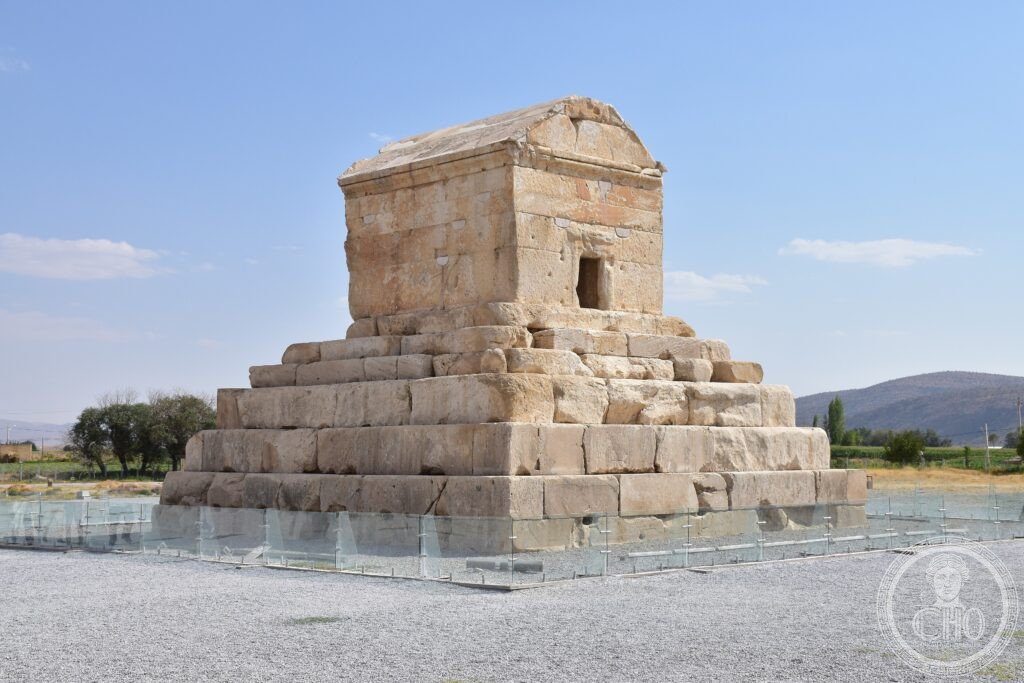
On the Murghab Plain in Fars Province stands the tomb of Cyrus the Great, founder of the Achaemenid Persian Empire and the first ruler in the ancient world to issue a written decree of religious and civic tolerance. Around it lie the remains of Pasargadae, the empire’s first capital and the site of the earliest known Persian formal garden.
At a glance
Pasargadae was built by Cyrus the Great after his victories over the Medes, the Lydians and the Babylonians, and served as the first capital of the Achaemenid Persian Empire. Within a generation that empire had grown to become the largest the ancient world had known, stretching from the Aegean coast to the Indus valley.
The site is best known for the tomb of Cyrus, a gabled stone chamber raised on six limestone steps, and for the ruins of a royal residential and ceremonial complex scattered across the plain. Cyrus is also associated with the Cyrus Cylinder, a clay document recording his policy of releasing captive peoples and restoring temples after the fall of Babylon, now held in the British Museum.
Key facts
- Founder: Cyrus the Great, first king of the Achaemenid dynasty.
- Date: capital established c.559–530 BCE; the tomb dates to around 530 BCE.
- The paradeisos: the walled royal garden at Pasargadae, divided into four quarters by irrigation channels, is considered the origin of the Persian and later Islamic garden tradition and the root of the word paradise.
- Tall-e Takht: a large limestone platform known as the Throne Hill, intended as a citadel but left unfinished at Cyrus’s death.
- Location: Murghab Plain, Fars Province, at roughly 1,900 metres altitude; coordinates 30.1942° N, 53.1676° E.
History
The fall of Babylon to Cyrus in 539 BCE, reportedly achieved without a battle, opened the way for the Jewish exiles held there since the Babylonian Captivity to return to Jerusalem. The prophet Isaiah refers to Cyrus as the Lord’s anointed, the only non-Jewish figure given that title in the Hebrew Bible, and Cyrus is said to have financed the rebuilding of the Second Temple.
After Cyrus’s death the administrative centre of the empire moved to Susa under his son Cambyses II, and Darius I later built a new imperial capital at Persepolis, which eclipsed Pasargadae politically. Pasargadae nonetheless kept its religious standing as the resting place of the dynasty’s founder, and later Achaemenid kings were formally crowned there.
In 330 BCE Alexander the Great visited the site during his Persian campaign and found the tomb of Cyrus broken open and robbed. Ancient writers, among them Arrian, Strabo and Aristobulus, record that he ordered its immediate restoration and posted a Macedonian guard, in what they present as a mark of his admiration for Cyrus. The tomb bore an inscription in Old Persian and Elamite identifying Cyrus as founder of the Persian empire and asking that the monument be respected.
What you see
The tomb stands alone on the open plain, its presence heightened by its isolation. Six limestone steps of diminishing size, cut and fitted without mortar, support a small gabled chamber that once held Cyrus’s sarcophagus; this had already been stripped by looters before Alexander’s arrival. The chamber measures little more than three metres in each dimension, yet the whole structure rises to about eleven metres.
Scattered across the surrounding plain, at distances of half a kilometre to a kilometre and a half from the tomb, are the remains of Cyrus’s residential and ceremonial buildings, including a residential palace, a private palace, an audience hall and a monumental gateway. Their column bases and capitals are among the earliest surviving carved stone capitals in Persia, and some show proto-Ionic features attributed to Greek craftsmen working alongside Persian builders, evidence of the mixed workforce that raised the site.
About a kilometre to the northwest stands the Tall-e Takht, a massive dry-stone platform built with the same large ashlar blocks and iron clamps used later at Persepolis, but left unfinished when Cyrus died.
Practical information
- Time needed: around ninety minutes is generally enough to see the tomb and the palace remains.
- Combined visits: Pasargadae is often visited together with Persepolis and Naqsh-e Rustam as a single circuit through Achaemenid Fars.
- Tickets and access: current entry arrangements and any restrictions should be checked with Iran’s tourism authorities or a local operator before travelling.
Getting there
Pasargadae lies to the northeast of Shiraz, reached by road in a couple of hours by private car or shared taxi. Most visitors fly into Shiraz airport from Tehran or from international hubs such as Dubai, then continue overland to the site, often as part of a day trip that also takes in Persepolis and Naqsh-e Rustam.
Nearby
- Persepolis — about 45 km southwest, roughly an hour by car; the later Achaemenid ceremonial capital built by Darius I and Xerxes I, known for the Apadana audience hall and its carved reliefs, and burned during Alexander’s campaign in 330 BCE.
- Naqsh-e Rustam — about 60 km southwest; rock-cut tombs of four Achaemenid kings carved high into a cliff face, alongside the enigmatic Ka’ba-ye Zartosht tower.
Sources
- Wikipedia, Pasargadae
- Wikipedia, Cyrus the Great
- Wikipedia, Cyrus Cylinder
- UNESCO, Pasargadae (World Heritage Site reference 1106, inscribed 2004)
Find it on the map
See this place and what’s around it →📷 Become a Cultural Heritage Online photographer
Share your photos of places: they stay published under your name as the author. The more they're seen, the more you get noticed — and soon a contest will reward the most appreciated photos.
Log in or sign up free to add a photo