
The only printing establishment from the age of Gutenberg preserved entirely intact — workshops, foundry, archive, library, residence, and courtyard garden — where the most important press in 16th-century Europe produced the most ambitious scholarly book of the Renaissance. The original printing presses here are the oldest surviving in the world.
At a glance
The Plantin-Moretus House-Workshops-Museum Complex in Antwerp was inscribed on the UNESCO World Heritage List in 2005 as the only printing establishment from the era of Gutenberg preserved in its entirety. Founded in 1555 by Christophe Plantin, it became the most important printing house in the world during the first information revolution. When the Moretus family sold the intact complex to the City of Antwerp in 1876, they preserved one of the most extraordinary survivals in printing history: 16 original printing presses (the oldest in the world), thousands of woodcuts and copper engravings, original type matrices and punches, a complete archive of manuscripts and ledgers, and an intact Renaissance courtyard garden.
Key facts
- UNESCO inscription: 2005, World Heritage List (Cultural, criteria II, III, IV, VI)
- Location: Vrijdagmarkt 22, Antwerp, Belgium; GPS 51.2199 N, 4.3994 E
- Founded: 1555 by Christophe Plantin (c. 1520–1589)
- Museum since: 1876, when the Moretus family sold it to the City of Antwerp
- Key artifact: 16 original printing presses — the oldest surviving in the world
- Masterwork: Biblia Regia (Polyglot Bible), 1568–1572, in Hebrew, Aramaic, Greek, Latin, and Syriac
- Royal patron: Official printer to King Philip II of Spain
History
Christophe Plantin, a French-born bookbinder, arrived in Antwerp around 1549 and established his printing house in 1555. Antwerp at the time was the commercial capital of northern Europe and the centre of the first information revolution triggered by Gutenberg’s press. Plantin rapidly rose to become the most prolific and influential printer of his era, at his peak operating 16 presses simultaneously and employing over 80 workers. He was appointed official printer to King Philip II of Spain in 1570.
His most celebrated publication was the Biblia Regia — the Polyglot Bible of 1568–1572 — printed in parallel columns in five ancient languages. It remains the most ambitious scholarly publishing project of the 16th century. After Plantin’s death in 1589, the press passed to his son-in-law Jan Moretus and remained in the Moretus family for nearly three centuries, operating continuously until 1876. When the last Moretus heir sold the complex to the City of Antwerp as a museum, he preserved it entirely intact — a stroke of civic generosity that made possible one of the world’s most extraordinary historic interiors.
What you see
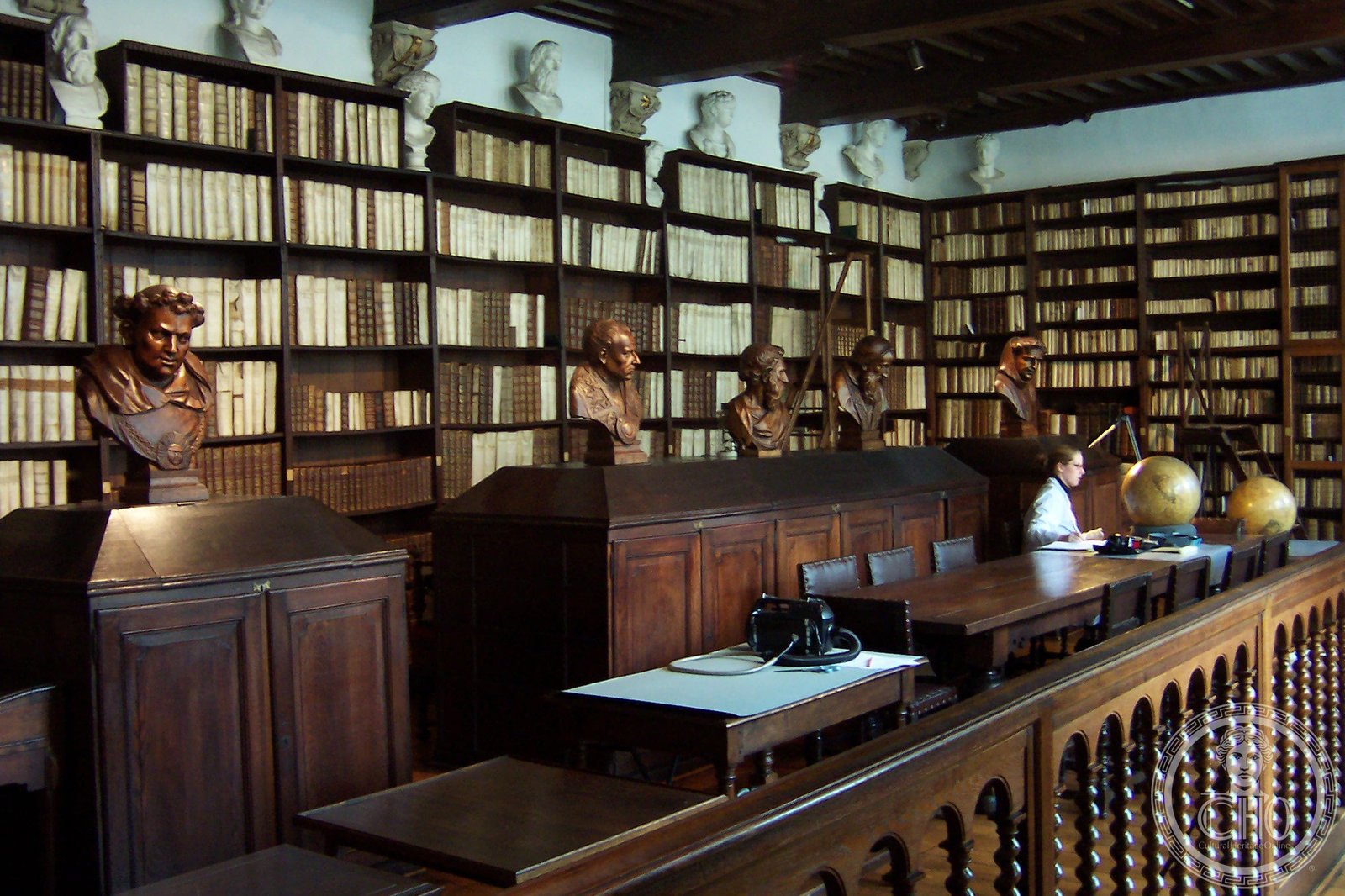
The complex occupies an entire city block and opens onto a quiet Renaissance courtyard garden. The 34 rooms include: the printing workshops, still equipped with the 16 original wooden presses; the type foundry where type was cast in-house; the proofreaders’ rooms; the counting house and archives; the family residence with portraits by Rubens (a close friend of the Moretus family); and the library, whose shelves retain the original collection of thousands of volumes acquired between the 16th and 19th centuries.
The archive holds the business correspondence of one of the most connected men in 16th-century Europe — letters from Erasmus, Justus Lipsius, and scholars across Christendom. The museum also holds the world’s largest collection of original type punches and matrices, and thousands of woodcut and engraved illustrations that passed through the Plantin press over three centuries.
Practical information
- Address: Vrijdagmarkt 22, 2000 Antwerp, Belgium
- Open: Tuesday–Sunday, 10:00–17:00; closed Mondays and major holidays
- Admission: Full price approx. EUR 14; reductions available; free for under-19s
- Guided tours: Available in multiple languages; audio guide included with admission
- Photography: Permitted in most areas without flash
- Accessibility: Ground floor largely accessible; upper floors via stairs
Getting there
The museum is in Antwerp’s historic centre, a 15-minute walk from Antwerp Central Station. By tram: line 3 or 5 to Groenplaats, then 5 minutes on foot. By car: parking available at Sint-Jansvliet or Steenplein. Antwerp is 45 minutes by direct train from Brussels Central; trains run every 30 minutes. The museum is within easy walking distance of the Cathedral of Our Lady and the Grote Markt.
Nearby
The Cathedral of Our Lady (Onze-Lieve-Vrouwekathedraal), five minutes’ walk away, holds four major paintings by Rubens including The Descent from the Cross — Rubens, a family friend of the Moretuses, also painted the portraits in the museum. The Grote Markt with its 16th-century Brabo fountain and guild houses is three minutes away. The Museum aan de Stroom (MAS), Antwerp’s city history museum with rooftop panorama, is a 20-minute walk north along the Scheldt waterfront.
Sources
- UNESCO WHL: Plantin-Moretus House-Workshops-Museum Complex (No. 1185, 2005)
- Wikipedia: Plantin-Moretus Museum
- Museum Plantin-Moretus: museumplantinmoretus.be
Find it on the map
See this place and what’s around it →📷 Become a Cultural Heritage Online photographer
Share your photos of places: they stay published under your name as the author. The more they're seen, the more you get noticed — and soon a contest will reward the most appreciated photos.
Log in or sign up free to add a photoIs this page about you?
This page is read by travellers and heritage enthusiasts who find it on Google. Tell us how you are connected to this place and we will take it from there.