

The last place in the ancient world where hieroglyphics were still written — and then the centrepiece of history’s largest ancient monument rescue operation.
At a glance
The Philae temple complex sits on Agilkia Island in the Nile, accessible only by boat from the south end of Aswan. Built between 380 BC and the 4th century AD, it was the primary cult centre of Isis in the ancient world and the last active Egyptian religious site in the Graeco-Roman era — the final hieroglyphic inscription known to have been carved anywhere in Egypt was made here in 394 AD. After the Aswan Low Dam flooded the original island of Philae from 1902 onwards, UNESCO coordinated the dismantling and relocation of the entire complex to higher ground on Agilkia between 1972 and 1980: the most ambitious ancient monument relocation project ever completed, surpassed in scale only by the Abu Simbel operation of 1968.
Key facts
- Location: Agilkia Island, Aswan Governorate, Egypt — 24.0253° N, 32.8844° E (Google Maps)
- Period: 380 BC – 4th century AD; original island seasonally submerged 1902–1970; relocated 1972–1980
- Main deity: Isis, goddess of magic and motherhood; also Osiris (smaller temple) and Hathor
- Last hieroglyph: The Graffito of Esmet-Akhom (394 AD) — the latest known dated hieroglyphic inscription, carved at Philae’s Gate of Hadrian
- Relocation: UNESCO project 1972–1980 dismantled 45,000 stone blocks and rebuilt the complex on Agilkia Island, 500 m from the original site
- UNESCO: Nubian Monuments from Abu Simbel to Philae, World Heritage Site (1979)
- Access: By motorboat only from the Shellal embankment south of Aswan; boats depart continuously during opening hours
History
Philae’s original island — a granite outcrop near the First Cataract — was considered by ancient Egyptians to be one of the burial places of Osiris. The earliest stone structures on the island date to the reigns of Nectanebo I and II (380–343 BC), but the temple complex as it stands was built mainly under the Ptolemaic dynasty and the Roman emperors, beginning with Ptolemy II Philadelphus around 280 BC. The cult of Isis at Philae remained active into the early Christian period through a formal treaty between the Roman emperor Diocletian and the Blemmyes and Nobatae tribes (298 AD), who were permitted to continue worshipping at Philae after paganism had been banned elsewhere in the Empire. The last hieroglyphic inscription — a priest’s demotic graffito dated 394 AD and translated by the Egyptologist Francis Griffith in 1935 — was carved at the Gate of Hadrian.
The Aswan Low Dam, completed by the British in 1902, raised the Nile’s water level sufficiently to submerge Philae’s island for most of each year. Between December and April — when dam sluices were opened — the temples re-emerged from the brown water, encrusted with silt and slowly dissolving. Divers mapped the submerged stonework; photographers documented the temples from boats, the columns rising from the water like a mirage. The Aswan High Dam, completed in 1970, would have submerged the site permanently, which prompted the UNESCO campaign that began in 1972. Working from 1972 to 1980, an international team dismantled 45,000 blocks of stone — numbered and catalogued individually — and reassembled the complex on Agilkia Island, which had been reshaped with fill to match Philae’s original topography. The project cost $30 million (1980 values) and involved 23 countries.
What you see
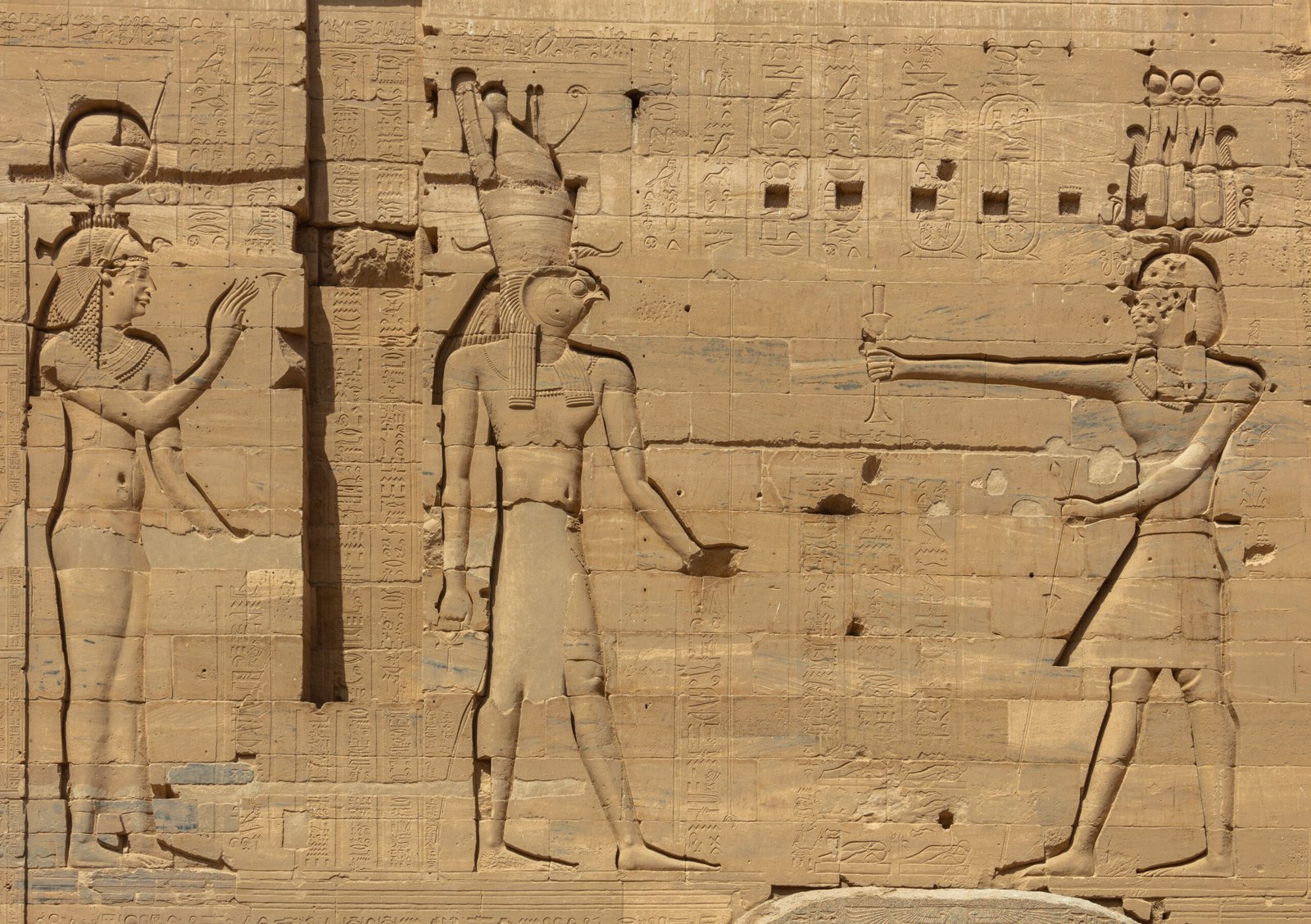
The boat approach from Aswan gives the complex its most dramatic angle: the long colonnade of the outer precinct runs along the water’s edge, and the pylon of the main Isis temple rises behind it, the relief carvings on its face catching the low morning light at different depths depending on the time of day. The two towers of the first pylon stand 18 metres high; the relief on the right tower shows Ptolemy XII Neos Dionysos seizing enemies by the hair before Isis and Horus, the standard “smiting pharaoh” composition executed here with particular sharpness.
The inner sanctuary is small and dark, its walls bearing scenes of Isis nursing Horus in the papyrus swamps — the mythological episode that made Philae the pre-eminent Isis cult site in the ancient world. The Mammisi (birth house) to the west of the main axis contains some of the most complete painted column capitals in Egypt. The Kiosk of Trajan — a Roman-era structure sometimes called “Pharaoh’s Bed” — stands unroofed at the south end of the complex, its fluted columns and decorated lintels a hybrid of Egyptian and classical form. From its platform, on clear days, the Aswan High Dam is visible to the north and the desert hills of Sudan to the south.
Practical information
- Opening hours: Daily 7:00–17:00 (summer until 18:00); sound and light show evenings (times vary by season)
- Getting on-site: Ticket includes motorboat ride from Shellal embarkation point; boats are shared and depart when full (usually very short wait)
- Tickets: Single site entry fee; sound and light show is a separate ticket
- Best season: October–March for manageable temperatures; the site is beautiful at all times but summer mornings start early and hot
- What to wear: Comfortable shoes for uneven stone; light clothing; sunscreen; the boat ride is exposed to sun
- Time needed: 1.5–2 hours for the main temple complex; 30 additional minutes for the Kiosk of Trajan and outlying structures
Getting there
The Shellal embarkation dock is located approximately 12 kilometres south of Aswan city centre, accessible by taxi (15–20 minutes) or as part of organised tours. Aswan’s main train station connects to Luxor (3.5 hours) and Cairo (12–15 hours). Aswan Airport (ASW) has connections to Cairo and a small number of regional destinations. Most visitors to Philae combine the visit with Aswan’s other sites — the Unfinished Obelisk, the Nubian Museum, and Elephantine Island — in a single full-day itinerary.
Nearby
- Aswan High Dam — 3 km north: the 1970 infrastructure project that necessitated the UNESCO relocation campaign; viewpoint above the dam with views of Lake Nasser
- Nubian Museum, Aswan — 10 km north: definitive collection of Nubian artefacts recovered before the High Dam flooding, including objects from Philae
- Abu Simbel — 280 km south: twin rock-cut temples of Ramesses II, the other landmark of the UNESCO Nubian salvage campaign
- Elephantine Island, Aswan — 12 km north: ancient island settlement at the First Cataract with Predynastic and pharaonic remains
Sources
- UNESCO — Nubian Monuments from Abu Simbel to Philae: whc.unesco.org/en/list/88
- Wikipedia — Philae temple complex: en.wikipedia.org/wiki/Philae_temple_complex
- Griffith, Francis Llewellyn. “The Inscriptions of Darius at Philae.” Journal of Egyptian Archaeology 23, 1937 — on the last hieroglyphic inscription
- Save the Temples of Nubia — UNESCO documentation archive, 1972–1980 campaign
Find it on the map
See this place and what’s around it →📷 Become a Cultural Heritage Online photographer
Share your photos of places: they stay published under your name as the author. The more they're seen, the more you get noticed — and soon a contest will reward the most appreciated photos.
Log in or sign up free to add a photoIs this page about you?
This page is read by travellers and heritage enthusiasts who find it on Google. Tell us how you are connected to this place and we will take it from there.